

50
3 Metal Cluster Reacting with Oxygen
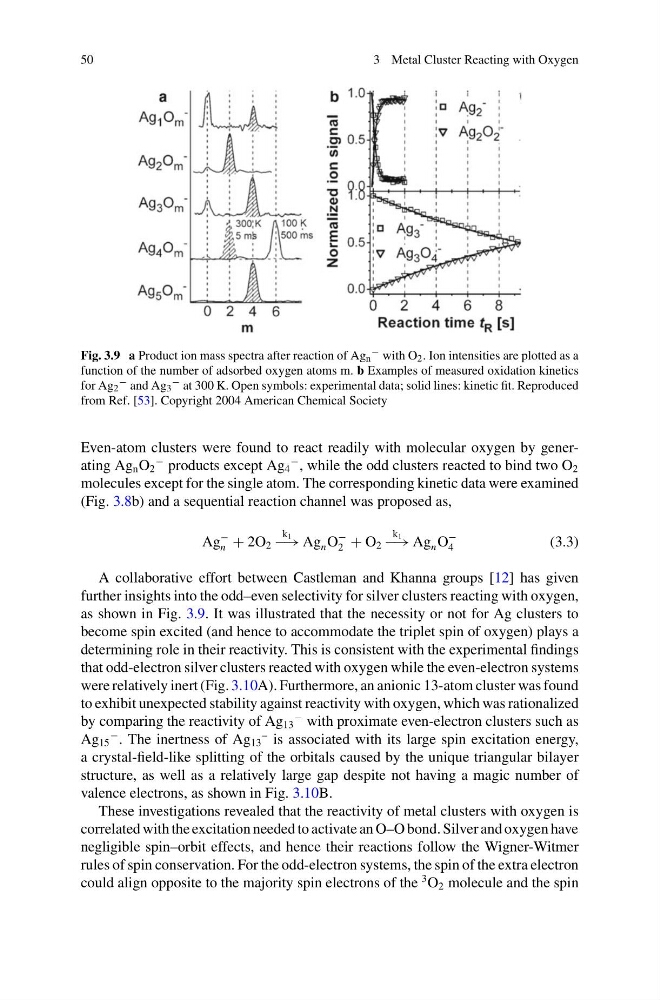
Fig. 3.9 a Product ion mass spectra after reaction of Ag n
− with O 2 . Ion intensities are plotted as a
function of the number of adsorbed oxygen atoms m. b Examples of measured oxidation kinetics
for Ag 2
− and Ag 3
− at 300 K. Open symbols: experimental data; solid lines: kinetic fit. Reproduced
from Ref. [53]. Copyright 2004 American Chemical Society
Even-atom clusters were found to react readily with molecular oxygen by generating Ag n O 2
− products except Ag 4
− , while the odd clusters reacted to bind two O 2
molecules except for the single atom. The corresponding kinetic data were examined
(Fig. 3.8b) and a sequential reaction channel was proposed as,
Ag
−
n + 2O 2
k 1
−→ Ag n O
−
2 + O 2
k 1
−→ Ag n O
−
4
(3.3)
A collaborative effort between Castleman and Khanna groups [12] has given
further insights into the odd–even selectivity for silver clusters reacting with oxygen,
as shown in Fig. 3.9. It was illustrated that the necessity or not for Ag clusters to
become spin excited (and hence to accommodate the triplet spin of oxygen) plays a
determining role in their reactivity. This is consistent with the experimental findings
that odd-electron silver clusters reacted with oxygen while the even-electron systems
were relatively inert (Fig. 3.10A). Furthermore, an anionic 13-atom cluster was found
to exhibit unexpected stability against reactivity with oxygen, which was rationalized
by comparing the reactivity of Ag 13
− with proximate even-electron clusters such as
Ag 15
− . The inertness of Ag 13
– is associated with its large spin excitation energy,
a crystal-field-like splitting of the orbitals caused by the unique triangular bilayer
structure, as well as a relatively large gap despite not having a magic number of
valence electrons, as shown in Fig. 3.10B.
These investigations revealed that the reactivity of metal clusters with oxygen is
correlated with the excitation needed to activate an O–O bond. Silver and oxygen have
negligible spin–orbit effects, and hence their reactions follow the Wigner-Witmer
rules of spin conservation. For the odd-electron systems, the spin of the extra electron
could align opposite to the majority spin electrons of the
3 O 2 molecule and the spin
3 Metal Cluster Reacting with Oxygen
Fig. 3.9 a Product ion mass spectra after reaction of Ag n
− with O 2 . Ion intensities are plotted as a
function of the number of adsorbed oxygen atoms m. b Examples of measured oxidation kinetics
for Ag 2
− and Ag 3
− at 300 K. Open symbols: experimental data; solid lines: kinetic fit. Reproduced
from Ref. [53]. Copyright 2004 American Chemical Society
Even-atom clusters were found to react readily with molecular oxygen by generating Ag n O 2
− products except Ag 4
− , while the odd clusters reacted to bind two O 2
molecules except for the single atom. The corresponding kinetic data were examined
(Fig. 3.8b) and a sequential reaction channel was proposed as,
Ag
−
n + 2O 2
k 1
−→ Ag n O
−
2 + O 2
k 1
−→ Ag n O
−
4
(3.3)
A collaborative effort between Castleman and Khanna groups [12] has given
further insights into the odd–even selectivity for silver clusters reacting with oxygen,
as shown in Fig. 3.9. It was illustrated that the necessity or not for Ag clusters to
become spin excited (and hence to accommodate the triplet spin of oxygen) plays a
determining role in their reactivity. This is consistent with the experimental findings
that odd-electron silver clusters reacted with oxygen while the even-electron systems
were relatively inert (Fig. 3.10A). Furthermore, an anionic 13-atom cluster was found
to exhibit unexpected stability against reactivity with oxygen, which was rationalized
by comparing the reactivity of Ag 13
− with proximate even-electron clusters such as
Ag 15
− . The inertness of Ag 13
– is associated with its large spin excitation energy,
a crystal-field-like splitting of the orbitals caused by the unique triangular bilayer
structure, as well as a relatively large gap despite not having a magic number of
valence electrons, as shown in Fig. 3.10B.
These investigations revealed that the reactivity of metal clusters with oxygen is
correlated with the excitation needed to activate an O–O bond. Silver and oxygen have
negligible spin–orbit effects, and hence their reactions follow the Wigner-Witmer
rules of spin conservation. For the odd-electron systems, the spin of the extra electron
could align opposite to the majority spin electrons of the
3 O 2 molecule and the spin