

2.3 Cluster Reaction Apparatus
23
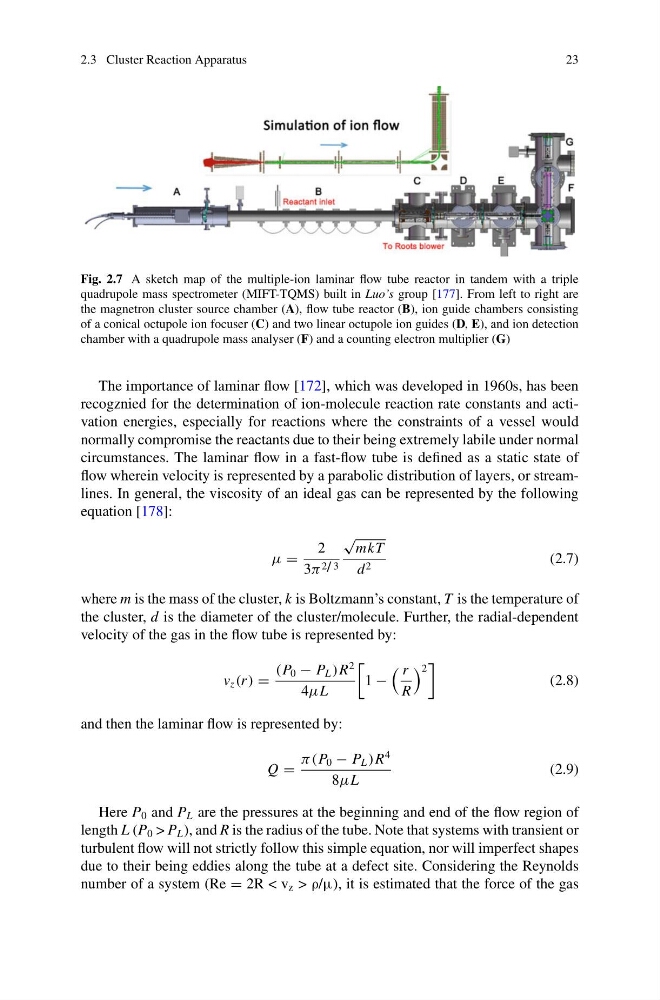
Fig. 2.7 A sketch map of the multiple-ion laminar flow tube reactor in tandem with a triple
quadrupole mass spectrometer (MIFT-TQMS) built in Luo’s group [177]. From left to right are
the magnetron cluster source chamber (A), flow tube reactor (B), ion guide chambers consisting
of a conical octupole ion focuser (C) and two linear octupole ion guides (D, E), and ion detection
chamber with a quadrupole mass analyser (F) and a counting electron multiplier (G)
The importance of laminar flow [172], which was developed in 1960s, has been
recogznied for the determination of ion-molecule reaction rate constants and activation energies, especially for reactions where the constraints of a vessel would
normally compromise the reactants due to their being extremely labile under normal
circumstances. The laminar flow in a fast-flow tube is defined as a static state of
flow wherein velocity is represented by a parabolic distribution of layers, or streamlines. In general, the viscosity of an ideal gas can be represented by the following
equation [178]:
μ =
2
3π 2 / 3
√
mkT
d 2
(2.7)
where m is the mass of the cluster, k is Boltzmann’s constant, T is the temperature of
the cluster, d is the diameter of the cluster/molecule. Further, the radial-dependent
velocity of the gas in the flow tube is represented by:
v z (r ) =
(P 0 − P L )R
2
4μL
1 −
r
R
2
(2.8)
and then the laminar flow is represented by:
Q =
π (P 0 − P L )R
4
8μL
(2.9)
Here P 0 and P L are the pressures at the beginning and end of the flow region of
length L (P 0 > P L ), and R is the radius of the tube. Note that systems with transient or
turbulent flow will not strictly follow this simple equation, nor will imperfect shapes
due to their being eddies along the tube at a defect site. Considering the Reynolds
number of a system (Re = 2R < v z > ρ/μ), it is estimated that the force of the gas
23
Fig. 2.7 A sketch map of the multiple-ion laminar flow tube reactor in tandem with a triple
quadrupole mass spectrometer (MIFT-TQMS) built in Luo’s group [177]. From left to right are
the magnetron cluster source chamber (A), flow tube reactor (B), ion guide chambers consisting
of a conical octupole ion focuser (C) and two linear octupole ion guides (D, E), and ion detection
chamber with a quadrupole mass analyser (F) and a counting electron multiplier (G)
The importance of laminar flow [172], which was developed in 1960s, has been
recogznied for the determination of ion-molecule reaction rate constants and activation energies, especially for reactions where the constraints of a vessel would
normally compromise the reactants due to their being extremely labile under normal
circumstances. The laminar flow in a fast-flow tube is defined as a static state of
flow wherein velocity is represented by a parabolic distribution of layers, or streamlines. In general, the viscosity of an ideal gas can be represented by the following
equation [178]:
μ =
2
3π 2 / 3
√
mkT
d 2
(2.7)
where m is the mass of the cluster, k is Boltzmann’s constant, T is the temperature of
the cluster, d is the diameter of the cluster/molecule. Further, the radial-dependent
velocity of the gas in the flow tube is represented by:
v z (r ) =
(P 0 − P L )R
2
4μL
1 −
r
R
2
(2.8)
and then the laminar flow is represented by:
Q =
π (P 0 − P L )R
4
8μL
(2.9)
Here P 0 and P L are the pressures at the beginning and end of the flow region of
length L (P 0 > P L ), and R is the radius of the tube. Note that systems with transient or
turbulent flow will not strictly follow this simple equation, nor will imperfect shapes
due to their being eddies along the tube at a defect site. Considering the Reynolds
number of a system (Re = 2R < v z > ρ/μ), it is estimated that the force of the gas