

24
2 Instrumentation for Cluster Science
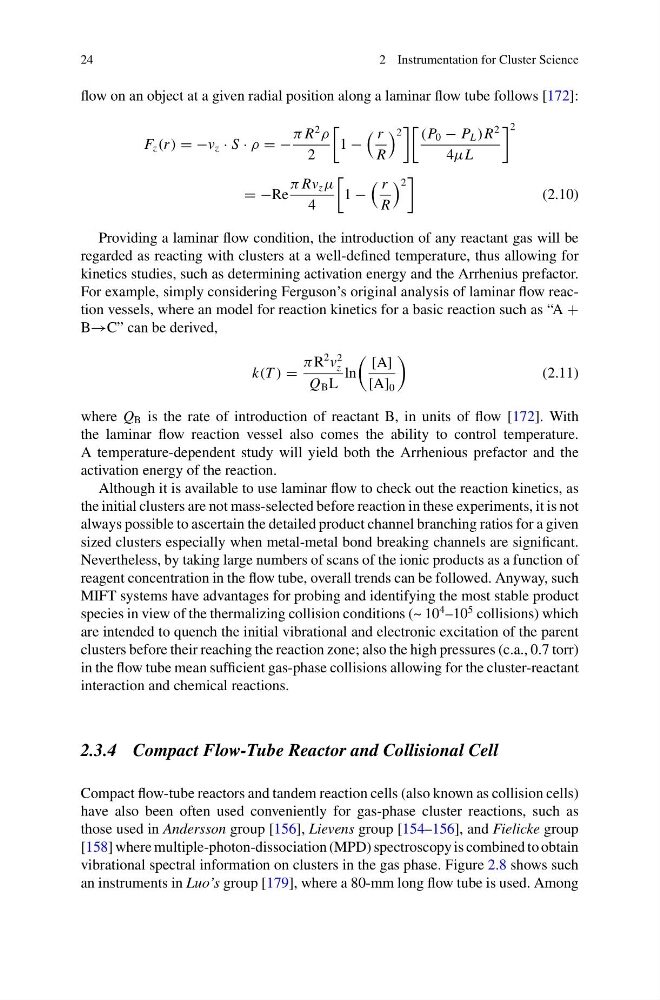
flow on an object at a given radial position along a laminar flow tube follows [172]:
F z (r ) = −v z · S · ρ = −
π R
2
ρ
2
1 −
r
R
2
(P 0 − P L )R
2
4μL
2
= −Re
π Rv z μ
4
1 −
r
R
2
(2.10)
Providing a laminar flow condition, the introduction of any reactant gas will be
regarded as reacting with clusters at a well-defined temperature, thus allowing for
kinetics studies, such as determining activation energy and the Arrhenius prefactor.
For example, simply considering Ferguson’s original analysis of laminar flow reaction vessels, where an model for reaction kinetics for a basic reaction such as “A +
B→C” can be derived,
k(T ) =
π R
2 v
2
z
Q B L
ln
[A]
[A] 0
(2.11)
where Q B is the rate of introduction of reactant B, in units of flow [172]. With
the laminar flow reaction vessel also comes the ability to control temperature.
A temperature-dependent study will yield both the Arrhenious prefactor and the
activation energy of the reaction.
Although it is available to use laminar flow to check out the reaction kinetics, as
the initial clusters are not mass-selected before reaction in these experiments, it is not
always possible to ascertain the detailed product channel branching ratios for a given
sized clusters especially when metal-metal bond breaking channels are significant.
Nevertheless, by taking large numbers of scans of the ionic products as a function of
reagent concentration in the flow tube, overall trends can be followed. Anyway, such
MIFT systems have advantages for probing and identifying the most stable product
species in view of the thermalizing collision conditions (~ 10
4 –10
5 collisions) which
are intended to quench the initial vibrational and electronic excitation of the parent
clusters before their reaching the reaction zone; also the high pressures (c.a., 0.7 torr)
in the flow tube mean sufficient gas-phase collisions allowing for the cluster-reactant
interaction and chemical reactions.
2.3.4 Compact Flow-Tube Reactor and Collisional Cell
Compact flow-tube reactors and tandem reaction cells (also known as collision cells)
have also been often used conveniently for gas-phase cluster reactions, such as
those used in Andersson group [156], Lievens group [154–156], and Fielicke group
[158] where multiple-photon-dissociation (MPD) spectroscopy is combined to obtain
vibrational spectral information on clusters in the gas phase. Figure 2.8 shows such
an instruments in Luo’s group [179], where a 80-mm long flow tube is used. Among
2 Instrumentation for Cluster Science
flow on an object at a given radial position along a laminar flow tube follows [172]:
F z (r ) = −v z · S · ρ = −
π R
2
ρ
2
1 −
r
R
2
(P 0 − P L )R
2
4μL
2
= −Re
π Rv z μ
4
1 −
r
R
2
(2.10)
Providing a laminar flow condition, the introduction of any reactant gas will be
regarded as reacting with clusters at a well-defined temperature, thus allowing for
kinetics studies, such as determining activation energy and the Arrhenius prefactor.
For example, simply considering Ferguson’s original analysis of laminar flow reaction vessels, where an model for reaction kinetics for a basic reaction such as “A +
B→C” can be derived,
k(T ) =
π R
2 v
2
z
Q B L
ln
[A]
[A] 0
(2.11)
where Q B is the rate of introduction of reactant B, in units of flow [172]. With
the laminar flow reaction vessel also comes the ability to control temperature.
A temperature-dependent study will yield both the Arrhenious prefactor and the
activation energy of the reaction.
Although it is available to use laminar flow to check out the reaction kinetics, as
the initial clusters are not mass-selected before reaction in these experiments, it is not
always possible to ascertain the detailed product channel branching ratios for a given
sized clusters especially when metal-metal bond breaking channels are significant.
Nevertheless, by taking large numbers of scans of the ionic products as a function of
reagent concentration in the flow tube, overall trends can be followed. Anyway, such
MIFT systems have advantages for probing and identifying the most stable product
species in view of the thermalizing collision conditions (~ 10
4 –10
5 collisions) which
are intended to quench the initial vibrational and electronic excitation of the parent
clusters before their reaching the reaction zone; also the high pressures (c.a., 0.7 torr)
in the flow tube mean sufficient gas-phase collisions allowing for the cluster-reactant
interaction and chemical reactions.
2.3.4 Compact Flow-Tube Reactor and Collisional Cell
Compact flow-tube reactors and tandem reaction cells (also known as collision cells)
have also been often used conveniently for gas-phase cluster reactions, such as
those used in Andersson group [156], Lievens group [154–156], and Fielicke group
[158] where multiple-photon-dissociation (MPD) spectroscopy is combined to obtain
vibrational spectral information on clusters in the gas phase. Figure 2.8 shows such
an instruments in Luo’s group [179], where a 80-mm long flow tube is used. Among