

22
2 Instrumentation for Cluster Science
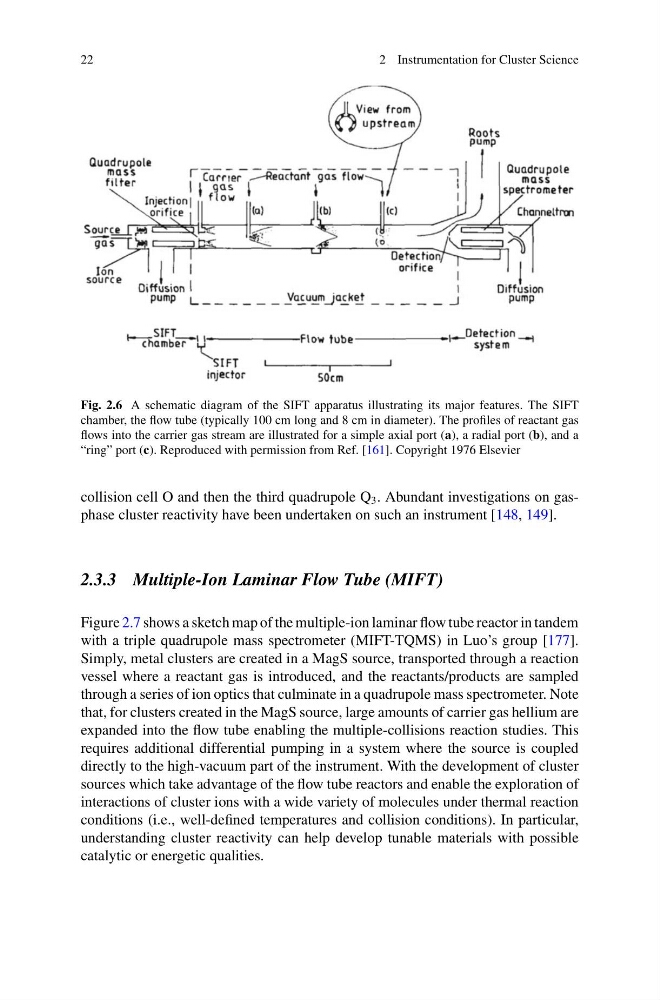
Fig. 2.6 A schematic diagram of the SIFT apparatus illustrating its major features. The SIFT
chamber, the flow tube (typically 100 cm long and 8 cm in diameter). The profiles of reactant gas
flows into the carrier gas stream are illustrated for a simple axial port (a), a radial port (b), and a
“ring” port (c). Reproduced with permission from Ref. [161]. Copyright 1976 Elsevier
collision cell O and then the third quadrupole Q 3 . Abundant investigations on gasphase cluster reactivity have been undertaken on such an instrument [148, 149].
2.3.3 Multiple-Ion Laminar Flow Tube (MIFT)
Figure 2.7 shows a sketch map of the multiple-ion laminar flow tube reactor in tandem
with a triple quadrupole mass spectrometer (MIFT-TQMS) in Luo’s group [177].
Simply, metal clusters are created in a MagS source, transported through a reaction
vessel where a reactant gas is introduced, and the reactants/products are sampled
through a series of ion optics that culminate in a quadrupole mass spectrometer. Note
that, for clusters created in the MagS source, large amounts of carrier gas hellium are
expanded into the flow tube enabling the multiple-collisions reaction studies. This
requires additional differential pumping in a system where the source is coupled
directly to the high-vacuum part of the instrument. With the development of cluster
sources which take advantage of the flow tube reactors and enable the exploration of
interactions of cluster ions with a wide variety of molecules under thermal reaction
conditions (i.e., well-defined temperatures and collision conditions). In particular,
understanding cluster reactivity can help develop tunable materials with possible
catalytic or energetic qualities.
2 Instrumentation for Cluster Science
Fig. 2.6 A schematic diagram of the SIFT apparatus illustrating its major features. The SIFT
chamber, the flow tube (typically 100 cm long and 8 cm in diameter). The profiles of reactant gas
flows into the carrier gas stream are illustrated for a simple axial port (a), a radial port (b), and a
“ring” port (c). Reproduced with permission from Ref. [161]. Copyright 1976 Elsevier
collision cell O and then the third quadrupole Q 3 . Abundant investigations on gasphase cluster reactivity have been undertaken on such an instrument [148, 149].
2.3.3 Multiple-Ion Laminar Flow Tube (MIFT)
Figure 2.7 shows a sketch map of the multiple-ion laminar flow tube reactor in tandem
with a triple quadrupole mass spectrometer (MIFT-TQMS) in Luo’s group [177].
Simply, metal clusters are created in a MagS source, transported through a reaction
vessel where a reactant gas is introduced, and the reactants/products are sampled
through a series of ion optics that culminate in a quadrupole mass spectrometer. Note
that, for clusters created in the MagS source, large amounts of carrier gas hellium are
expanded into the flow tube enabling the multiple-collisions reaction studies. This
requires additional differential pumping in a system where the source is coupled
directly to the high-vacuum part of the instrument. With the development of cluster
sources which take advantage of the flow tube reactors and enable the exploration of
interactions of cluster ions with a wide variety of molecules under thermal reaction
conditions (i.e., well-defined temperatures and collision conditions). In particular,
understanding cluster reactivity can help develop tunable materials with possible
catalytic or energetic qualities.