

252
14 Creating Genetic Materials of Metal Clusters
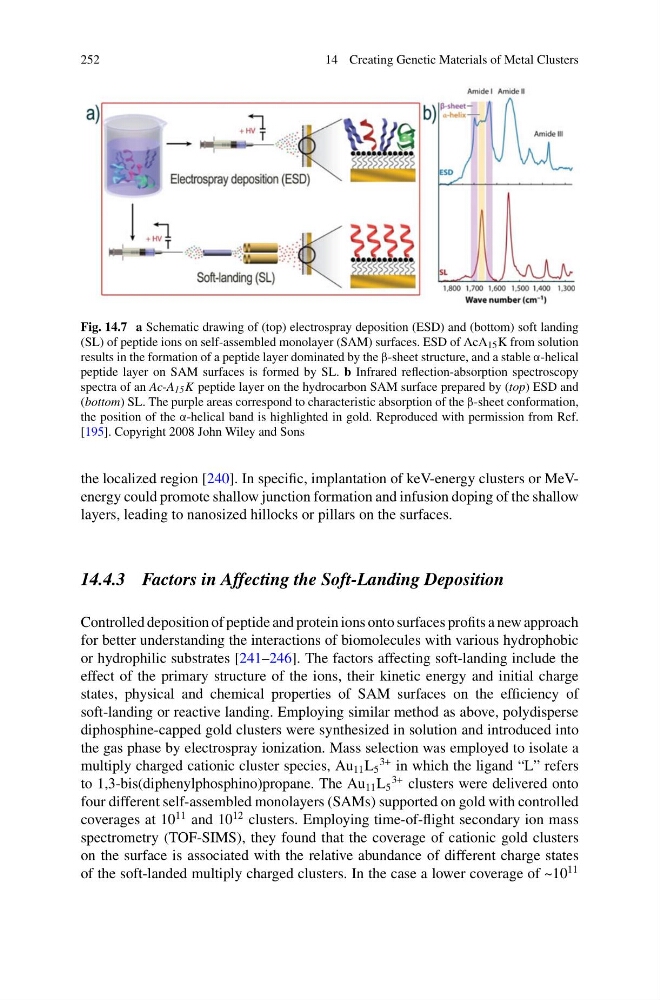
Fig. 14.7 a Schematic drawing of (top) electrospray deposition (ESD) and (bottom) soft landing
(SL) of peptide ions on self-assembled monolayer (SAM) surfaces. ESD of AcA 15 K from solution
results in the formation of a peptide layer dominated by the β-sheet structure, and a stable α-helical
peptide layer on SAM surfaces is formed by SL. b Infrared reflection-absorption spectroscopy
spectra of an Ac-A 15 K peptide layer on the hydrocarbon SAM surface prepared by (top) ESD and
(bottom) SL. The purple areas correspond to characteristic absorption of the β-sheet conformation,
the position of the α-helical band is highlighted in gold. Reproduced with permission from Ref.
[195]. Copyright 2008 John Wiley and Sons
the localized region [240]. In specific, implantation of keV-energy clusters or MeVenergy could promote shallow junction formation and infusion doping of the shallow
layers, leading to nanosized hillocks or pillars on the surfaces.
14.4.3 Factors in Affecting the Soft-Landing Deposition
Controlled deposition of peptide and protein ions onto surfaces profits a new approach
for better understanding the interactions of biomolecules with various hydrophobic
or hydrophilic substrates [241–246]. The factors affecting soft-landing include the
effect of the primary structure of the ions, their kinetic energy and initial charge
states, physical and chemical properties of SAM surfaces on the efficiency of
soft-landing or reactive landing. Employing similar method as above, polydisperse
diphosphine-capped gold clusters were synthesized in solution and introduced into
the gas phase by electrospray ionization. Mass selection was employed to isolate a
multiply charged cationic cluster species, Au 11 L 5
3+ in which the ligand “L” refers
to 1,3-bis(diphenylphosphino)propane. The Au 11 L 5
3+ clusters were delivered onto
four different self-assembled monolayers (SAMs) supported on gold with controlled
coverages at 10
11 and 10
12 clusters. Employing time-of-flight secondary ion mass
spectrometry (TOF-SIMS), they found that the coverage of cationic gold clusters
on the surface is associated with the relative abundance of different charge states
of the soft-landed multiply charged clusters. In the case a lower coverage of ~10
11
14 Creating Genetic Materials of Metal Clusters
Fig. 14.7 a Schematic drawing of (top) electrospray deposition (ESD) and (bottom) soft landing
(SL) of peptide ions on self-assembled monolayer (SAM) surfaces. ESD of AcA 15 K from solution
results in the formation of a peptide layer dominated by the β-sheet structure, and a stable α-helical
peptide layer on SAM surfaces is formed by SL. b Infrared reflection-absorption spectroscopy
spectra of an Ac-A 15 K peptide layer on the hydrocarbon SAM surface prepared by (top) ESD and
(bottom) SL. The purple areas correspond to characteristic absorption of the β-sheet conformation,
the position of the α-helical band is highlighted in gold. Reproduced with permission from Ref.
[195]. Copyright 2008 John Wiley and Sons
the localized region [240]. In specific, implantation of keV-energy clusters or MeVenergy could promote shallow junction formation and infusion doping of the shallow
layers, leading to nanosized hillocks or pillars on the surfaces.
14.4.3 Factors in Affecting the Soft-Landing Deposition
Controlled deposition of peptide and protein ions onto surfaces profits a new approach
for better understanding the interactions of biomolecules with various hydrophobic
or hydrophilic substrates [241–246]. The factors affecting soft-landing include the
effect of the primary structure of the ions, their kinetic energy and initial charge
states, physical and chemical properties of SAM surfaces on the efficiency of
soft-landing or reactive landing. Employing similar method as above, polydisperse
diphosphine-capped gold clusters were synthesized in solution and introduced into
the gas phase by electrospray ionization. Mass selection was employed to isolate a
multiply charged cationic cluster species, Au 11 L 5
3+ in which the ligand “L” refers
to 1,3-bis(diphenylphosphino)propane. The Au 11 L 5
3+ clusters were delivered onto
four different self-assembled monolayers (SAMs) supported on gold with controlled
coverages at 10
11 and 10
12 clusters. Employing time-of-flight secondary ion mass
spectrometry (TOF-SIMS), they found that the coverage of cationic gold clusters
on the surface is associated with the relative abundance of different charge states
of the soft-landed multiply charged clusters. In the case a lower coverage of ~10
11