

14.4 Solid-Supported Metal Clusters
253
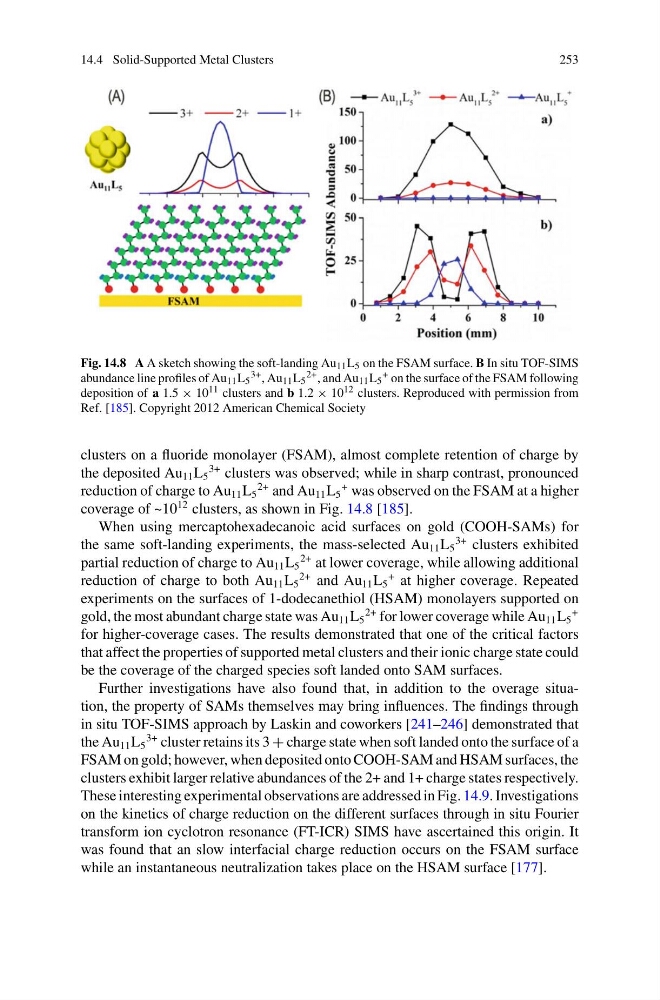
Fig. 14.8 A A sketch showing the soft-landing Au 11 L 5 on the FSAM surface. B In situ TOF-SIMS
abundance line profiles of Au 11 L 5
3+ , Au 11 L 5
2+ , and Au 11 L 5
+ on the surface of the FSAM following
deposition of a 1.5 × 10 11 clusters and b 1.2 × 10 12 clusters. Reproduced with permission from
Ref. [185]. Copyright 2012 American Chemical Society
clusters on a fluoride monolayer (FSAM), almost complete retention of charge by
the deposited Au 11 L 5
3+ clusters was observed; while in sharp contrast, pronounced
reduction of charge to Au 11 L 5
2+ and Au 11 L 5
+ was observed on the FSAM at a higher
coverage of ~10
12 clusters, as shown in Fig. 14.8 [185].
When using mercaptohexadecanoic acid surfaces on gold (COOH-SAMs) for
the same soft-landing experiments, the mass-selected Au 11 L 5
3+ clusters exhibited
partial reduction of charge to Au 11 L 5
2+ at lower coverage, while allowing additional
reduction of charge to both Au 11 L 5
2+ and Au 11 L 5
+ at higher coverage. Repeated
experiments on the surfaces of 1-dodecanethiol (HSAM) monolayers supported on
gold, the most abundant charge state was Au 11 L 5
2+ for lower coverage while Au 11 L 5
+
for higher-coverage cases. The results demonstrated that one of the critical factors
that affect the properties of supported metal clusters and their ionic charge state could
be the coverage of the charged species soft landed onto SAM surfaces.
Further investigations have also found that, in addition to the overage situation, the property of SAMs themselves may bring influences. The findings through
in situ TOF-SIMS approach by Laskin and coworkers [241–246] demonstrated that
the Au 11 L 5
3+ cluster retains its 3 + charge state when soft landed onto the surface of a
FSAM on gold; however, when deposited onto COOH-SAM and HSAM surfaces, the
clusters exhibit larger relative abundances of the 2+ and 1+ charge states respectively.
These interesting experimental observations are addressed in Fig. 14.9. Investigations
on the kinetics of charge reduction on the different surfaces through in situ Fourier
transform ion cyclotron resonance (FT-ICR) SIMS have ascertained this origin. It
was found that an slow interfacial charge reduction occurs on the FSAM surface
while an instantaneous neutralization takes place on the HSAM surface [177].
253
Fig. 14.8 A A sketch showing the soft-landing Au 11 L 5 on the FSAM surface. B In situ TOF-SIMS
abundance line profiles of Au 11 L 5
3+ , Au 11 L 5
2+ , and Au 11 L 5
+ on the surface of the FSAM following
deposition of a 1.5 × 10 11 clusters and b 1.2 × 10 12 clusters. Reproduced with permission from
Ref. [185]. Copyright 2012 American Chemical Society
clusters on a fluoride monolayer (FSAM), almost complete retention of charge by
the deposited Au 11 L 5
3+ clusters was observed; while in sharp contrast, pronounced
reduction of charge to Au 11 L 5
2+ and Au 11 L 5
+ was observed on the FSAM at a higher
coverage of ~10
12 clusters, as shown in Fig. 14.8 [185].
When using mercaptohexadecanoic acid surfaces on gold (COOH-SAMs) for
the same soft-landing experiments, the mass-selected Au 11 L 5
3+ clusters exhibited
partial reduction of charge to Au 11 L 5
2+ at lower coverage, while allowing additional
reduction of charge to both Au 11 L 5
2+ and Au 11 L 5
+ at higher coverage. Repeated
experiments on the surfaces of 1-dodecanethiol (HSAM) monolayers supported on
gold, the most abundant charge state was Au 11 L 5
2+ for lower coverage while Au 11 L 5
+
for higher-coverage cases. The results demonstrated that one of the critical factors
that affect the properties of supported metal clusters and their ionic charge state could
be the coverage of the charged species soft landed onto SAM surfaces.
Further investigations have also found that, in addition to the overage situation, the property of SAMs themselves may bring influences. The findings through
in situ TOF-SIMS approach by Laskin and coworkers [241–246] demonstrated that
the Au 11 L 5
3+ cluster retains its 3 + charge state when soft landed onto the surface of a
FSAM on gold; however, when deposited onto COOH-SAM and HSAM surfaces, the
clusters exhibit larger relative abundances of the 2+ and 1+ charge states respectively.
These interesting experimental observations are addressed in Fig. 14.9. Investigations
on the kinetics of charge reduction on the different surfaces through in situ Fourier
transform ion cyclotron resonance (FT-ICR) SIMS have ascertained this origin. It
was found that an slow interfacial charge reduction occurs on the FSAM surface
while an instantaneous neutralization takes place on the HSAM surface [177].