

14.4 Solid-Supported Metal Clusters
251
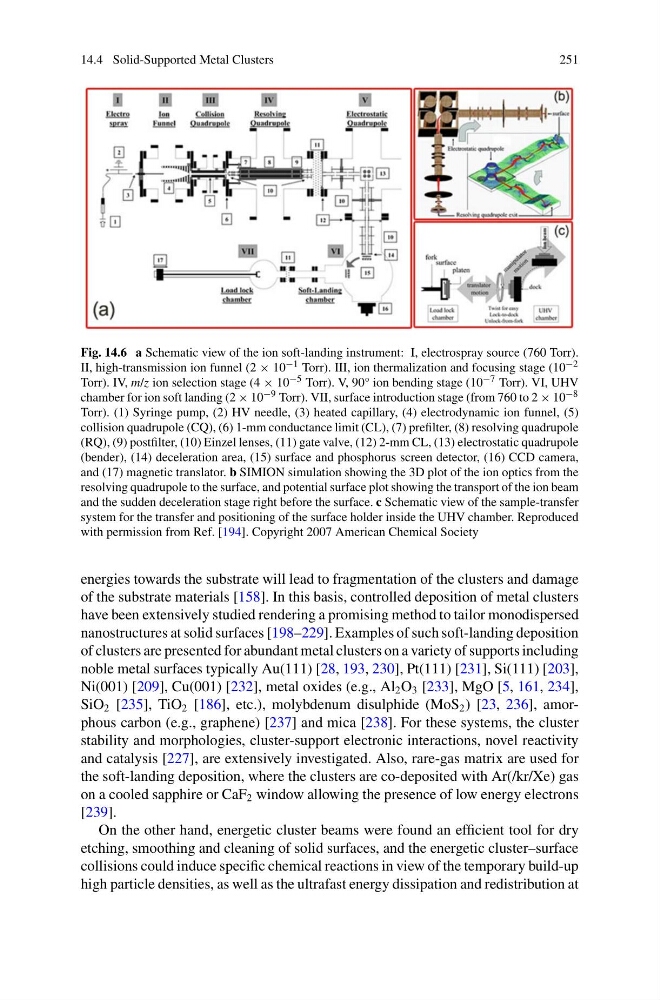
Fig. 14.6 a Schematic view of the ion soft-landing instrument: I, electrospray source (760 Torr).
II, high-transmission ion funnel (2 × 10 −1 Torr). III, ion thermalization and focusing stage (10 −2
Torr). IV, m/z ion selection stage (4 × 10 −5 Torr). V, 90° ion bending stage (10 −7 Torr). VI, UHV
chamber for ion soft landing (2 × 10 −9 Torr). VII, surface introduction stage (from 760 to 2 × 10 −8
Torr). (1) Syringe pump, (2) HV needle, (3) heated capillary, (4) electrodynamic ion funnel, (5)
collision quadrupole (CQ), (6) 1-mm conductance limit (CL), (7) prefilter, (8) resolving quadrupole
(RQ), (9) postfilter, (10) Einzel lenses, (11) gate valve, (12) 2-mm CL, (13) electrostatic quadrupole
(bender), (14) deceleration area, (15) surface and phosphorus screen detector, (16) CCD camera,
and (17) magnetic translator. b SIMION simulation showing the 3D plot of the ion optics from the
resolving quadrupole to the surface, and potential surface plot showing the transport of the ion beam
and the sudden deceleration stage right before the surface. c Schematic view of the sample-transfer
system for the transfer and positioning of the surface holder inside the UHV chamber. Reproduced
with permission from Ref. [194]. Copyright 2007 American Chemical Society
energies towards the substrate will lead to fragmentation of the clusters and damage
of the substrate materials [158]. In this basis, controlled deposition of metal clusters
have been extensively studied rendering a promising method to tailor monodispersed
nanostructures at solid surfaces [198–229]. Examples of such soft-landing deposition
of clusters are presented for abundant metal clusters on a variety of supports including
noble metal surfaces typically Au(111) [28, 193, 230], Pt(111) [231], Si(111) [203],
Ni(001) [209], Cu(001) [232], metal oxides (e.g., Al 2 O 3 [233], MgO [5, 161, 234],
SiO 2 [235], TiO 2 [186], etc.), molybdenum disulphide (MoS 2 ) [23, 236], amorphous carbon (e.g., graphene) [237] and mica [238]. For these systems, the cluster
stability and morphologies, cluster-support electronic interactions, novel reactivity
and catalysis [227], are extensively investigated. Also, rare-gas matrix are used for
the soft-landing deposition, where the clusters are co-deposited with Ar(/kr/Xe) gas
on a cooled sapphire or CaF 2 window allowing the presence of low energy electrons
[239].
On the other hand, energetic cluster beams were found an efficient tool for dry
etching, smoothing and cleaning of solid surfaces, and the energetic cluster–surface
collisions could induce specific chemical reactions in view of the temporary build-up
high particle densities, as well as the ultrafast energy dissipation and redistribution at
251
Fig. 14.6 a Schematic view of the ion soft-landing instrument: I, electrospray source (760 Torr).
II, high-transmission ion funnel (2 × 10 −1 Torr). III, ion thermalization and focusing stage (10 −2
Torr). IV, m/z ion selection stage (4 × 10 −5 Torr). V, 90° ion bending stage (10 −7 Torr). VI, UHV
chamber for ion soft landing (2 × 10 −9 Torr). VII, surface introduction stage (from 760 to 2 × 10 −8
Torr). (1) Syringe pump, (2) HV needle, (3) heated capillary, (4) electrodynamic ion funnel, (5)
collision quadrupole (CQ), (6) 1-mm conductance limit (CL), (7) prefilter, (8) resolving quadrupole
(RQ), (9) postfilter, (10) Einzel lenses, (11) gate valve, (12) 2-mm CL, (13) electrostatic quadrupole
(bender), (14) deceleration area, (15) surface and phosphorus screen detector, (16) CCD camera,
and (17) magnetic translator. b SIMION simulation showing the 3D plot of the ion optics from the
resolving quadrupole to the surface, and potential surface plot showing the transport of the ion beam
and the sudden deceleration stage right before the surface. c Schematic view of the sample-transfer
system for the transfer and positioning of the surface holder inside the UHV chamber. Reproduced
with permission from Ref. [194]. Copyright 2007 American Chemical Society
energies towards the substrate will lead to fragmentation of the clusters and damage
of the substrate materials [158]. In this basis, controlled deposition of metal clusters
have been extensively studied rendering a promising method to tailor monodispersed
nanostructures at solid surfaces [198–229]. Examples of such soft-landing deposition
of clusters are presented for abundant metal clusters on a variety of supports including
noble metal surfaces typically Au(111) [28, 193, 230], Pt(111) [231], Si(111) [203],
Ni(001) [209], Cu(001) [232], metal oxides (e.g., Al 2 O 3 [233], MgO [5, 161, 234],
SiO 2 [235], TiO 2 [186], etc.), molybdenum disulphide (MoS 2 ) [23, 236], amorphous carbon (e.g., graphene) [237] and mica [238]. For these systems, the cluster
stability and morphologies, cluster-support electronic interactions, novel reactivity
and catalysis [227], are extensively investigated. Also, rare-gas matrix are used for
the soft-landing deposition, where the clusters are co-deposited with Ar(/kr/Xe) gas
on a cooled sapphire or CaF 2 window allowing the presence of low energy electrons
[239].
On the other hand, energetic cluster beams were found an efficient tool for dry
etching, smoothing and cleaning of solid surfaces, and the energetic cluster–surface
collisions could induce specific chemical reactions in view of the temporary build-up
high particle densities, as well as the ultrafast energy dissipation and redistribution at