

14
2 Instrumentation for Cluster Science
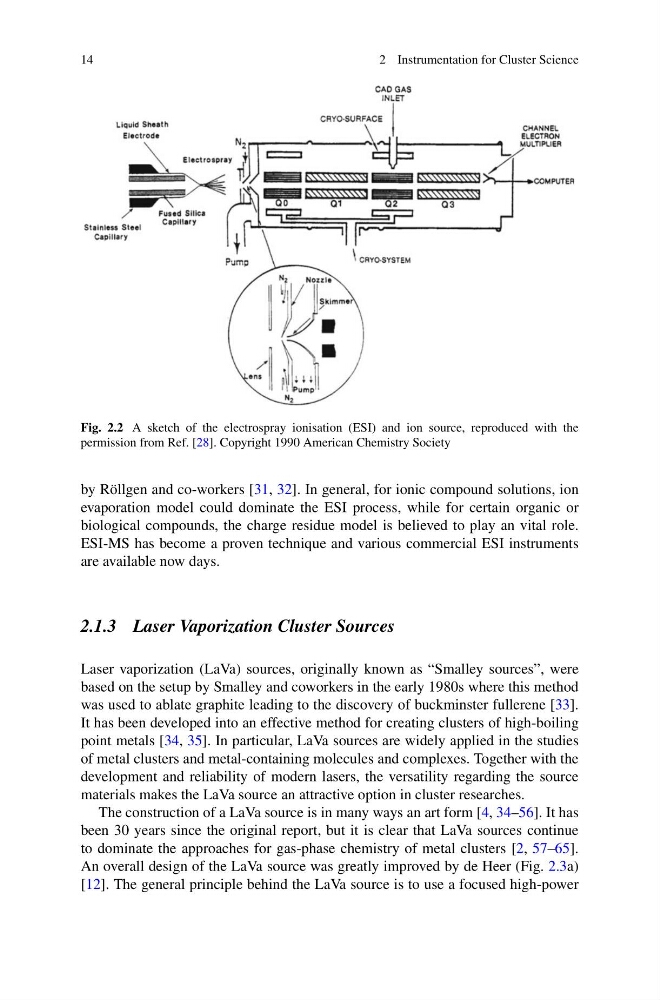
Fig. 2.2 A sketch of the electrospray ionisation (ESI) and ion source, reproduced with the
permission from Ref. [28]. Copyright 1990 American Chemistry Society
by Röllgen and co-workers [31, 32]. In general, for ionic compound solutions, ion
evaporation model could dominate the ESI process, while for certain organic or
biological compounds, the charge residue model is believed to play an vital role.
ESI-MS has become a proven technique and various commercial ESI instruments
are available now days.
2.1.3 Laser Vaporization Cluster Sources
Laser vaporization (LaVa) sources, originally known as “Smalley sources”, were
based on the setup by Smalley and coworkers in the early 1980s where this method
was used to ablate graphite leading to the discovery of buckminster fullerene [33].
It has been developed into an effective method for creating clusters of high-boiling
point metals [34, 35]. In particular, LaVa sources are widely applied in the studies
of metal clusters and metal-containing molecules and complexes. Together with the
development and reliability of modern lasers, the versatility regarding the source
materials makes the LaVa source an attractive option in cluster researches.
The construction of a LaVa source is in many ways an art form [4, 34–56]. It has
been 30 years since the original report, but it is clear that LaVa sources continue
to dominate the approaches for gas-phase chemistry of metal clusters [2, 57–65].
An overall design of the LaVa source was greatly improved by de Heer (Fig. 2.3a)
[12]. The general principle behind the LaVa source is to use a focused high-power
2 Instrumentation for Cluster Science
Fig. 2.2 A sketch of the electrospray ionisation (ESI) and ion source, reproduced with the
permission from Ref. [28]. Copyright 1990 American Chemistry Society
by Röllgen and co-workers [31, 32]. In general, for ionic compound solutions, ion
evaporation model could dominate the ESI process, while for certain organic or
biological compounds, the charge residue model is believed to play an vital role.
ESI-MS has become a proven technique and various commercial ESI instruments
are available now days.
2.1.3 Laser Vaporization Cluster Sources
Laser vaporization (LaVa) sources, originally known as “Smalley sources”, were
based on the setup by Smalley and coworkers in the early 1980s where this method
was used to ablate graphite leading to the discovery of buckminster fullerene [33].
It has been developed into an effective method for creating clusters of high-boiling
point metals [34, 35]. In particular, LaVa sources are widely applied in the studies
of metal clusters and metal-containing molecules and complexes. Together with the
development and reliability of modern lasers, the versatility regarding the source
materials makes the LaVa source an attractive option in cluster researches.
The construction of a LaVa source is in many ways an art form [4, 34–56]. It has
been 30 years since the original report, but it is clear that LaVa sources continue
to dominate the approaches for gas-phase chemistry of metal clusters [2, 57–65].
An overall design of the LaVa source was greatly improved by de Heer (Fig. 2.3a)
[12]. The general principle behind the LaVa source is to use a focused high-power