

2.1 Cluster Sources
15
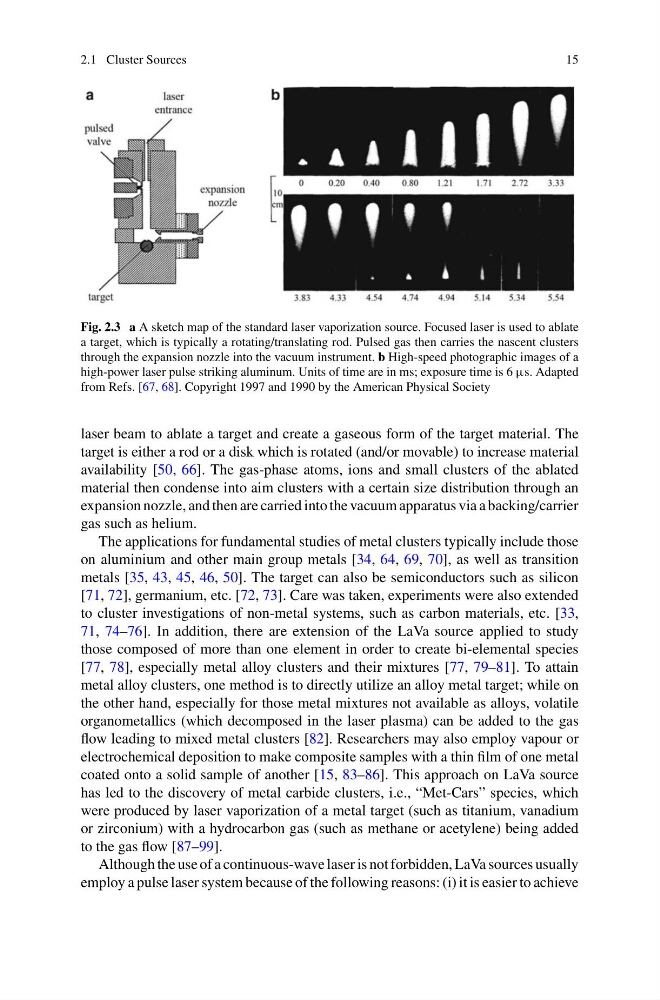
Fig. 2.3 a A sketch map of the standard laser vaporization source. Focused laser is used to ablate
a target, which is typically a rotating/translating rod. Pulsed gas then carries the nascent clusters
through the expansion nozzle into the vacuum instrument. b High-speed photographic images of a
high-power laser pulse striking aluminum. Units of time are in ms; exposure time is 6 μs. Adapted
from Refs. [67, 68]. Copyright 1997 and 1990 by the American Physical Society
laser beam to ablate a target and create a gaseous form of the target material. The
target is either a rod or a disk which is rotated (and/or movable) to increase material
availability [50, 66]. The gas-phase atoms, ions and small clusters of the ablated
material then condense into aim clusters with a certain size distribution through an
expansion nozzle, and then are carried into the vacuum apparatus via a backing/carrier
gas such as helium.
The applications for fundamental studies of metal clusters typically include those
on aluminium and other main group metals [34, 64, 69, 70], as well as transition
metals [35, 43, 45, 46, 50]. The target can also be semiconductors such as silicon
[71, 72], germanium, etc. [72, 73]. Care was taken, experiments were also extended
to cluster investigations of non-metal systems, such as carbon materials, etc. [33,
71, 74–76]. In addition, there are extension of the LaVa source applied to study
those composed of more than one element in order to create bi-elemental species
[77, 78], especially metal alloy clusters and their mixtures [77, 79–81]. To attain
metal alloy clusters, one method is to directly utilize an alloy metal target; while on
the other hand, especially for those metal mixtures not available as alloys, volatile
organometallics (which decomposed in the laser plasma) can be added to the gas
flow leading to mixed metal clusters [82]. Researchers may also employ vapour or
electrochemical deposition to make composite samples with a thin film of one metal
coated onto a solid sample of another [15, 83–86]. This approach on LaVa source
has led to the discovery of metal carbide clusters, i.e., “Met-Cars” species, which
were produced by laser vaporization of a metal target (such as titanium, vanadium
or zirconium) with a hydrocarbon gas (such as methane or acetylene) being added
to the gas flow [87–99].
Although the use of a continuous-wave laser is not forbidden, LaVa sources usually
employ a pulse laser system because of the following reasons: (i) it is easier to achieve
15
Fig. 2.3 a A sketch map of the standard laser vaporization source. Focused laser is used to ablate
a target, which is typically a rotating/translating rod. Pulsed gas then carries the nascent clusters
through the expansion nozzle into the vacuum instrument. b High-speed photographic images of a
high-power laser pulse striking aluminum. Units of time are in ms; exposure time is 6 μs. Adapted
from Refs. [67, 68]. Copyright 1997 and 1990 by the American Physical Society
laser beam to ablate a target and create a gaseous form of the target material. The
target is either a rod or a disk which is rotated (and/or movable) to increase material
availability [50, 66]. The gas-phase atoms, ions and small clusters of the ablated
material then condense into aim clusters with a certain size distribution through an
expansion nozzle, and then are carried into the vacuum apparatus via a backing/carrier
gas such as helium.
The applications for fundamental studies of metal clusters typically include those
on aluminium and other main group metals [34, 64, 69, 70], as well as transition
metals [35, 43, 45, 46, 50]. The target can also be semiconductors such as silicon
[71, 72], germanium, etc. [72, 73]. Care was taken, experiments were also extended
to cluster investigations of non-metal systems, such as carbon materials, etc. [33,
71, 74–76]. In addition, there are extension of the LaVa source applied to study
those composed of more than one element in order to create bi-elemental species
[77, 78], especially metal alloy clusters and their mixtures [77, 79–81]. To attain
metal alloy clusters, one method is to directly utilize an alloy metal target; while on
the other hand, especially for those metal mixtures not available as alloys, volatile
organometallics (which decomposed in the laser plasma) can be added to the gas
flow leading to mixed metal clusters [82]. Researchers may also employ vapour or
electrochemical deposition to make composite samples with a thin film of one metal
coated onto a solid sample of another [15, 83–86]. This approach on LaVa source
has led to the discovery of metal carbide clusters, i.e., “Met-Cars” species, which
were produced by laser vaporization of a metal target (such as titanium, vanadium
or zirconium) with a hydrocarbon gas (such as methane or acetylene) being added
to the gas flow [87–99].
Although the use of a continuous-wave laser is not forbidden, LaVa sources usually
employ a pulse laser system because of the following reasons: (i) it is easier to achieve