

13.5 Catalysis of Titanium and Vanadium Oxides
231
become trapped in metastable surface states, or they can react with electron acceptors
and electron donors adsorbed on the semiconductor surface or within the surrounding
electrical double layer of the charged particles. Moreover, the illuminated semiconductors have been successfully applied in the remediation of contaminants for a
wide variety of compounds [187–194], and recently the discovery of photo-induced
superhydrophilicity and the self-cleaning effect of TiO 2 thin films has led to even
wider applications for TiO 2 photocatalysts [195]. Several recent investigations have
also enlightened the studies of preparing titanium oxide photocatalysts loaded on
activated supports by an ionized cluster beam (ICB) method, based on which the
transparent TiO 2 thin film photocatalysts showed specific interference fringes and
enhanced photocatalytic reactivity [196–205].
In various studies as partly have presented above, it was found that clusters of
selected sizes can serve as surface sites, where their structures may have geometries
akin to steps, ledges, or corners, with characteristic accompanying charge densities
[206–209]. Comparing with single-crystal surfaces, certain cluster structures can
serve as ideal model surface sites and hence can be readily studied using standard
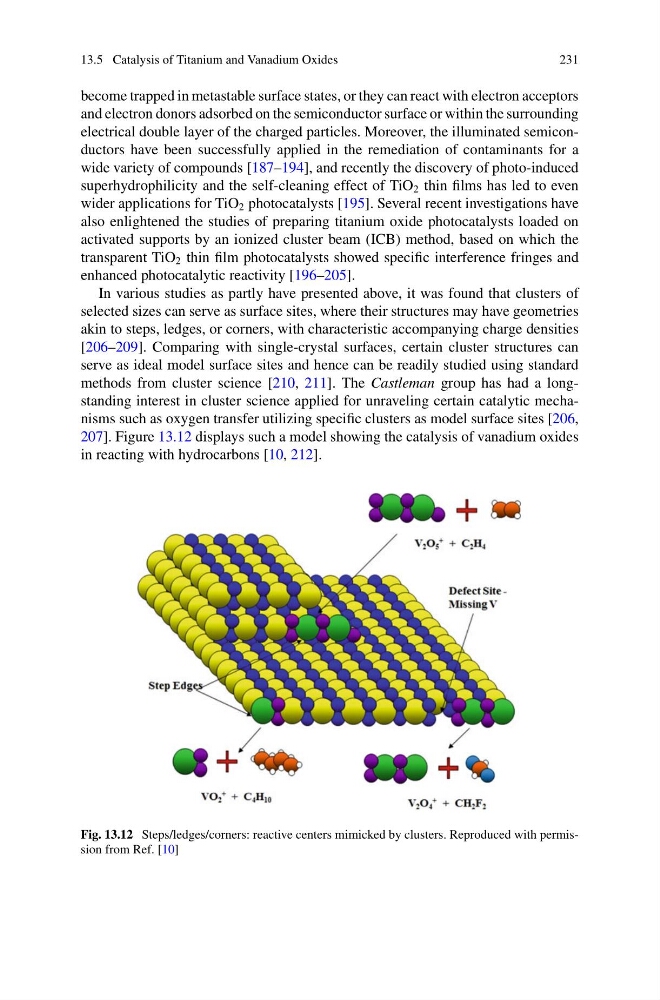
methods from cluster science [210, 211]. The Castleman group has had a longstanding interest in cluster science applied for unraveling certain catalytic mechanisms such as oxygen transfer utilizing specific clusters as model surface sites [206,
207]. Figure 13.12 displays such a model showing the catalysis of vanadium oxides
in reacting with hydrocarbons [10, 212].
Fig. 13.12 Steps/ledges/corners: reactive centers mimicked by clusters. Reproduced with permission from Ref. [10]
231
become trapped in metastable surface states, or they can react with electron acceptors
and electron donors adsorbed on the semiconductor surface or within the surrounding
electrical double layer of the charged particles. Moreover, the illuminated semiconductors have been successfully applied in the remediation of contaminants for a
wide variety of compounds [187–194], and recently the discovery of photo-induced
superhydrophilicity and the self-cleaning effect of TiO 2 thin films has led to even
wider applications for TiO 2 photocatalysts [195]. Several recent investigations have
also enlightened the studies of preparing titanium oxide photocatalysts loaded on
activated supports by an ionized cluster beam (ICB) method, based on which the
transparent TiO 2 thin film photocatalysts showed specific interference fringes and
enhanced photocatalytic reactivity [196–205].
In various studies as partly have presented above, it was found that clusters of
selected sizes can serve as surface sites, where their structures may have geometries
akin to steps, ledges, or corners, with characteristic accompanying charge densities
[206–209]. Comparing with single-crystal surfaces, certain cluster structures can
serve as ideal model surface sites and hence can be readily studied using standard
methods from cluster science [210, 211]. The Castleman group has had a longstanding interest in cluster science applied for unraveling certain catalytic mechanisms such as oxygen transfer utilizing specific clusters as model surface sites [206,
207]. Figure 13.12 displays such a model showing the catalysis of vanadium oxides
in reacting with hydrocarbons [10, 212].
Fig. 13.12 Steps/ledges/corners: reactive centers mimicked by clusters. Reproduced with permission from Ref. [10]