

232
13 Metal Cluster Catalysis
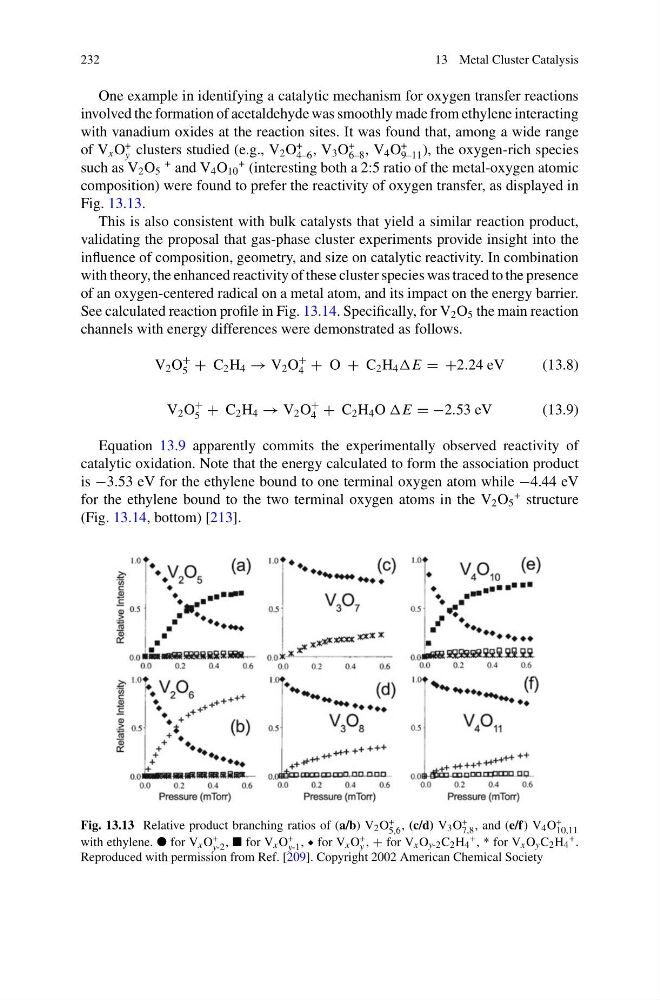
One example in identifying a catalytic mechanism for oxygen transfer reactions
involved the formation of acetaldehyde was smoothly made from ethylene interacting
with vanadium oxides at the reaction sites. It was found that, among a wide range
of V x O
+
y clusters studied (e.g., V 2 O
+
4–6 , V 3 O
+
6–8 , V 4 O
+
9–11 ), the oxygen-rich species
such as V 2 O 5
+ and V 4 O 10
+ (interesting both a 2:5 ratio of the metal-oxygen atomic
composition) were found to prefer the reactivity of oxygen transfer, as displayed in
Fig. 13.13.
This is also consistent with bulk catalysts that yield a similar reaction product,
validating the proposal that gas-phase cluster experiments provide insight into the
influence of composition, geometry, and size on catalytic reactivity. In combination
with theory, the enhanced reactivity of these cluster species was traced to the presence
of an oxygen-centered radical on a metal atom, and its impact on the energy barrier.
See calculated reaction profile in Fig. 13.14. Specifically, for V 2 O 5 the main reaction
channels with energy differences were demonstrated as follows.
V 2 O
+
5 + C 2 H 4 → V 2 O
+
4 + O + C 2 H 4 E = +2.24 eV
(13.8)
V 2 O
+
5 + C 2 H 4 → V 2 O
+
4 + C 2 H 4 O E = −2.53 eV
(13.9)
Equation 13.9 apparently commits the experimentally observed reactivity of
catalytic oxidation. Note that the energy calculated to form the association product
is −3.53 eV for the ethylene bound to one terminal oxygen atom while −4.44 eV
for the ethylene bound to the two terminal oxygen atoms in the V 2 O 5
+ structure
(Fig. 13.14, bottom) [213].
Fig. 13.13 Relative product branching ratios of (a/b) V 2 O +
5,6 , (c/d) V 3 O +
7,8 , and (e/f) V 4 O +
10,11
with ethylene. ● for V x O +
y-2 , for V x O +
y-1 , ˛ for V x O +
y , + for V x O y-2 C 2 H 4
+ , * for V x O y C 2 H 4
+ .
Reproduced with permission from Ref. [209]. Copyright 2002 American Chemical Society
13 Metal Cluster Catalysis
One example in identifying a catalytic mechanism for oxygen transfer reactions
involved the formation of acetaldehyde was smoothly made from ethylene interacting
with vanadium oxides at the reaction sites. It was found that, among a wide range
of V x O
+
y clusters studied (e.g., V 2 O
+
4–6 , V 3 O
+
6–8 , V 4 O
+
9–11 ), the oxygen-rich species
such as V 2 O 5
+ and V 4 O 10
+ (interesting both a 2:5 ratio of the metal-oxygen atomic
composition) were found to prefer the reactivity of oxygen transfer, as displayed in
Fig. 13.13.
This is also consistent with bulk catalysts that yield a similar reaction product,
validating the proposal that gas-phase cluster experiments provide insight into the
influence of composition, geometry, and size on catalytic reactivity. In combination
with theory, the enhanced reactivity of these cluster species was traced to the presence
of an oxygen-centered radical on a metal atom, and its impact on the energy barrier.
See calculated reaction profile in Fig. 13.14. Specifically, for V 2 O 5 the main reaction
channels with energy differences were demonstrated as follows.
V 2 O
+
5 + C 2 H 4 → V 2 O
+
4 + O + C 2 H 4 E = +2.24 eV
(13.8)
V 2 O
+
5 + C 2 H 4 → V 2 O
+
4 + C 2 H 4 O E = −2.53 eV
(13.9)
Equation 13.9 apparently commits the experimentally observed reactivity of
catalytic oxidation. Note that the energy calculated to form the association product
is −3.53 eV for the ethylene bound to one terminal oxygen atom while −4.44 eV
for the ethylene bound to the two terminal oxygen atoms in the V 2 O 5
+ structure
(Fig. 13.14, bottom) [213].
Fig. 13.13 Relative product branching ratios of (a/b) V 2 O +
5,6 , (c/d) V 3 O +
7,8 , and (e/f) V 4 O +
10,11
with ethylene. ● for V x O +
y-2 , for V x O +
y-1 , ˛ for V x O +
y , + for V x O y-2 C 2 H 4
+ , * for V x O y C 2 H 4
+ .
Reproduced with permission from Ref. [209]. Copyright 2002 American Chemical Society