

13.4 Catalysis of Copper-Related Systems
229
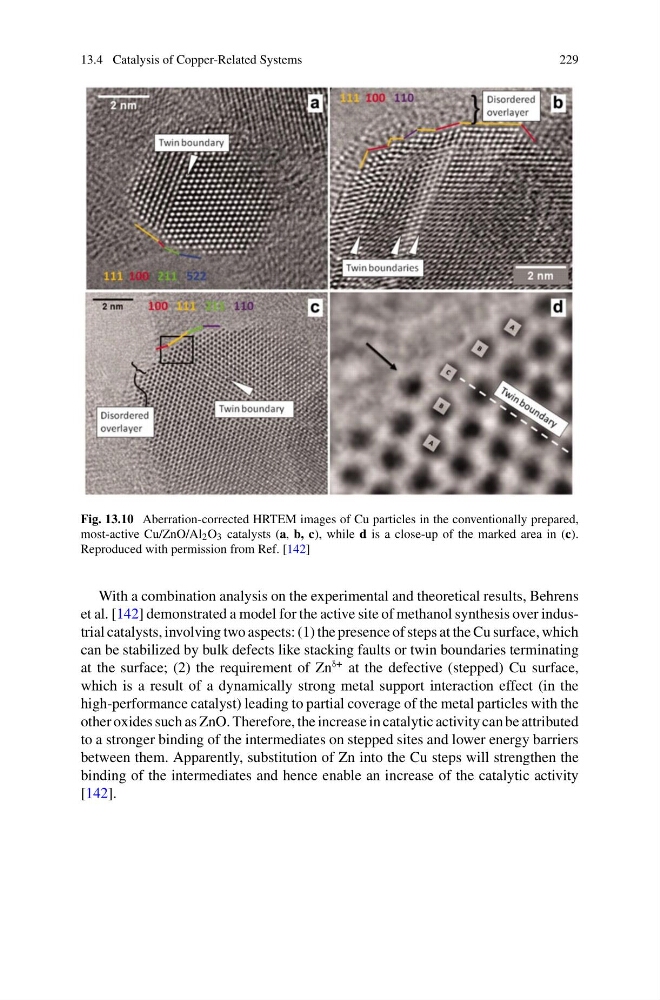
Fig. 13.10 Aberration-corrected HRTEM images of Cu particles in the conventionally prepared,
most-active Cu/ZnO/Al 2 O 3 catalysts (a, b, c), while d is a close-up of the marked area in (c).
Reproduced with permission from Ref. [142]
With a combination analysis on the experimental and theoretical results, Behrens
et al. [142] demonstrated a model for the active site of methanol synthesis over industrial catalysts, involving two aspects: (1) the presence of steps at the Cu surface, which
can be stabilized by bulk defects like stacking faults or twin boundaries terminating
at the surface; (2) the requirement of Zn
δ+ at the defective (stepped) Cu surface,
which is a result of a dynamically strong metal support interaction effect (in the
high-performance catalyst) leading to partial coverage of the metal particles with the
other oxides such as ZnO. Therefore, the increase in catalytic activity can be attributed
to a stronger binding of the intermediates on stepped sites and lower energy barriers
between them. Apparently, substitution of Zn into the Cu steps will strengthen the
binding of the intermediates and hence enable an increase of the catalytic activity
[142].
229
Fig. 13.10 Aberration-corrected HRTEM images of Cu particles in the conventionally prepared,
most-active Cu/ZnO/Al 2 O 3 catalysts (a, b, c), while d is a close-up of the marked area in (c).
Reproduced with permission from Ref. [142]
With a combination analysis on the experimental and theoretical results, Behrens
et al. [142] demonstrated a model for the active site of methanol synthesis over industrial catalysts, involving two aspects: (1) the presence of steps at the Cu surface, which
can be stabilized by bulk defects like stacking faults or twin boundaries terminating
at the surface; (2) the requirement of Zn
δ+ at the defective (stepped) Cu surface,
which is a result of a dynamically strong metal support interaction effect (in the
high-performance catalyst) leading to partial coverage of the metal particles with the
other oxides such as ZnO. Therefore, the increase in catalytic activity can be attributed
to a stronger binding of the intermediates on stepped sites and lower energy barriers
between them. Apparently, substitution of Zn into the Cu steps will strengthen the
binding of the intermediates and hence enable an increase of the catalytic activity
[142].