

13.2 Gold Cluster Catalysis
219
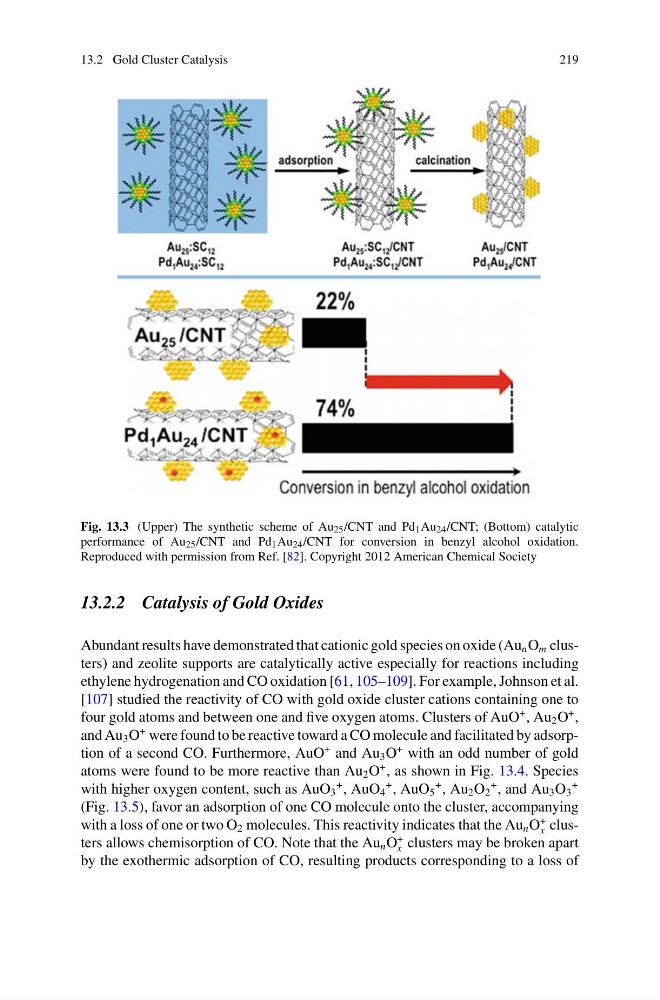
Fig. 13.3 (Upper) The synthetic scheme of Au 25 /CNT and Pd 1 Au 24 /CNT; (Bottom) catalytic
performance of Au 25 /CNT and Pd 1 Au 24 /CNT for conversion in benzyl alcohol oxidation.
Reproduced with permission from Ref. [82]. Copyright 2012 American Chemical Society
13.2.2 Catalysis of Gold Oxides
Abundant results have demonstrated that cationic gold species on oxide (Au n O m clusters) and zeolite supports are catalytically active especially for reactions including
ethylene hydrogenation and CO oxidation [61, 105–109]. For example, Johnson et al.
[107] studied the reactivity of CO with gold oxide cluster cations containing one to
four gold atoms and between one and five oxygen atoms. Clusters of AuO
+ , Au 2 O
+ ,
and Au 3 O
+ were found to be reactive toward a CO molecule and facilitated by adsorption of a second CO. Furthermore, AuO
+ and Au 3 O
+ with an odd number of gold
atoms were found to be more reactive than Au 2 O
+ , as shown in Fig. 13.4. Species
with higher oxygen content, such as AuO 3
+ , AuO 4
+ , AuO 5
+ , Au 2 O 2
+ , and Au 3 O 3
+
(Fig. 13.5), favor an adsorption of one CO molecule onto the cluster, accompanying
with a loss of one or two O 2 molecules. This reactivity indicates that the Au n O
+
x clusters allows chemisorption of CO. Note that the Au n O
+
x clusters may be broken apart
by the exothermic adsorption of CO, resulting products corresponding to a loss of
219
Fig. 13.3 (Upper) The synthetic scheme of Au 25 /CNT and Pd 1 Au 24 /CNT; (Bottom) catalytic
performance of Au 25 /CNT and Pd 1 Au 24 /CNT for conversion in benzyl alcohol oxidation.
Reproduced with permission from Ref. [82]. Copyright 2012 American Chemical Society
13.2.2 Catalysis of Gold Oxides
Abundant results have demonstrated that cationic gold species on oxide (Au n O m clusters) and zeolite supports are catalytically active especially for reactions including
ethylene hydrogenation and CO oxidation [61, 105–109]. For example, Johnson et al.
[107] studied the reactivity of CO with gold oxide cluster cations containing one to
four gold atoms and between one and five oxygen atoms. Clusters of AuO
+ , Au 2 O
+ ,
and Au 3 O
+ were found to be reactive toward a CO molecule and facilitated by adsorption of a second CO. Furthermore, AuO
+ and Au 3 O
+ with an odd number of gold
atoms were found to be more reactive than Au 2 O
+ , as shown in Fig. 13.4. Species
with higher oxygen content, such as AuO 3
+ , AuO 4
+ , AuO 5
+ , Au 2 O 2
+ , and Au 3 O 3
+
(Fig. 13.5), favor an adsorption of one CO molecule onto the cluster, accompanying
with a loss of one or two O 2 molecules. This reactivity indicates that the Au n O
+
x clusters allows chemisorption of CO. Note that the Au n O
+
x clusters may be broken apart
by the exothermic adsorption of CO, resulting products corresponding to a loss of