

218
13 Metal Cluster Catalysis
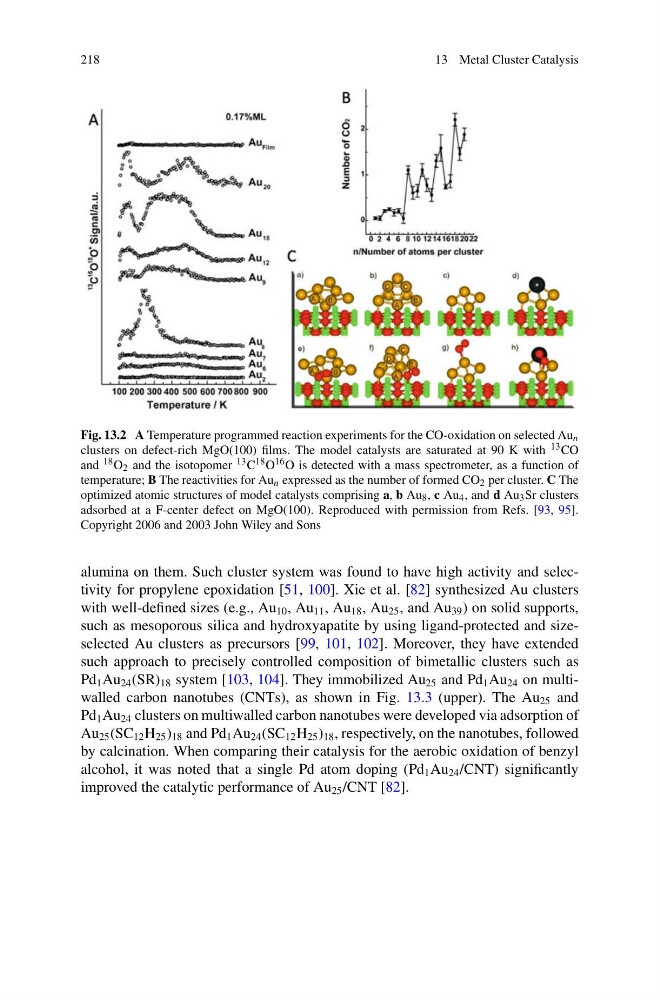
Fig. 13.2 A Temperature programmed reaction experiments for the CO-oxidation on selected Au n
clusters on defect-rich MgO(100) films. The model catalysts are saturated at 90 K with 13 CO
and 18 O 2 and the isotopomer 13 C 18 O 16 O is detected with a mass spectrometer, as a function of
temperature; B The reactivities for Au n expressed as the number of formed CO 2 per cluster. C The
optimized atomic structures of model catalysts comprising a, b Au 8 , c Au 4 , and d Au 3 Sr clusters
adsorbed at a F-center defect on MgO(100). Reproduced with permission from Refs. [93, 95].
Copyright 2006 and 2003 John Wiley and Sons
alumina on them. Such cluster system was found to have high activity and selectivity for propylene epoxidation [51, 100]. Xie et al. [82] synthesized Au clusters
with well-defined sizes (e.g., Au 10 , Au 11 , Au 18 , Au 25 , and Au 39 ) on solid supports,
such as mesoporous silica and hydroxyapatite by using ligand-protected and sizeselected Au clusters as precursors [99, 101, 102]. Moreover, they have extended
such approach to precisely controlled composition of bimetallic clusters such as
Pd 1 Au 24 (SR) 18 system [103, 104]. They immobilized Au 25 and Pd 1 Au 24 on multiwalled carbon nanotubes (CNTs), as shown in Fig. 13.3 (upper). The Au 25 and
Pd 1 Au 24 clusters on multiwalled carbon nanotubes were developed via adsorption of
Au 25 (SC 12 H 25 ) 18 and Pd 1 Au 24 (SC 12 H 25 ) 18 , respectively, on the nanotubes, followed
by calcination. When comparing their catalysis for the aerobic oxidation of benzyl
alcohol, it was noted that a single Pd atom doping (Pd 1 Au 24 /CNT) significantly
improved the catalytic performance of Au 25 /CNT [82].
13 Metal Cluster Catalysis
Fig. 13.2 A Temperature programmed reaction experiments for the CO-oxidation on selected Au n
clusters on defect-rich MgO(100) films. The model catalysts are saturated at 90 K with 13 CO
and 18 O 2 and the isotopomer 13 C 18 O 16 O is detected with a mass spectrometer, as a function of
temperature; B The reactivities for Au n expressed as the number of formed CO 2 per cluster. C The
optimized atomic structures of model catalysts comprising a, b Au 8 , c Au 4 , and d Au 3 Sr clusters
adsorbed at a F-center defect on MgO(100). Reproduced with permission from Refs. [93, 95].
Copyright 2006 and 2003 John Wiley and Sons
alumina on them. Such cluster system was found to have high activity and selectivity for propylene epoxidation [51, 100]. Xie et al. [82] synthesized Au clusters
with well-defined sizes (e.g., Au 10 , Au 11 , Au 18 , Au 25 , and Au 39 ) on solid supports,
such as mesoporous silica and hydroxyapatite by using ligand-protected and sizeselected Au clusters as precursors [99, 101, 102]. Moreover, they have extended
such approach to precisely controlled composition of bimetallic clusters such as
Pd 1 Au 24 (SR) 18 system [103, 104]. They immobilized Au 25 and Pd 1 Au 24 on multiwalled carbon nanotubes (CNTs), as shown in Fig. 13.3 (upper). The Au 25 and
Pd 1 Au 24 clusters on multiwalled carbon nanotubes were developed via adsorption of
Au 25 (SC 12 H 25 ) 18 and Pd 1 Au 24 (SC 12 H 25 ) 18 , respectively, on the nanotubes, followed
by calcination. When comparing their catalysis for the aerobic oxidation of benzyl
alcohol, it was noted that a single Pd atom doping (Pd 1 Au 24 /CNT) significantly
improved the catalytic performance of Au 25 /CNT [82].