

13.2 Gold Cluster Catalysis
217
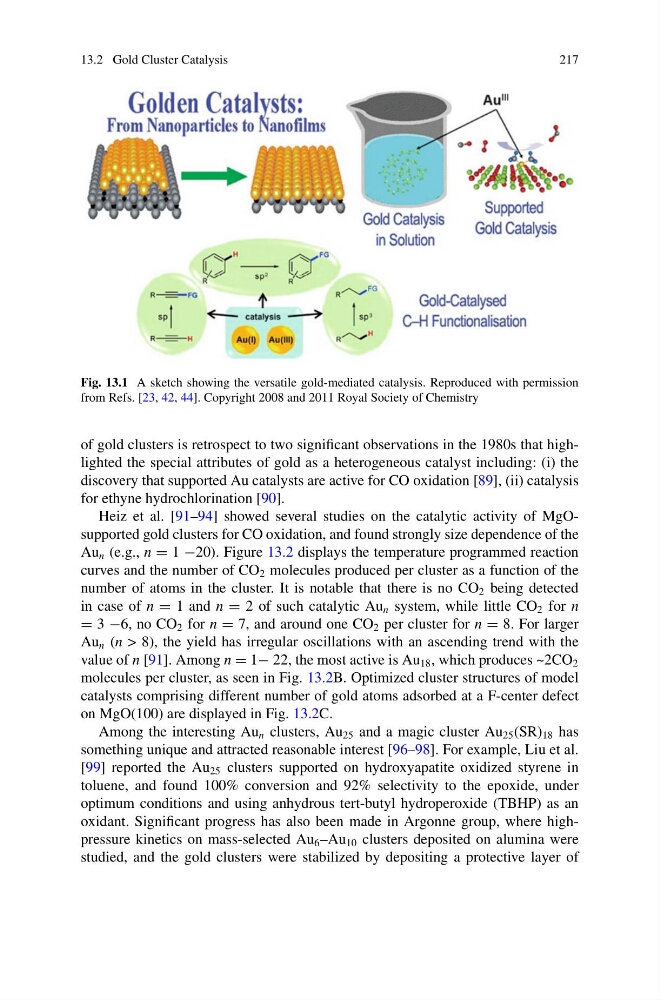
Fig. 13.1 A sketch showing the versatile gold-mediated catalysis. Reproduced with permission
from Refs. [23, 42, 44]. Copyright 2008 and 2011 Royal Society of Chemistry
of gold clusters is retrospect to two significant observations in the 1980s that highlighted the special attributes of gold as a heterogeneous catalyst including: (i) the
discovery that supported Au catalysts are active for CO oxidation [89], (ii) catalysis
for ethyne hydrochlorination [90].
Heiz et al. [91–94] showed several studies on the catalytic activity of MgOsupported gold clusters for CO oxidation, and found strongly size dependence of the
Au n (e.g., n = 1 −20). Figure 13.2 displays the temperature programmed reaction
curves and the number of CO 2 molecules produced per cluster as a function of the
number of atoms in the cluster. It is notable that there is no CO 2 being detected
in case of n = 1 and n = 2 of such catalytic Au n system, while little CO 2 for n
= 3 −6, no CO 2 for n = 7, and around one CO 2 per cluster for n = 8. For larger
Au n (n > 8), the yield has irregular oscillations with an ascending trend with the
value of n [91]. Among n = 1− 22, the most active is Au 18 , which produces ~2CO 2
molecules per cluster, as seen in Fig. 13.2B. Optimized cluster structures of model
catalysts comprising different number of gold atoms adsorbed at a F-center defect
on MgO(100) are displayed in Fig. 13.2C.
Among the interesting Au n clusters, Au 25 and a magic cluster Au 25 (SR) 18 has
something unique and attracted reasonable interest [96–98]. For example, Liu et al.
[99] reported the Au 25 clusters supported on hydroxyapatite oxidized styrene in
toluene, and found 100% conversion and 92% selectivity to the epoxide, under
optimum conditions and using anhydrous tert-butyl hydroperoxide (TBHP) as an
oxidant. Significant progress has also been made in Argonne group, where highpressure kinetics on mass-selected Au 6 –Au 10 clusters deposited on alumina were
studied, and the gold clusters were stabilized by depositing a protective layer of
217
Fig. 13.1 A sketch showing the versatile gold-mediated catalysis. Reproduced with permission
from Refs. [23, 42, 44]. Copyright 2008 and 2011 Royal Society of Chemistry
of gold clusters is retrospect to two significant observations in the 1980s that highlighted the special attributes of gold as a heterogeneous catalyst including: (i) the
discovery that supported Au catalysts are active for CO oxidation [89], (ii) catalysis
for ethyne hydrochlorination [90].
Heiz et al. [91–94] showed several studies on the catalytic activity of MgOsupported gold clusters for CO oxidation, and found strongly size dependence of the
Au n (e.g., n = 1 −20). Figure 13.2 displays the temperature programmed reaction
curves and the number of CO 2 molecules produced per cluster as a function of the
number of atoms in the cluster. It is notable that there is no CO 2 being detected
in case of n = 1 and n = 2 of such catalytic Au n system, while little CO 2 for n
= 3 −6, no CO 2 for n = 7, and around one CO 2 per cluster for n = 8. For larger
Au n (n > 8), the yield has irregular oscillations with an ascending trend with the
value of n [91]. Among n = 1− 22, the most active is Au 18 , which produces ~2CO 2
molecules per cluster, as seen in Fig. 13.2B. Optimized cluster structures of model
catalysts comprising different number of gold atoms adsorbed at a F-center defect
on MgO(100) are displayed in Fig. 13.2C.
Among the interesting Au n clusters, Au 25 and a magic cluster Au 25 (SR) 18 has
something unique and attracted reasonable interest [96–98]. For example, Liu et al.
[99] reported the Au 25 clusters supported on hydroxyapatite oxidized styrene in
toluene, and found 100% conversion and 92% selectivity to the epoxide, under
optimum conditions and using anhydrous tert-butyl hydroperoxide (TBHP) as an
oxidant. Significant progress has also been made in Argonne group, where highpressure kinetics on mass-selected Au 6 –Au 10 clusters deposited on alumina were
studied, and the gold clusters were stabilized by depositing a protective layer of