

12.3 The Harpoon Mechanism
207
For the [Ag 8·· Cl 2 ]
– and [Cu 8·· Cl 2 ]
– systems, a solution to Eq. 12.19 was calculated
by utilizing Mathematica software, and subsequently, two curves representing the
attractive potential and the repulsive potential were plotted based on this solution,
as shown in Fig. 12.8g, h. For “[Ag 8 ]
–
+ Cl 2 ” (Fig. 12.8g), the intersection of
the two curves is at r
∗
1 = 8.71 ´
Å. Based on intersection, the reactive cross section
was calculated as σ
∗
1 = π
r
∗
1
2 = 238.33 ´
Å
2 and P
1 =
π
r
∗
1
2
σ 1
= 3.16. (The
accent signs refer to values calculated using the second DFT method). Similarly, the
calculation results show that the crossing of the two potential curves for the system
of “[Cu 8 ]
–
+ Cl 2 ” (Fig. 12.8h) occurs at r
∗
1 = 8.64 ´
Å, which indicates a cross section
of σ
∗
2 = π
r
∗
2
2 = 234.52 ´
Å and a P
2 = 3.68.
The optimized ground-state structure of [Cu 8 ]
– bears the same symmetry (C 2v )
as [Ag 8 ]
– and [Cu 8 Cl]
– exhibits a similar structure to [Ag 8 Cl]
– [126, 127]. Considering E = E(M 8 ) + E(Cl 2 )−E(M 8 Cl)−E(Cl), they calculated the energy difference
and found that the reactivities of [Ag 8 ]
– and [Cu 8 ]
– toward Cl 2 are exothermic, as
shown in Fig. 12.8i, j (E Ag = 2.69 eV and E Cu = 3.11 eV respectively from the
calculation). This conforms to the general principles when alkali metals react with
a halogen to produce alkali-halides [128]. While the ground states (
1
+ ) of alkali
halide molecules exhibit the characteristics of a closed valence shell, the alkali-like
halide cluster anions reveal an electronic structure with an electron count similar to a
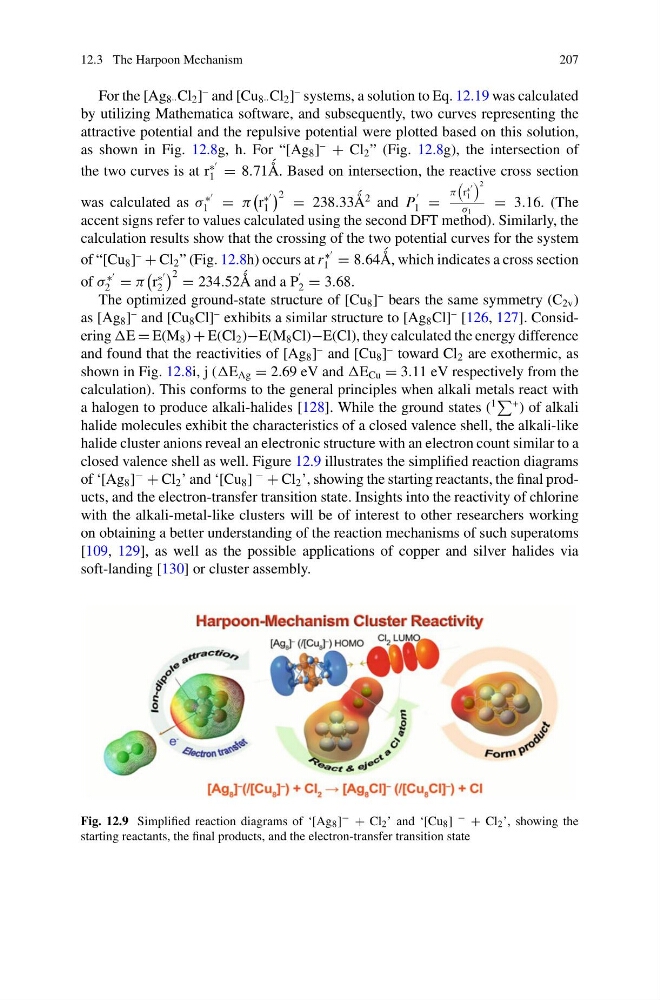
closed valence shell as well. Figure 12.9 illustrates the simplified reaction diagrams
of ‘[Ag 8 ]
−
+ Cl 2 ’ and ‘[Cu 8 ]
−
+ Cl 2 ’, showing the starting reactants, the final products, and the electron-transfer transition state. Insights into the reactivity of chlorine
with the alkali-metal-like clusters will be of interest to other researchers working
on obtaining a better understanding of the reaction mechanisms of such superatoms
[109, 129], as well as the possible applications of copper and silver halides via
soft-landing [130] or cluster assembly.
Fig. 12.9 Simplified reaction diagrams of ‘[Ag 8 ] − + Cl 2 ’ and ‘[Cu 8 ] − + Cl 2 ’, showing the
starting reactants, the final products, and the electron-transfer transition state
207
For the [Ag 8·· Cl 2 ]
– and [Cu 8·· Cl 2 ]
– systems, a solution to Eq. 12.19 was calculated
by utilizing Mathematica software, and subsequently, two curves representing the
attractive potential and the repulsive potential were plotted based on this solution,
as shown in Fig. 12.8g, h. For “[Ag 8 ]
–
+ Cl 2 ” (Fig. 12.8g), the intersection of
the two curves is at r
∗
1 = 8.71 ´
Å. Based on intersection, the reactive cross section
was calculated as σ
∗
1 = π
r
∗
1
2 = 238.33 ´
Å
2 and P
1 =
π
r
∗
1
2
σ 1
= 3.16. (The
accent signs refer to values calculated using the second DFT method). Similarly, the
calculation results show that the crossing of the two potential curves for the system
of “[Cu 8 ]
–
+ Cl 2 ” (Fig. 12.8h) occurs at r
∗
1 = 8.64 ´
Å, which indicates a cross section
of σ
∗
2 = π
r
∗
2
2 = 234.52 ´
Å and a P
2 = 3.68.
The optimized ground-state structure of [Cu 8 ]
– bears the same symmetry (C 2v )
as [Ag 8 ]
– and [Cu 8 Cl]
– exhibits a similar structure to [Ag 8 Cl]
– [126, 127]. Considering E = E(M 8 ) + E(Cl 2 )−E(M 8 Cl)−E(Cl), they calculated the energy difference
and found that the reactivities of [Ag 8 ]
– and [Cu 8 ]
– toward Cl 2 are exothermic, as
shown in Fig. 12.8i, j (E Ag = 2.69 eV and E Cu = 3.11 eV respectively from the
calculation). This conforms to the general principles when alkali metals react with
a halogen to produce alkali-halides [128]. While the ground states (
1
+ ) of alkali
halide molecules exhibit the characteristics of a closed valence shell, the alkali-like
halide cluster anions reveal an electronic structure with an electron count similar to a
closed valence shell as well. Figure 12.9 illustrates the simplified reaction diagrams
of ‘[Ag 8 ]
−
+ Cl 2 ’ and ‘[Cu 8 ]
−
+ Cl 2 ’, showing the starting reactants, the final products, and the electron-transfer transition state. Insights into the reactivity of chlorine
with the alkali-metal-like clusters will be of interest to other researchers working
on obtaining a better understanding of the reaction mechanisms of such superatoms
[109, 129], as well as the possible applications of copper and silver halides via
soft-landing [130] or cluster assembly.
Fig. 12.9 Simplified reaction diagrams of ‘[Ag 8 ] − + Cl 2 ’ and ‘[Cu 8 ] − + Cl 2 ’, showing the
starting reactants, the final products, and the electron-transfer transition state