

208
12 Charge Transfer and the Harpoon Mechanism
12.4 Dependence on the Ionization Energy
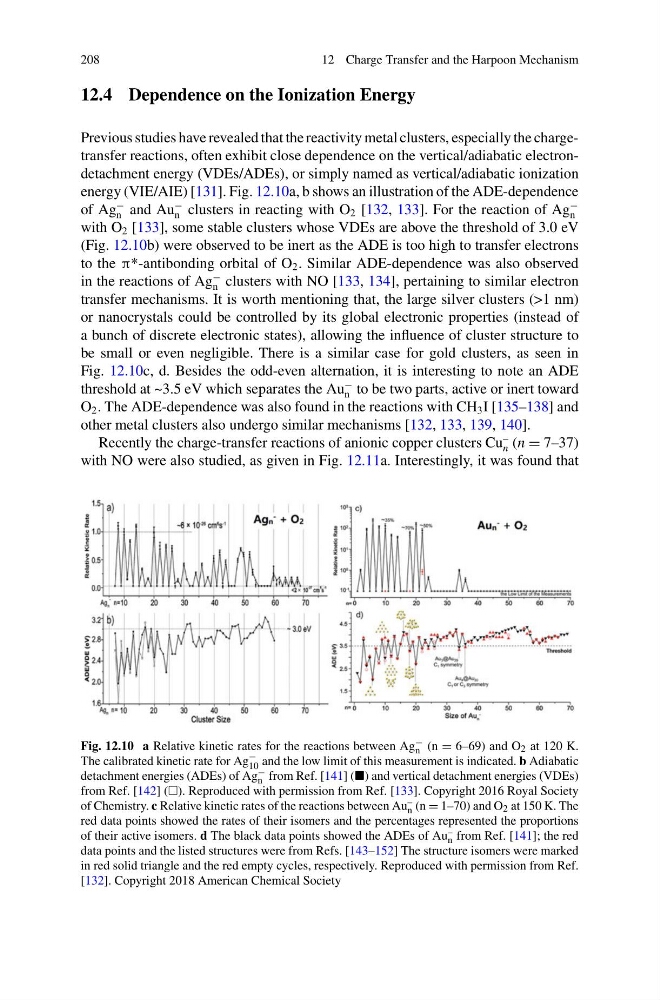
Previous studies have revealed that the reactivity metal clusters, especially the chargetransfer reactions, often exhibit close dependence on the vertical/adiabatic electrondetachment energy (VDEs/ADEs), or simply named as vertical/adiabatic ionization
energy (VIE/AIE) [131]. Fig. 12.10a, b shows an illustration of the ADE-dependence
of Ag
−
n and Au
−
n clusters in reacting with O 2 [132, 133]. For the reaction of Ag
−
n
with O 2 [133], some stable clusters whose VDEs are above the threshold of 3.0 eV
(Fig. 12.10b) were observed to be inert as the ADE is too high to transfer electrons
to the π*-antibonding orbital of O 2 . Similar ADE-dependence was also observed
in the reactions of Ag
−
n clusters with NO [133, 134], pertaining to similar electron
transfer mechanisms. It is worth mentioning that, the large silver clusters (>1 nm)
or nanocrystals could be controlled by its global electronic properties (instead of
a bunch of discrete electronic states), allowing the influence of cluster structure to
be small or even negligible. There is a similar case for gold clusters, as seen in
Fig. 12.10c, d. Besides the odd-even alternation, it is interesting to note an ADE
threshold at ~3.5 eV which separates the Au
−
n to be two parts, active or inert toward
O 2 . The ADE-dependence was also found in the reactions with CH 3 I [135–138] and
other metal clusters also undergo similar mechanisms [132, 133, 139, 140].
Recently the charge-transfer reactions of anionic copper clusters Cu
–
n (n = 7–37)
with NO were also studied, as given in Fig. 12.11a. Interestingly, it was found that
Fig. 12.10 a Relative kinetic rates for the reactions between Ag −
n (n = 6–69) and O 2 at 120 K.
The calibrated kinetic rate for Ag
−
10 and the low limit of this measurement is indicated. b Adiabatic
detachment energies (ADEs) of Ag −
n from Ref. [141] () and vertical detachment energies (VDEs)
from Ref. [142] (). Reproduced with permission from Ref. [133]. Copyright 2016 Royal Society
of Chemistry. c Relative kinetic rates of the reactions between Au –
n (n = 1–70) and O 2 at 150 K. The
red data points showed the rates of their isomers and the percentages represented the proportions
of their active isomers. d The black data points showed the ADEs of Au –
n from Ref. [141]; the red
data points and the listed structures were from Refs. [143–152] The structure isomers were marked
in red solid triangle and the red empty cycles, respectively. Reproduced with permission from Ref.
[132]. Copyright 2018 American Chemical Society
12 Charge Transfer and the Harpoon Mechanism
12.4 Dependence on the Ionization Energy
Previous studies have revealed that the reactivity metal clusters, especially the chargetransfer reactions, often exhibit close dependence on the vertical/adiabatic electrondetachment energy (VDEs/ADEs), or simply named as vertical/adiabatic ionization
energy (VIE/AIE) [131]. Fig. 12.10a, b shows an illustration of the ADE-dependence
of Ag
−
n and Au
−
n clusters in reacting with O 2 [132, 133]. For the reaction of Ag
−
n
with O 2 [133], some stable clusters whose VDEs are above the threshold of 3.0 eV
(Fig. 12.10b) were observed to be inert as the ADE is too high to transfer electrons
to the π*-antibonding orbital of O 2 . Similar ADE-dependence was also observed
in the reactions of Ag
−
n clusters with NO [133, 134], pertaining to similar electron
transfer mechanisms. It is worth mentioning that, the large silver clusters (>1 nm)
or nanocrystals could be controlled by its global electronic properties (instead of
a bunch of discrete electronic states), allowing the influence of cluster structure to
be small or even negligible. There is a similar case for gold clusters, as seen in
Fig. 12.10c, d. Besides the odd-even alternation, it is interesting to note an ADE
threshold at ~3.5 eV which separates the Au
−
n to be two parts, active or inert toward
O 2 . The ADE-dependence was also found in the reactions with CH 3 I [135–138] and
other metal clusters also undergo similar mechanisms [132, 133, 139, 140].
Recently the charge-transfer reactions of anionic copper clusters Cu
–
n (n = 7–37)
with NO were also studied, as given in Fig. 12.11a. Interestingly, it was found that
Fig. 12.10 a Relative kinetic rates for the reactions between Ag −
n (n = 6–69) and O 2 at 120 K.
The calibrated kinetic rate for Ag
−
10 and the low limit of this measurement is indicated. b Adiabatic
detachment energies (ADEs) of Ag −
n from Ref. [141] () and vertical detachment energies (VDEs)
from Ref. [142] (). Reproduced with permission from Ref. [133]. Copyright 2016 Royal Society
of Chemistry. c Relative kinetic rates of the reactions between Au –
n (n = 1–70) and O 2 at 150 K. The
red data points showed the rates of their isomers and the percentages represented the proportions
of their active isomers. d The black data points showed the ADEs of Au –
n from Ref. [141]; the red
data points and the listed structures were from Refs. [143–152] The structure isomers were marked
in red solid triangle and the red empty cycles, respectively. Reproduced with permission from Ref.
[132]. Copyright 2018 American Chemical Society