

12.3 The Harpoon Mechanism
205
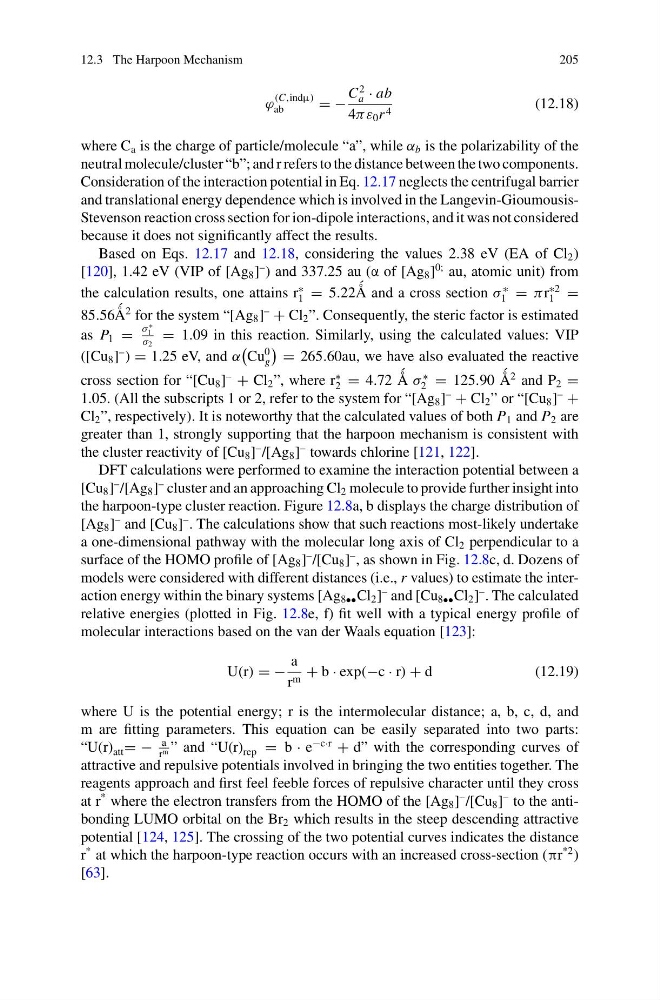
ϕ
(C,indμ)
ab
= −
C
2
a · ab
4πε 0 r 4
(12.18)
where C a is the charge of particle/molecule “a”, while α b is the polarizability of the
neutral molecule/cluster “b”; and r refers to the distance between the two components.
Consideration of the interaction potential in Eq. 12.17 neglects the centrifugal barrier
and translational energy dependence which is involved in the Langevin-GioumousisStevenson reaction cross section for ion-dipole interactions, and it was not considered
because it does not significantly affect the results.
Based on Eqs. 12.17 and 12.18, considering the values 2.38 eV (EA of Cl 2 )
[120], 1.42 eV (VIP of [Ag 8 ]
– ) and 337.25 au (α of [Ag 8 ]
0; au, atomic unit) from
the calculation results, one attains r
∗
1 = 5.22 ´
Å and a cross section σ
∗
1 = π r
∗2
1 =
85.56 ´
Å
2 for the system “[Ag 8 ]
–
+ Cl 2 ”. Consequently, the steric factor is estimated
as P 1 =
σ
∗
1
σ 2
= 1.09 in this reaction. Similarly, using the calculated values: VIP
([Cu 8 ]
– ) = 1.25 eV, and α
Cu
0
g
= 265.60au, we have also evaluated the reactive
cross section for “[Cu 8 ]
–
+ Cl 2 ”, where r
∗
2 = 4.72 ´
Å σ
∗
2 = 125.90 ´
Å
2 and P 2 =
1.05. (All the subscripts 1 or 2, refer to the system for “[Ag 8 ]
–
+ Cl 2 ” or “[Cu 8 ]
–
+
Cl 2 ”, respectively). It is noteworthy that the calculated values of both P 1 and P 2 are
greater than 1, strongly supporting that the harpoon mechanism is consistent with
the cluster reactivity of [Cu 8 ]
– /[Ag 8 ]
– towards chlorine [121, 122].
DFT calculations were performed to examine the interaction potential between a
[Cu 8 ]
– /[Ag 8 ]
– cluster and an approaching Cl 2 molecule to provide further insight into
the harpoon-type cluster reaction. Figure 12.8a, b displays the charge distribution of
[Ag 8 ]
– and [Cu 8 ]
– . The calculations show that such reactions most-likely undertake
a one-dimensional pathway with the molecular long axis of Cl 2 perpendicular to a
surface of the HOMO profile of [Ag 8 ]
– /[Cu 8 ]
– , as shown in Fig. 12.8c, d. Dozens of
models were considered with different distances (i.e., r values) to estimate the interaction energy within the binary systems [Ag 8•• Cl 2 ]
– and [Cu 8•• Cl 2 ]
– . The calculated
relative energies (plotted in Fig. 12.8e, f) fit well with a typical energy profile of
molecular interactions based on the van der Waals equation [123]:
U(r) = −
a
r m + b · exp(−c · r) + d
(12.19)
where U is the potential energy; r is the intermolecular distance; a, b, c, d, and
m are fitting parameters. This equation can be easily separated into two parts:
“U(r) att = −
a
r m ” and “U(r) rep = b · e
−c·r
+ d” with the corresponding curves of
attractive and repulsive potentials involved in bringing the two entities together. The
reagents approach and first feel feeble forces of repulsive character until they cross
at r
* where the electron transfers from the HOMO of the [Ag 8 ]
– /[Cu 8 ]
– to the antibonding LUMO orbital on the Br 2 which results in the steep descending attractive
potential [124, 125]. The crossing of the two potential curves indicates the distance
r
* at which the harpoon-type reaction occurs with an increased cross-section (πr
*2 )
[63].
205
ϕ
(C,indμ)
ab
= −
C
2
a · ab
4πε 0 r 4
(12.18)
where C a is the charge of particle/molecule “a”, while α b is the polarizability of the
neutral molecule/cluster “b”; and r refers to the distance between the two components.
Consideration of the interaction potential in Eq. 12.17 neglects the centrifugal barrier
and translational energy dependence which is involved in the Langevin-GioumousisStevenson reaction cross section for ion-dipole interactions, and it was not considered
because it does not significantly affect the results.
Based on Eqs. 12.17 and 12.18, considering the values 2.38 eV (EA of Cl 2 )
[120], 1.42 eV (VIP of [Ag 8 ]
– ) and 337.25 au (α of [Ag 8 ]
0; au, atomic unit) from
the calculation results, one attains r
∗
1 = 5.22 ´
Å and a cross section σ
∗
1 = π r
∗2
1 =
85.56 ´
Å
2 for the system “[Ag 8 ]
–
+ Cl 2 ”. Consequently, the steric factor is estimated
as P 1 =
σ
∗
1
σ 2
= 1.09 in this reaction. Similarly, using the calculated values: VIP
([Cu 8 ]
– ) = 1.25 eV, and α
Cu
0
g
= 265.60au, we have also evaluated the reactive
cross section for “[Cu 8 ]
–
+ Cl 2 ”, where r
∗
2 = 4.72 ´
Å σ
∗
2 = 125.90 ´
Å
2 and P 2 =
1.05. (All the subscripts 1 or 2, refer to the system for “[Ag 8 ]
–
+ Cl 2 ” or “[Cu 8 ]
–
+
Cl 2 ”, respectively). It is noteworthy that the calculated values of both P 1 and P 2 are
greater than 1, strongly supporting that the harpoon mechanism is consistent with
the cluster reactivity of [Cu 8 ]
– /[Ag 8 ]
– towards chlorine [121, 122].
DFT calculations were performed to examine the interaction potential between a
[Cu 8 ]
– /[Ag 8 ]
– cluster and an approaching Cl 2 molecule to provide further insight into
the harpoon-type cluster reaction. Figure 12.8a, b displays the charge distribution of
[Ag 8 ]
– and [Cu 8 ]
– . The calculations show that such reactions most-likely undertake
a one-dimensional pathway with the molecular long axis of Cl 2 perpendicular to a
surface of the HOMO profile of [Ag 8 ]
– /[Cu 8 ]
– , as shown in Fig. 12.8c, d. Dozens of
models were considered with different distances (i.e., r values) to estimate the interaction energy within the binary systems [Ag 8•• Cl 2 ]
– and [Cu 8•• Cl 2 ]
– . The calculated
relative energies (plotted in Fig. 12.8e, f) fit well with a typical energy profile of
molecular interactions based on the van der Waals equation [123]:
U(r) = −
a
r m + b · exp(−c · r) + d
(12.19)
where U is the potential energy; r is the intermolecular distance; a, b, c, d, and
m are fitting parameters. This equation can be easily separated into two parts:
“U(r) att = −
a
r m ” and “U(r) rep = b · e
−c·r
+ d” with the corresponding curves of
attractive and repulsive potentials involved in bringing the two entities together. The
reagents approach and first feel feeble forces of repulsive character until they cross
at r
* where the electron transfers from the HOMO of the [Ag 8 ]
– /[Cu 8 ]
– to the antibonding LUMO orbital on the Br 2 which results in the steep descending attractive
potential [124, 125]. The crossing of the two potential curves indicates the distance
r
* at which the harpoon-type reaction occurs with an increased cross-section (πr
*2 )
[63].