

204
12 Charge Transfer and the Harpoon Mechanism
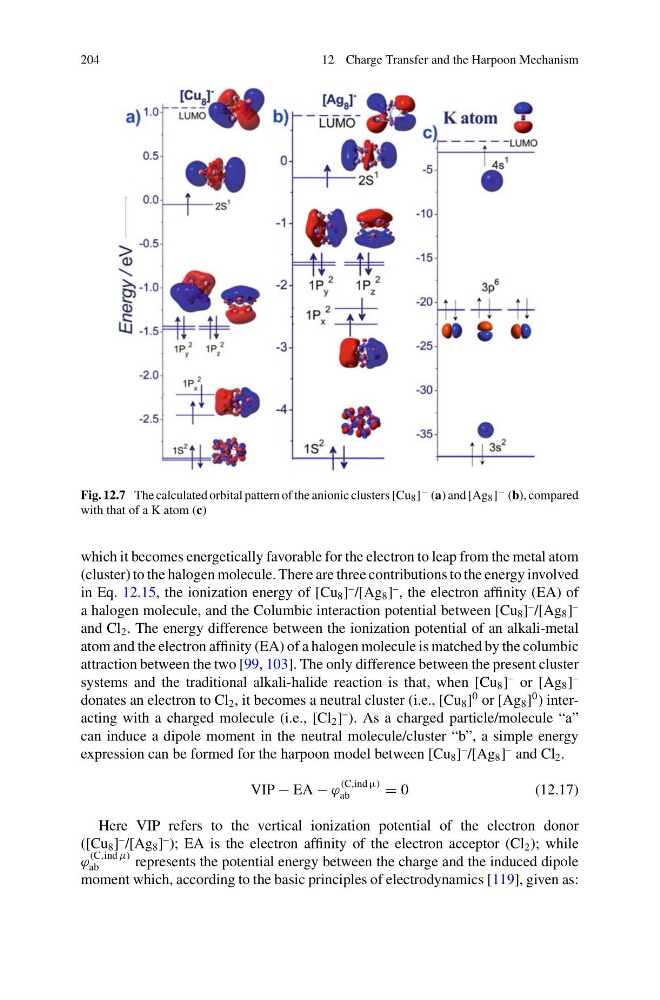
Fig. 12.7 The calculated orbital pattern of the anionic clusters [Cu 8 ] − (a) and [Ag 8 ] − (b), compared
with that of a K atom (c)
which it becomes energetically favorable for the electron to leap from the metal atom
(cluster) to the halogen molecule. There are three contributions to the energy involved
in Eq. 12.15, the ionization energy of [Cu 8 ]
– /[Ag 8 ]
– , the electron affinity (EA) of
a halogen molecule, and the Columbic interaction potential between [Cu 8 ]
– /[Ag 8 ]
–
and Cl 2 . The energy difference between the ionization potential of an alkali-metal
atom and the electron affinity (EA) of a halogen molecule is matched by the columbic
attraction between the two [99, 103]. The only difference between the present cluster
systems and the traditional alkali-halide reaction is that, when [Cu 8 ]
– or [Ag 8 ]
–
donates an electron to Cl 2 , it becomes a neutral cluster (i.e., [Cu 8 ]
0 or [Ag 8 ]
0 ) interacting with a charged molecule (i.e., [Cl 2 ]
– ). As a charged particle/molecule “a”
can induce a dipole moment in the neutral molecule/cluster “b”, a simple energy
expression can be formed for the harpoon model between [Cu 8 ]
– /[Ag 8 ]
– and Cl 2 .
VIP − EA − ϕ
(C,ind μ)
ab
= 0
(12.17)
Here VIP refers to the vertical ionization potential of the electron donor
([Cu 8 ]
– /[Ag 8 ]
– ); EA is the electron affinity of the electron acceptor (Cl 2 ); while
ϕ
(C,ind μ)
ab
represents the potential energy between the charge and the induced dipole
moment which, according to the basic principles of electrodynamics [119], given as:
12 Charge Transfer and the Harpoon Mechanism
Fig. 12.7 The calculated orbital pattern of the anionic clusters [Cu 8 ] − (a) and [Ag 8 ] − (b), compared
with that of a K atom (c)
which it becomes energetically favorable for the electron to leap from the metal atom
(cluster) to the halogen molecule. There are three contributions to the energy involved
in Eq. 12.15, the ionization energy of [Cu 8 ]
– /[Ag 8 ]
– , the electron affinity (EA) of
a halogen molecule, and the Columbic interaction potential between [Cu 8 ]
– /[Ag 8 ]
–
and Cl 2 . The energy difference between the ionization potential of an alkali-metal
atom and the electron affinity (EA) of a halogen molecule is matched by the columbic
attraction between the two [99, 103]. The only difference between the present cluster
systems and the traditional alkali-halide reaction is that, when [Cu 8 ]
– or [Ag 8 ]
–
donates an electron to Cl 2 , it becomes a neutral cluster (i.e., [Cu 8 ]
0 or [Ag 8 ]
0 ) interacting with a charged molecule (i.e., [Cl 2 ]
– ). As a charged particle/molecule “a”
can induce a dipole moment in the neutral molecule/cluster “b”, a simple energy
expression can be formed for the harpoon model between [Cu 8 ]
– /[Ag 8 ]
– and Cl 2 .
VIP − EA − ϕ
(C,ind μ)
ab
= 0
(12.17)
Here VIP refers to the vertical ionization potential of the electron donor
([Cu 8 ]
– /[Ag 8 ]
– ); EA is the electron affinity of the electron acceptor (Cl 2 ); while
ϕ
(C,ind μ)
ab
represents the potential energy between the charge and the induced dipole
moment which, according to the basic principles of electrodynamics [119], given as: