

12.3 The Harpoon Mechanism
203
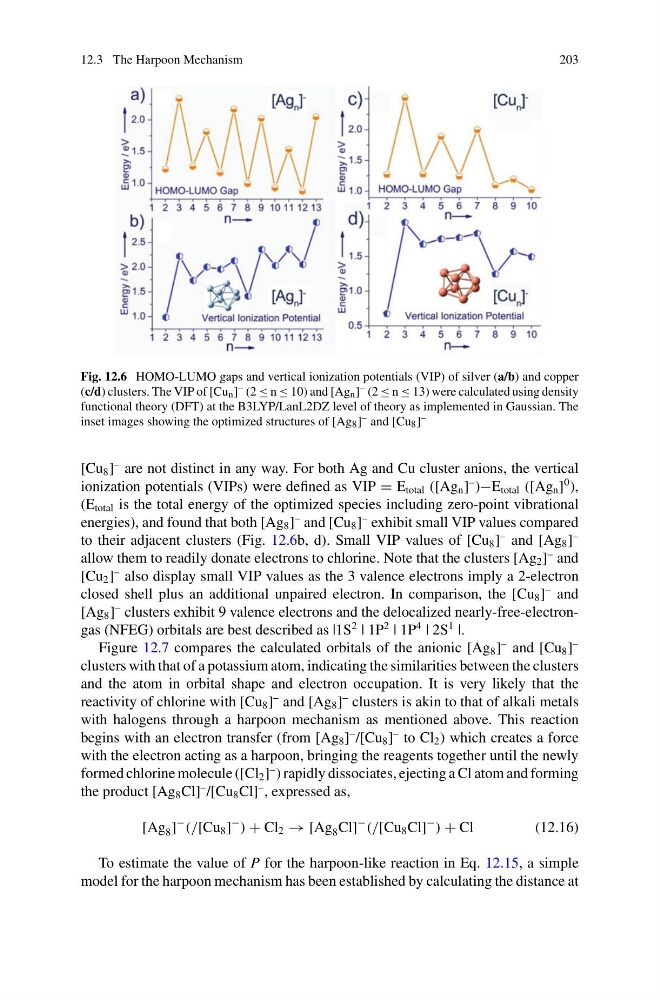
Fig. 12.6 HOMO-LUMO gaps and vertical ionization potentials (VIP) of silver (a/b) and copper
(c/d) clusters. The VIP of [Cu n ] – (2 ≤ n ≤ 10) and [Ag n ] – (2 ≤ n ≤ 13) were calculated using density
functional theory (DFT) at the B3LYP/LanL2DZ level of theory as implemented in Gaussian. The
inset images showing the optimized structures of [Ag 8 ] – and [Cu 8 ] –
[Cu 8 ]
– are not distinct in any way. For both Ag and Cu cluster anions, the vertical
ionization potentials (VIPs) were defined as VIP = E total ([Ag n ]
– )−E total ([Ag n ]
0 ),
(E total is the total energy of the optimized species including zero-point vibrational
energies), and found that both [Ag 8 ]
– and [Cu 8 ]
– exhibit small VIP values compared
to their adjacent clusters (Fig. 12.6b, d). Small VIP values of [Cu 8 ]
– and [Ag 8 ]
–
allow them to readily donate electrons to chlorine. Note that the clusters [Ag 2 ]
– and
[Cu 2 ]
– also display small VIP values as the 3 valence electrons imply a 2-electron
closed shell plus an additional unpaired electron. In comparison, the [Cu 8 ]
– and
[Ag 8 ]
– clusters exhibit 9 valence electrons and the delocalized nearly-free-electrongas (NFEG) orbitals are best described as |1S
2 | 1P
2 | 1P
4 | 2S
1 |.
Figure 12.7 compares the calculated orbitals of the anionic [Ag 8 ]
– and [Cu 8 ]
–
clusters with that of a potassium atom, indicating the similarities between the clusters
and the atom in orbital shape and electron occupation. It is very likely that the
reactivity of chlorine with [Cu 8 ]
– and [Ag 8 ]
– clusters is akin to that of alkali metals
with halogens through a harpoon mechanism as mentioned above. This reaction
begins with an electron transfer (from [Ag 8 ]
– /[Cu 8 ]
– to Cl 2 ) which creates a force
with the electron acting as a harpoon, bringing the reagents together until the newly
formed chlorine molecule ([Cl 2 ]
– ) rapidly dissociates, ejecting a Cl atom and forming
the product [Ag 8 Cl]
– /[Cu 8 Cl]
– , expressed as,
[Ag 8 ]
−
(/[Cu 8 ]
−
) + Cl 2 → [Ag 8 Cl]
−
(/[Cu 8 Cl]
−
) + Cl
(12.16)
To estimate the value of P for the harpoon-like reaction in Eq. 12.15, a simple
model for the harpoon mechanism has been established by calculating the distance at
203
Fig. 12.6 HOMO-LUMO gaps and vertical ionization potentials (VIP) of silver (a/b) and copper
(c/d) clusters. The VIP of [Cu n ] – (2 ≤ n ≤ 10) and [Ag n ] – (2 ≤ n ≤ 13) were calculated using density
functional theory (DFT) at the B3LYP/LanL2DZ level of theory as implemented in Gaussian. The
inset images showing the optimized structures of [Ag 8 ] – and [Cu 8 ] –
[Cu 8 ]
– are not distinct in any way. For both Ag and Cu cluster anions, the vertical
ionization potentials (VIPs) were defined as VIP = E total ([Ag n ]
– )−E total ([Ag n ]
0 ),
(E total is the total energy of the optimized species including zero-point vibrational
energies), and found that both [Ag 8 ]
– and [Cu 8 ]
– exhibit small VIP values compared
to their adjacent clusters (Fig. 12.6b, d). Small VIP values of [Cu 8 ]
– and [Ag 8 ]
–
allow them to readily donate electrons to chlorine. Note that the clusters [Ag 2 ]
– and
[Cu 2 ]
– also display small VIP values as the 3 valence electrons imply a 2-electron
closed shell plus an additional unpaired electron. In comparison, the [Cu 8 ]
– and
[Ag 8 ]
– clusters exhibit 9 valence electrons and the delocalized nearly-free-electrongas (NFEG) orbitals are best described as |1S
2 | 1P
2 | 1P
4 | 2S
1 |.
Figure 12.7 compares the calculated orbitals of the anionic [Ag 8 ]
– and [Cu 8 ]
–
clusters with that of a potassium atom, indicating the similarities between the clusters
and the atom in orbital shape and electron occupation. It is very likely that the
reactivity of chlorine with [Cu 8 ]
– and [Ag 8 ]
– clusters is akin to that of alkali metals
with halogens through a harpoon mechanism as mentioned above. This reaction
begins with an electron transfer (from [Ag 8 ]
– /[Cu 8 ]
– to Cl 2 ) which creates a force
with the electron acting as a harpoon, bringing the reagents together until the newly
formed chlorine molecule ([Cl 2 ]
– ) rapidly dissociates, ejecting a Cl atom and forming
the product [Ag 8 Cl]
– /[Cu 8 Cl]
– , expressed as,
[Ag 8 ]
−
(/[Cu 8 ]
−
) + Cl 2 → [Ag 8 Cl]
−
(/[Cu 8 Cl]
−
) + Cl
(12.16)
To estimate the value of P for the harpoon-like reaction in Eq. 12.15, a simple
model for the harpoon mechanism has been established by calculating the distance at