

202
12 Charge Transfer and the Harpoon Mechanism
[Ag n ]
−
+ Cl 2 → Ag n−1 + [AgCl 2 ]
−
→
(12.13)
[Ag n ]
−
+ Cl 2 → [Ag n Cl 2 ]
−
→
(12.14)
[Ag n ]
−
+ Cl 2 → AgCl + [Ag n−1 Cl]
−
→
(12.15)
where Eq. 12.13 is responsible for the dominant product [AgCl 2 ]
– , while Eqs. 12.14
and 12.15 show the likely pathways in forming [Ag n Cl 2 ]
– and [Ag n Cl]
– , respectively;
also, an additional arrow in each equation indicates possible successive reactions.
Note that the [Ag n Cl]
– and [Ag n Cl 2 ]
– species appearing in the larger mass range (8
≤ n ≤ 14) display an odd-even alternation (Fig. 12.4b). This agrees with previous
theoretical findings that the calculated incremental binding energies, spin excitation
energies, and HOMO-LUMO gaps of [Ag n ]
– clusters all display an even/odd oscillation, which corresponds to their even/odd selective reactivity [118]. As seen in
Fig. 12.4b, the intensity ratio of [Ag 8 Cl]
– to [Ag 8 ]
– is larger than that of the other
observed [Ag n Cl]
– clusters and their correlated [Ag n ]
– product clusters when 8 ≤
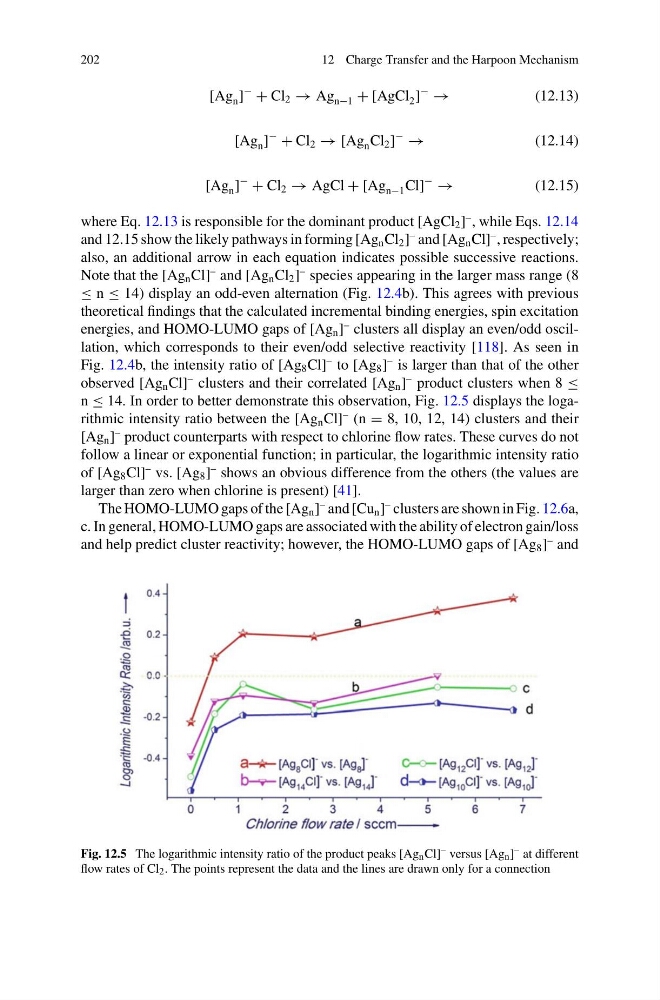
n ≤ 14. In order to better demonstrate this observation, Fig. 12.5 displays the logarithmic intensity ratio between the [Ag n Cl]
– (n = 8, 10, 12, 14) clusters and their
[Ag n ]
– product counterparts with respect to chlorine flow rates. These curves do not
follow a linear or exponential function; in particular, the logarithmic intensity ratio
of [Ag 8 Cl]
– vs. [Ag 8 ]
– shows an obvious difference from the others (the values are
larger than zero when chlorine is present) [41].
The HOMO-LUMO gaps of the [Ag n ]
– and [Cu n ]
– clusters are shown in Fig. 12.6a,
c. In general, HOMO-LUMO gaps are associated with the ability of electron gain/loss
and help predict cluster reactivity; however, the HOMO-LUMO gaps of [Ag 8 ]
– and
Fig. 12.5 The logarithmic intensity ratio of the product peaks [Ag n Cl] – versus [Ag n ] – at different
flow rates of Cl 2 . The points represent the data and the lines are drawn only for a connection
12 Charge Transfer and the Harpoon Mechanism
[Ag n ]
−
+ Cl 2 → Ag n−1 + [AgCl 2 ]
−
→
(12.13)
[Ag n ]
−
+ Cl 2 → [Ag n Cl 2 ]
−
→
(12.14)
[Ag n ]
−
+ Cl 2 → AgCl + [Ag n−1 Cl]
−
→
(12.15)
where Eq. 12.13 is responsible for the dominant product [AgCl 2 ]
– , while Eqs. 12.14
and 12.15 show the likely pathways in forming [Ag n Cl 2 ]
– and [Ag n Cl]
– , respectively;
also, an additional arrow in each equation indicates possible successive reactions.
Note that the [Ag n Cl]
– and [Ag n Cl 2 ]
– species appearing in the larger mass range (8
≤ n ≤ 14) display an odd-even alternation (Fig. 12.4b). This agrees with previous
theoretical findings that the calculated incremental binding energies, spin excitation
energies, and HOMO-LUMO gaps of [Ag n ]
– clusters all display an even/odd oscillation, which corresponds to their even/odd selective reactivity [118]. As seen in
Fig. 12.4b, the intensity ratio of [Ag 8 Cl]
– to [Ag 8 ]
– is larger than that of the other
observed [Ag n Cl]
– clusters and their correlated [Ag n ]
– product clusters when 8 ≤
n ≤ 14. In order to better demonstrate this observation, Fig. 12.5 displays the logarithmic intensity ratio between the [Ag n Cl]
– (n = 8, 10, 12, 14) clusters and their
[Ag n ]
– product counterparts with respect to chlorine flow rates. These curves do not
follow a linear or exponential function; in particular, the logarithmic intensity ratio
of [Ag 8 Cl]
– vs. [Ag 8 ]
– shows an obvious difference from the others (the values are
larger than zero when chlorine is present) [41].
The HOMO-LUMO gaps of the [Ag n ]
– and [Cu n ]
– clusters are shown in Fig. 12.6a,
c. In general, HOMO-LUMO gaps are associated with the ability of electron gain/loss
and help predict cluster reactivity; however, the HOMO-LUMO gaps of [Ag 8 ]
– and
Fig. 12.5 The logarithmic intensity ratio of the product peaks [Ag n Cl] – versus [Ag n ] – at different
flow rates of Cl 2 . The points represent the data and the lines are drawn only for a connection