

12.2 Charge-Transfer Reactions of Clusters
199
that the charge transfer patterns observed for various collisional systems present
similarities, which appear more sensitive to cluster quantum size effects than to
collision energy defects. The σ m and υ m parameters showed differences in both
their size evolution, and their absolute values varied in terms of projectile and target
electronic structures [50, 68].
It is notable that integral and exclusive charge-transfer cross sections can be understood only if all types of fragmentation processes including statistical decay are
considered. Moreover, the influence of the cluster structure (isomers, temperature,
size) on measured and measurable cross sections is associated with the different
charge transfer channels, as well as fragmentation aforementioned in Eq. 12.10 [96].
12.3 The Harpoon Mechanism 1
The harpoon mechanism is properly described in the reactivity of halogens with alkali
metal atoms. One current question is whether the harpoon mechanism can account
for the reactive behavior of microscopic charged systems. In order to examine this
question, a here-to-fore issue is to study the operative mechanism for the reactivity
of coinage metal clusters and chlorine in the gas phase. Gas-phase collision theory
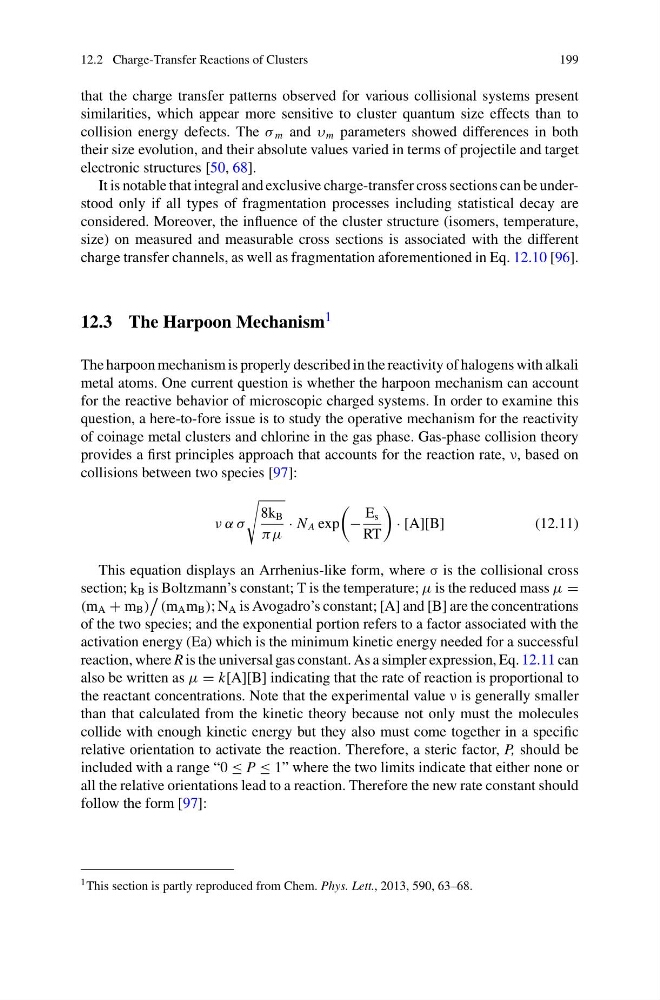
provides a first principles approach that accounts for the reaction rate, ν, based on
collisions between two species [97]:
ν α σ
8k B
πμ
· N A exp
−
E s
RT
· [A][B]
(12.11)
This equation displays an Arrhenius-like form, where σ is the collisional cross
section; k B is Boltzmann’s constant; T is the temperature; μ is the reduced mass μ =
(m A + m B )
(m A m B ); N A is Avogadro’s constant; [A] and [B] are the concentrations
of the two species; and the exponential portion refers to a factor associated with the
activation energy (Ea) which is the minimum kinetic energy needed for a successful
reaction, where R is the universal gas constant. As a simpler expression, Eq. 12.11 can
also be written as μ = k[A][B] indicating that the rate of reaction is proportional to
the reactant concentrations. Note that the experimental value ν is generally smaller
than that calculated from the kinetic theory because not only must the molecules
collide with enough kinetic energy but they also must come together in a specific
relative orientation to activate the reaction. Therefore, a steric factor, P, should be
included with a range “0 ≤ P ≤ 1” where the two limits indicate that either none or
all the relative orientations lead to a reaction. Therefore the new rate constant should
follow the form [97]:
1 This section is partly reproduced from Chem. Phys. Lett., 2013, 590, 63–68.
199
that the charge transfer patterns observed for various collisional systems present
similarities, which appear more sensitive to cluster quantum size effects than to
collision energy defects. The σ m and υ m parameters showed differences in both
their size evolution, and their absolute values varied in terms of projectile and target
electronic structures [50, 68].
It is notable that integral and exclusive charge-transfer cross sections can be understood only if all types of fragmentation processes including statistical decay are
considered. Moreover, the influence of the cluster structure (isomers, temperature,
size) on measured and measurable cross sections is associated with the different
charge transfer channels, as well as fragmentation aforementioned in Eq. 12.10 [96].
12.3 The Harpoon Mechanism 1
The harpoon mechanism is properly described in the reactivity of halogens with alkali
metal atoms. One current question is whether the harpoon mechanism can account
for the reactive behavior of microscopic charged systems. In order to examine this
question, a here-to-fore issue is to study the operative mechanism for the reactivity
of coinage metal clusters and chlorine in the gas phase. Gas-phase collision theory
provides a first principles approach that accounts for the reaction rate, ν, based on
collisions between two species [97]:
ν α σ
8k B
πμ
· N A exp
−
E s
RT
· [A][B]
(12.11)
This equation displays an Arrhenius-like form, where σ is the collisional cross
section; k B is Boltzmann’s constant; T is the temperature; μ is the reduced mass μ =
(m A + m B )
(m A m B ); N A is Avogadro’s constant; [A] and [B] are the concentrations
of the two species; and the exponential portion refers to a factor associated with the
activation energy (Ea) which is the minimum kinetic energy needed for a successful
reaction, where R is the universal gas constant. As a simpler expression, Eq. 12.11 can
also be written as μ = k[A][B] indicating that the rate of reaction is proportional to
the reactant concentrations. Note that the experimental value ν is generally smaller
than that calculated from the kinetic theory because not only must the molecules
collide with enough kinetic energy but they also must come together in a specific
relative orientation to activate the reaction. Therefore, a steric factor, P, should be
included with a range “0 ≤ P ≤ 1” where the two limits indicate that either none or
all the relative orientations lead to a reaction. Therefore the new rate constant should
follow the form [97]:
1 This section is partly reproduced from Chem. Phys. Lett., 2013, 590, 63–68.