

200
12 Charge Transfer and the Harpoon Mechanism
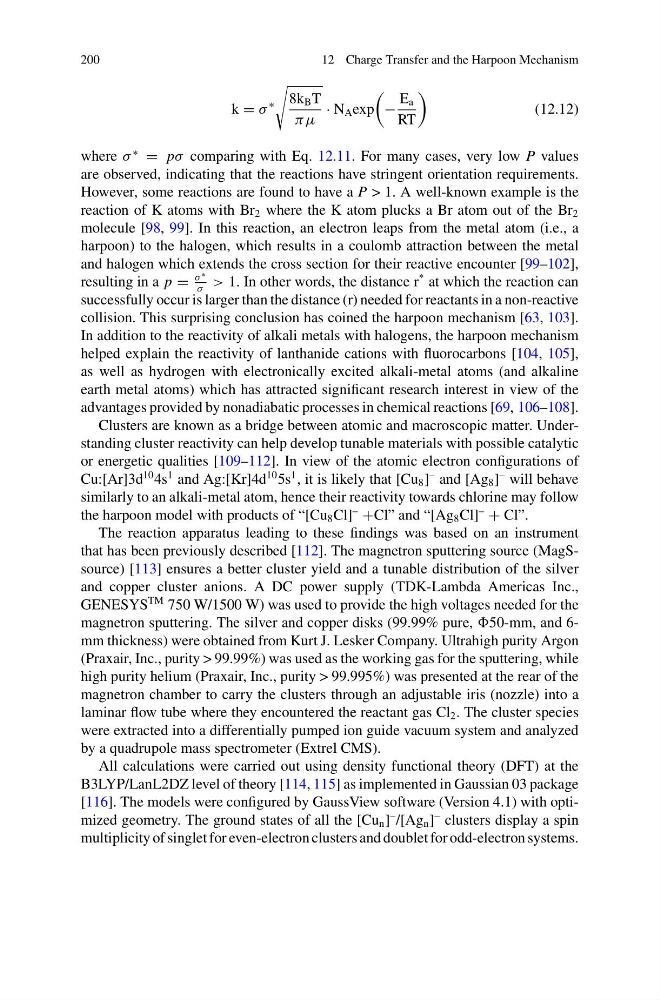
k = σ
∗
8k B T
πμ
· N A exp
−
E a
RT
(12.12)
where σ
∗
= pσ comparing with Eq. 12.11. For many cases, very low P values
are observed, indicating that the reactions have stringent orientation requirements.
However, some reactions are found to have a P > 1. A well-known example is the
reaction of K atoms with Br 2 where the K atom plucks a Br atom out of the Br 2
molecule [98, 99]. In this reaction, an electron leaps from the metal atom (i.e., a
harpoon) to the halogen, which results in a coulomb attraction between the metal
and halogen which extends the cross section for their reactive encounter [99–102],
resulting in a p =
σ
∗
σ
> 1. In other words, the distance r
* at which the reaction can
successfully occur is larger than the distance (r) needed for reactants in a non-reactive
collision. This surprising conclusion has coined the harpoon mechanism [63, 103].
In addition to the reactivity of alkali metals with halogens, the harpoon mechanism
helped explain the reactivity of lanthanide cations with fluorocarbons [104, 105],
as well as hydrogen with electronically excited alkali-metal atoms (and alkaline
earth metal atoms) which has attracted significant research interest in view of the
advantages provided by nonadiabatic processes in chemical reactions [69, 106–108].
Clusters are known as a bridge between atomic and macroscopic matter. Understanding cluster reactivity can help develop tunable materials with possible catalytic
or energetic qualities [109–112]. In view of the atomic electron configurations of
Cu:[Ar]3d
10 4s
1 and Ag:[Kr]4d
10 5s
1 , it is likely that [Cu 8 ]
– and [Ag 8 ]
– will behave
similarly to an alkali-metal atom, hence their reactivity towards chlorine may follow
the harpoon model with products of “[Cu 8 Cl]
–
+Cl” and “[Ag 8 Cl]
–
+ Cl”.
The reaction apparatus leading to these findings was based on an instrument
that has been previously described [112]. The magnetron sputtering source (MagSsource) [113] ensures a better cluster yield and a tunable distribution of the silver
and copper cluster anions. A DC power supply (TDK-Lambda Americas Inc.,
GENESYS
TM 750 W/1500 W) was used to provide the high voltages needed for the
magnetron sputtering. The silver and copper disks (99.99% pure, 50-mm, and 6mm thickness) were obtained from Kurt J. Lesker Company. Ultrahigh purity Argon
(Praxair, Inc., purity > 99.99%) was used as the working gas for the sputtering, while
high purity helium (Praxair, Inc., purity > 99.995%) was presented at the rear of the
magnetron chamber to carry the clusters through an adjustable iris (nozzle) into a
laminar flow tube where they encountered the reactant gas Cl 2 . The cluster species
were extracted into a differentially pumped ion guide vacuum system and analyzed
by a quadrupole mass spectrometer (Extrel CMS).
All calculations were carried out using density functional theory (DFT) at the
B3LYP/LanL2DZ level of theory [114, 115] as implemented in Gaussian 03 package
[116]. The models were configured by GaussView software (Version 4.1) with optimized geometry. The ground states of all the [Cu n ]
– /[Ag n ]
– clusters display a spin
multiplicity of singlet for even-electron clusters and doublet for odd-electron systems.
12 Charge Transfer and the Harpoon Mechanism
k = σ
∗
8k B T
πμ
· N A exp
−
E a
RT
(12.12)
where σ
∗
= pσ comparing with Eq. 12.11. For many cases, very low P values
are observed, indicating that the reactions have stringent orientation requirements.
However, some reactions are found to have a P > 1. A well-known example is the
reaction of K atoms with Br 2 where the K atom plucks a Br atom out of the Br 2
molecule [98, 99]. In this reaction, an electron leaps from the metal atom (i.e., a
harpoon) to the halogen, which results in a coulomb attraction between the metal
and halogen which extends the cross section for their reactive encounter [99–102],
resulting in a p =
σ
∗
σ
> 1. In other words, the distance r
* at which the reaction can
successfully occur is larger than the distance (r) needed for reactants in a non-reactive
collision. This surprising conclusion has coined the harpoon mechanism [63, 103].
In addition to the reactivity of alkali metals with halogens, the harpoon mechanism
helped explain the reactivity of lanthanide cations with fluorocarbons [104, 105],
as well as hydrogen with electronically excited alkali-metal atoms (and alkaline
earth metal atoms) which has attracted significant research interest in view of the
advantages provided by nonadiabatic processes in chemical reactions [69, 106–108].
Clusters are known as a bridge between atomic and macroscopic matter. Understanding cluster reactivity can help develop tunable materials with possible catalytic
or energetic qualities [109–112]. In view of the atomic electron configurations of
Cu:[Ar]3d
10 4s
1 and Ag:[Kr]4d
10 5s
1 , it is likely that [Cu 8 ]
– and [Ag 8 ]
– will behave
similarly to an alkali-metal atom, hence their reactivity towards chlorine may follow
the harpoon model with products of “[Cu 8 Cl]
–
+Cl” and “[Ag 8 Cl]
–
+ Cl”.
The reaction apparatus leading to these findings was based on an instrument
that has been previously described [112]. The magnetron sputtering source (MagSsource) [113] ensures a better cluster yield and a tunable distribution of the silver
and copper cluster anions. A DC power supply (TDK-Lambda Americas Inc.,
GENESYS
TM 750 W/1500 W) was used to provide the high voltages needed for the
magnetron sputtering. The silver and copper disks (99.99% pure, 50-mm, and 6mm thickness) were obtained from Kurt J. Lesker Company. Ultrahigh purity Argon
(Praxair, Inc., purity > 99.99%) was used as the working gas for the sputtering, while
high purity helium (Praxair, Inc., purity > 99.995%) was presented at the rear of the
magnetron chamber to carry the clusters through an adjustable iris (nozzle) into a
laminar flow tube where they encountered the reactant gas Cl 2 . The cluster species
were extracted into a differentially pumped ion guide vacuum system and analyzed
by a quadrupole mass spectrometer (Extrel CMS).
All calculations were carried out using density functional theory (DFT) at the
B3LYP/LanL2DZ level of theory [114, 115] as implemented in Gaussian 03 package
[116]. The models were configured by GaussView software (Version 4.1) with optimized geometry. The ground states of all the [Cu n ]
– /[Ag n ]
– clusters display a spin
multiplicity of singlet for even-electron clusters and doublet for odd-electron systems.