

198
12 Charge Transfer and the Harpoon Mechanism
cross-sections for collisional charge transfer between singly charged free clusters
M n (M = Li, Na; n = 1…50) and atomic targets A (cesium, potassium) as a function
of collisional relative velocity in an energy range of 1–10 keV. For each cluster size,
the experimental values of the charge transfer cross-section σ (υ) were fitted with
a universal parametric curve with two independent parameters, i.e., the maximum
cross-section (σ m ) and the corresponding velocity (υ m ). For small size clusters (n ≤
15), the σ (υ) characteristic parameters for the “M
+
n + A” showed strong variations
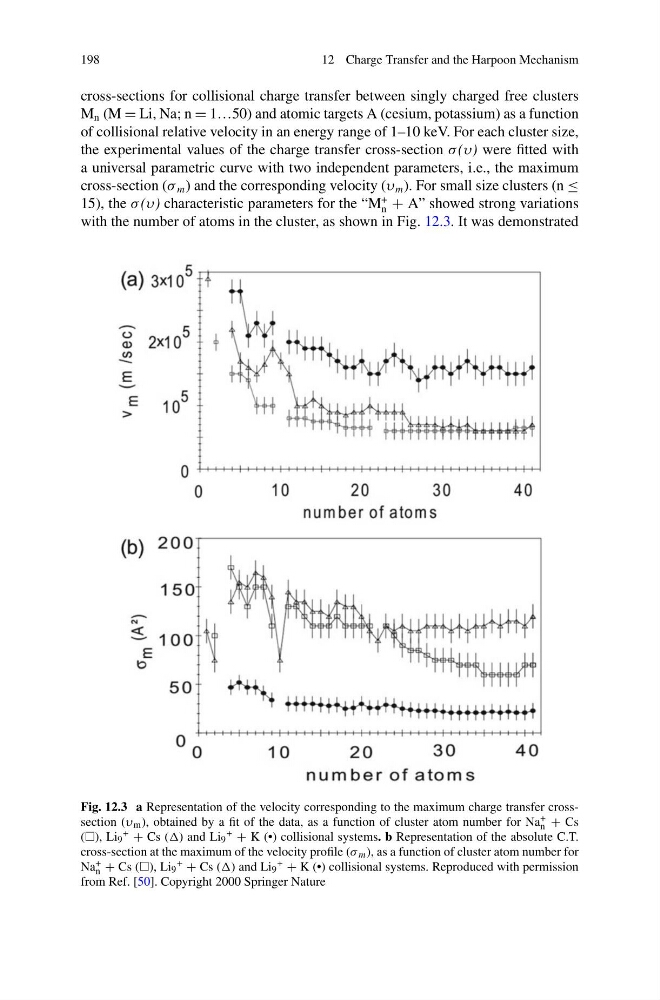
with the number of atoms in the cluster, as shown in Fig. 12.3. It was demonstrated
Fig. 12.3 a Representation of the velocity corresponding to the maximum charge transfer crosssection (υ m ), obtained by a fit of the data, as a function of cluster atom number for Na +
n + Cs
(), Li 9
+ + Cs () and Li 9
+ + K (•) collisional systems. b Representation of the absolute C.T.
cross-section at the maximum of the velocity profile (σ m ), as a function of cluster atom number for
Na +
n + Cs (), Li 9
+ + Cs () and Li 9
+ + K (•) collisional systems. Reproduced with permission
from Ref. [50]. Copyright 2000 Springer Nature
12 Charge Transfer and the Harpoon Mechanism
cross-sections for collisional charge transfer between singly charged free clusters
M n (M = Li, Na; n = 1…50) and atomic targets A (cesium, potassium) as a function
of collisional relative velocity in an energy range of 1–10 keV. For each cluster size,
the experimental values of the charge transfer cross-section σ (υ) were fitted with
a universal parametric curve with two independent parameters, i.e., the maximum
cross-section (σ m ) and the corresponding velocity (υ m ). For small size clusters (n ≤
15), the σ (υ) characteristic parameters for the “M
+
n + A” showed strong variations
with the number of atoms in the cluster, as shown in Fig. 12.3. It was demonstrated
Fig. 12.3 a Representation of the velocity corresponding to the maximum charge transfer crosssection (υ m ), obtained by a fit of the data, as a function of cluster atom number for Na +
n + Cs
(), Li 9
+ + Cs () and Li 9
+ + K (•) collisional systems. b Representation of the absolute C.T.
cross-section at the maximum of the velocity profile (σ m ), as a function of cluster atom number for
Na +
n + Cs (), Li 9
+ + Cs () and Li 9
+ + K (•) collisional systems. Reproduced with permission
from Ref. [50]. Copyright 2000 Springer Nature