

186
11 Cluster Dissociation, Intracluster Reactivity and Effect of the Ligands
11.3 Effect of Ligands on Reactivity
In addition to the intracluster interaction and reaction, there are a few previously
published studies that have demonstrated the effect of the ligand on the reactivities
of the metal complexes [91–96]. Meanwhile, ongoing efforts are devoted to explore
the reactivity and catalysis of ligand-protected metal clusters of the ligand always
bring forth a significant influence in the practical experiments. It is believed that, to
minimize the reactivity (maximize the stability) of a ligand-protected metal cluster,
the metallic core should correspond to a spheroidal geometric structure and an even
distribution of surface charges; meanwhile, it is preferred for the ligands to be located
in a balanced position on opposite sides of the metallic core [97]. An example of
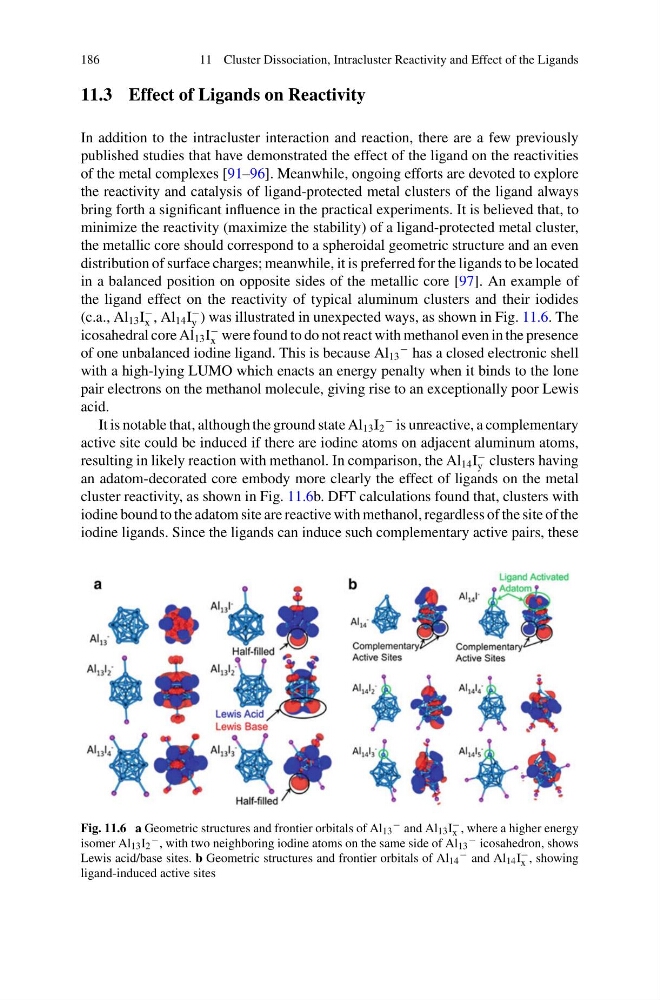
the ligand effect on the reactivity of typical aluminum clusters and their iodides
(c.a., Al 13 I
−
x , Al 14 I
−
y ) was illustrated in unexpected ways, as shown in Fig. 11.6. The
icosahedral core Al 13 I
−
x were found to do not react with methanol even in the presence
of one unbalanced iodine ligand. This is because Al 13
− has a closed electronic shell
with a high-lying LUMO which enacts an energy penalty when it binds to the lone
pair electrons on the methanol molecule, giving rise to an exceptionally poor Lewis
acid.
It is notable that, although the ground state Al 13 I 2
− is unreactive, a complementary
active site could be induced if there are iodine atoms on adjacent aluminum atoms,
resulting in likely reaction with methanol. In comparison, the Al 14 I
−
y clusters having
an adatom-decorated core embody more clearly the effect of ligands on the metal
cluster reactivity, as shown in Fig. 11.6b. DFT calculations found that, clusters with
iodine bound to the adatom site are reactive with methanol, regardless of the site of the
iodine ligands. Since the ligands can induce such complementary active pairs, these
Fig. 11.6 a Geometric structures and frontier orbitals of Al 13
− and Al 13 I −
x , where a higher energy
isomer Al 13 I 2
− , with two neighboring iodine atoms on the same side of Al 13
− icosahedron, shows
Lewis acid/base sites. b Geometric structures and frontier orbitals of Al 14
− and Al 14 I −
x , showing
ligand-induced active sites
11 Cluster Dissociation, Intracluster Reactivity and Effect of the Ligands
11.3 Effect of Ligands on Reactivity
In addition to the intracluster interaction and reaction, there are a few previously
published studies that have demonstrated the effect of the ligand on the reactivities
of the metal complexes [91–96]. Meanwhile, ongoing efforts are devoted to explore
the reactivity and catalysis of ligand-protected metal clusters of the ligand always
bring forth a significant influence in the practical experiments. It is believed that, to
minimize the reactivity (maximize the stability) of a ligand-protected metal cluster,
the metallic core should correspond to a spheroidal geometric structure and an even
distribution of surface charges; meanwhile, it is preferred for the ligands to be located
in a balanced position on opposite sides of the metallic core [97]. An example of
the ligand effect on the reactivity of typical aluminum clusters and their iodides
(c.a., Al 13 I
−
x , Al 14 I
−
y ) was illustrated in unexpected ways, as shown in Fig. 11.6. The
icosahedral core Al 13 I
−
x were found to do not react with methanol even in the presence
of one unbalanced iodine ligand. This is because Al 13
− has a closed electronic shell
with a high-lying LUMO which enacts an energy penalty when it binds to the lone
pair electrons on the methanol molecule, giving rise to an exceptionally poor Lewis
acid.
It is notable that, although the ground state Al 13 I 2
− is unreactive, a complementary
active site could be induced if there are iodine atoms on adjacent aluminum atoms,
resulting in likely reaction with methanol. In comparison, the Al 14 I
−
y clusters having
an adatom-decorated core embody more clearly the effect of ligands on the metal
cluster reactivity, as shown in Fig. 11.6b. DFT calculations found that, clusters with
iodine bound to the adatom site are reactive with methanol, regardless of the site of the
iodine ligands. Since the ligands can induce such complementary active pairs, these
Fig. 11.6 a Geometric structures and frontier orbitals of Al 13
− and Al 13 I −
x , where a higher energy
isomer Al 13 I 2
− , with two neighboring iodine atoms on the same side of Al 13
− icosahedron, shows
Lewis acid/base sites. b Geometric structures and frontier orbitals of Al 14
− and Al 14 I −
x , showing
ligand-induced active sites