

11.2 Intracluster Reactivity
185
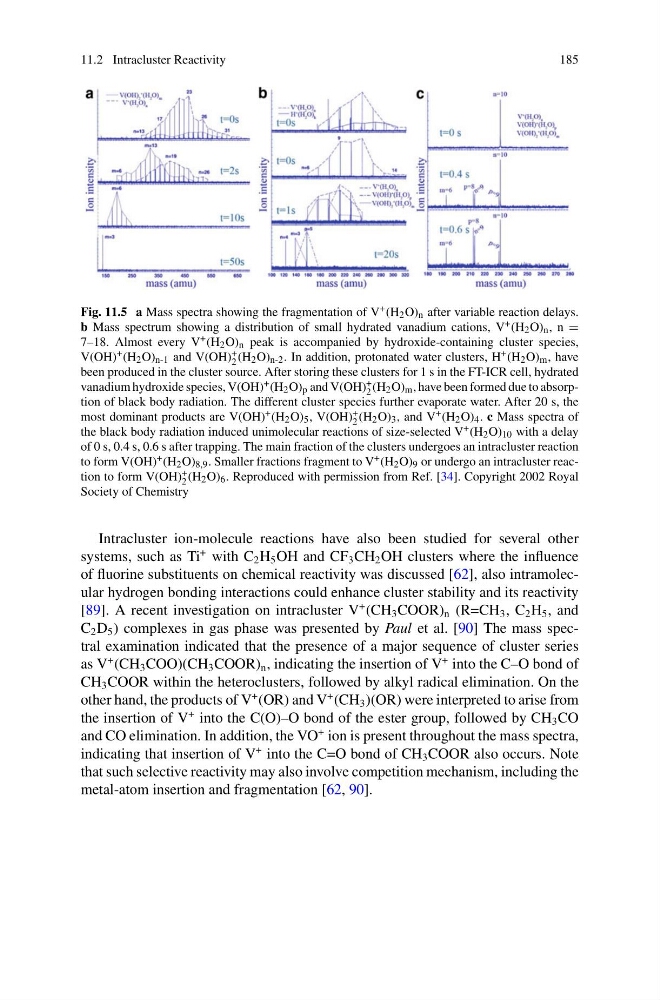
Fig. 11.5 a Mass spectra showing the fragmentation of V + (H 2 O) n after variable reaction delays.
b Mass spectrum showing a distribution of small hydrated vanadium cations, V + (H 2 O) n , n =
7–18. Almost every V + (H 2 O) n peak is accompanied by hydroxide-containing cluster species,
V(OH) + (H 2 O) n-1 and V(OH) +
2 (H 2 O) n-2 . In addition, protonated water clusters, H + (H 2 O) m , have
been produced in the cluster source. After storing these clusters for 1 s in the FT-ICR cell, hydrated
vanadium hydroxide species, V(OH) + (H 2 O) p and V(OH) +
2 (H 2 O) m , have been formed due to absorption of black body radiation. The different cluster species further evaporate water. After 20 s, the
most dominant products are V(OH) + (H 2 O) 5 , V(OH) +
2 (H 2 O) 3 , and V + (H 2 O) 4 . c Mass spectra of
the black body radiation induced unimolecular reactions of size-selected V + (H 2 O) 10 with a delay
of 0 s, 0.4 s, 0.6 s after trapping. The main fraction of the clusters undergoes an intracluster reaction
to form V(OH) + (H 2 O) 8,9 . Smaller fractions fragment to V + (H 2 O) 9 or undergo an intracluster reaction to form V(OH) +
2 (H 2 O) 6 . Reproduced with permission from Ref. [34]. Copyright 2002 Royal
Society of Chemistry
Intracluster ion-molecule reactions have also been studied for several other
systems, such as Ti
+ with C 2 H 5 OH and CF 3 CH 2 OH clusters where the influence
of fluorine substituents on chemical reactivity was discussed [62], also intramolecular hydrogen bonding interactions could enhance cluster stability and its reactivity
[89]. A recent investigation on intracluster V
+ (CH 3 COOR) n (R=CH 3 , C 2 H 5 , and
C 2 D 5 ) complexes in gas phase was presented by Paul et al. [90] The mass spectral examination indicated that the presence of a major sequence of cluster series
as V
+ (CH 3 COO)(CH 3 COOR) n , indicating the insertion of V
+ into the C–O bond of
CH 3 COOR within the heteroclusters, followed by alkyl radical elimination. On the
other hand, the products of V
+ (OR) and V
+ (CH 3 )(OR) were interpreted to arise from
the insertion of V
+ into the C(O)–O bond of the ester group, followed by CH 3 CO
and CO elimination. In addition, the VO
+ ion is present throughout the mass spectra,
indicating that insertion of V
+ into the C=O bond of CH 3 COOR also occurs. Note
that such selective reactivity may also involve competition mechanism, including the
metal-atom insertion and fragmentation [62, 90].
185
Fig. 11.5 a Mass spectra showing the fragmentation of V + (H 2 O) n after variable reaction delays.
b Mass spectrum showing a distribution of small hydrated vanadium cations, V + (H 2 O) n , n =
7–18. Almost every V + (H 2 O) n peak is accompanied by hydroxide-containing cluster species,
V(OH) + (H 2 O) n-1 and V(OH) +
2 (H 2 O) n-2 . In addition, protonated water clusters, H + (H 2 O) m , have
been produced in the cluster source. After storing these clusters for 1 s in the FT-ICR cell, hydrated
vanadium hydroxide species, V(OH) + (H 2 O) p and V(OH) +
2 (H 2 O) m , have been formed due to absorption of black body radiation. The different cluster species further evaporate water. After 20 s, the
most dominant products are V(OH) + (H 2 O) 5 , V(OH) +
2 (H 2 O) 3 , and V + (H 2 O) 4 . c Mass spectra of
the black body radiation induced unimolecular reactions of size-selected V + (H 2 O) 10 with a delay
of 0 s, 0.4 s, 0.6 s after trapping. The main fraction of the clusters undergoes an intracluster reaction
to form V(OH) + (H 2 O) 8,9 . Smaller fractions fragment to V + (H 2 O) 9 or undergo an intracluster reaction to form V(OH) +
2 (H 2 O) 6 . Reproduced with permission from Ref. [34]. Copyright 2002 Royal
Society of Chemistry
Intracluster ion-molecule reactions have also been studied for several other
systems, such as Ti
+ with C 2 H 5 OH and CF 3 CH 2 OH clusters where the influence
of fluorine substituents on chemical reactivity was discussed [62], also intramolecular hydrogen bonding interactions could enhance cluster stability and its reactivity
[89]. A recent investigation on intracluster V
+ (CH 3 COOR) n (R=CH 3 , C 2 H 5 , and
C 2 D 5 ) complexes in gas phase was presented by Paul et al. [90] The mass spectral examination indicated that the presence of a major sequence of cluster series
as V
+ (CH 3 COO)(CH 3 COOR) n , indicating the insertion of V
+ into the C–O bond of
CH 3 COOR within the heteroclusters, followed by alkyl radical elimination. On the
other hand, the products of V
+ (OR) and V
+ (CH 3 )(OR) were interpreted to arise from
the insertion of V
+ into the C(O)–O bond of the ester group, followed by CH 3 CO
and CO elimination. In addition, the VO
+ ion is present throughout the mass spectra,
indicating that insertion of V
+ into the C=O bond of CH 3 COOR also occurs. Note
that such selective reactivity may also involve competition mechanism, including the
metal-atom insertion and fragmentation [62, 90].