

11.3 Effect of Ligands on Reactivity
187
results explain the tendency of ligand-protected clusters toward compact metallic
cores with closed geometric shells.
On the other hand, the gas-phase reactivity of metal clusters repeatedly suggested
that, species having a non-uniform charge distribution enable to generate complementary active sites (i.e., both Lewis acid site and Lewis base site that could accept or
donate electrons), which promotes the metal cluster reactions with polar molecules
[98–106]. On this point, the chemical stability of a small metal cluster (although
essentially determined by geometric and electronic structure) could be maximized
when i) the cluster has a closed electronic shell that corresponds to a large HOMOLUMO gap (c.a., >1 eV, along with likely large atomic binding energies, and/or
electron removal/addition energies); and (ii) the charge density is evenly distributed
on the cluster thus prohibiting the presence of active sites.
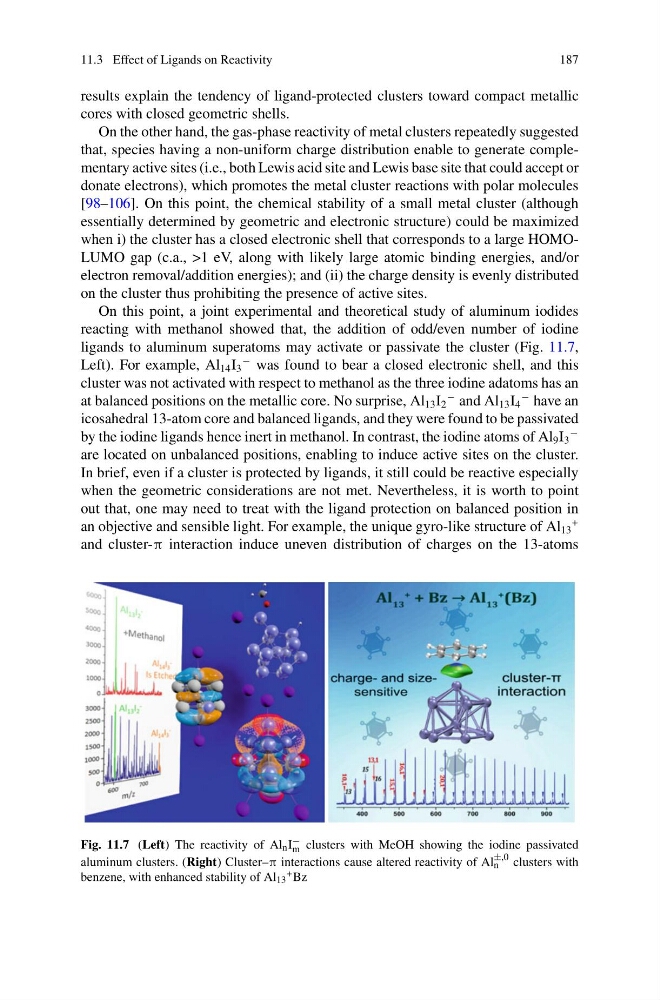
On this point, a joint experimental and theoretical study of aluminum iodides
reacting with methanol showed that, the addition of odd/even number of iodine
ligands to aluminum superatoms may activate or passivate the cluster (Fig. 11.7,
Left). For example, Al 14 I 3
− was found to bear a closed electronic shell, and this
cluster was not activated with respect to methanol as the three iodine adatoms has an
at balanced positions on the metallic core. No surprise, Al 13 I 2
− and Al 13 I 4
− have an
icosahedral 13-atom core and balanced ligands, and they were found to be passivated
by the iodine ligands hence inert in methanol. In contrast, the iodine atoms of Al 9 I 3
−
are located on unbalanced positions, enabling to induce active sites on the cluster.
In brief, even if a cluster is protected by ligands, it still could be reactive especially
when the geometric considerations are not met. Nevertheless, it is worth to point
out that, one may need to treat with the ligand protection on balanced position in
an objective and sensible light. For example, the unique gyro-like structure of Al 13
+
and cluster-π interaction induce uneven distribution of charges on the 13-atoms
Fig. 11.7 (Left) The reactivity of Al n I −
m clusters with MeOH showing the iodine passivated
aluminum clusters. (Right) Cluster–π interactions cause altered reactivity of Al
±,0
n
clusters with
benzene, with enhanced stability of Al 13
+ Bz
187
results explain the tendency of ligand-protected clusters toward compact metallic
cores with closed geometric shells.
On the other hand, the gas-phase reactivity of metal clusters repeatedly suggested
that, species having a non-uniform charge distribution enable to generate complementary active sites (i.e., both Lewis acid site and Lewis base site that could accept or
donate electrons), which promotes the metal cluster reactions with polar molecules
[98–106]. On this point, the chemical stability of a small metal cluster (although
essentially determined by geometric and electronic structure) could be maximized
when i) the cluster has a closed electronic shell that corresponds to a large HOMOLUMO gap (c.a., >1 eV, along with likely large atomic binding energies, and/or
electron removal/addition energies); and (ii) the charge density is evenly distributed
on the cluster thus prohibiting the presence of active sites.
On this point, a joint experimental and theoretical study of aluminum iodides
reacting with methanol showed that, the addition of odd/even number of iodine
ligands to aluminum superatoms may activate or passivate the cluster (Fig. 11.7,
Left). For example, Al 14 I 3
− was found to bear a closed electronic shell, and this
cluster was not activated with respect to methanol as the three iodine adatoms has an
at balanced positions on the metallic core. No surprise, Al 13 I 2
− and Al 13 I 4
− have an
icosahedral 13-atom core and balanced ligands, and they were found to be passivated
by the iodine ligands hence inert in methanol. In contrast, the iodine atoms of Al 9 I 3
−
are located on unbalanced positions, enabling to induce active sites on the cluster.
In brief, even if a cluster is protected by ligands, it still could be reactive especially
when the geometric considerations are not met. Nevertheless, it is worth to point
out that, one may need to treat with the ligand protection on balanced position in
an objective and sensible light. For example, the unique gyro-like structure of Al 13
+
and cluster-π interaction induce uneven distribution of charges on the 13-atoms
Fig. 11.7 (Left) The reactivity of Al n I −
m clusters with MeOH showing the iodine passivated
aluminum clusters. (Right) Cluster–π interactions cause altered reactivity of Al
±,0
n
clusters with
benzene, with enhanced stability of Al 13
+ Bz