

180
11 Cluster Dissociation, Intracluster Reactivity and Effect of the Ligands
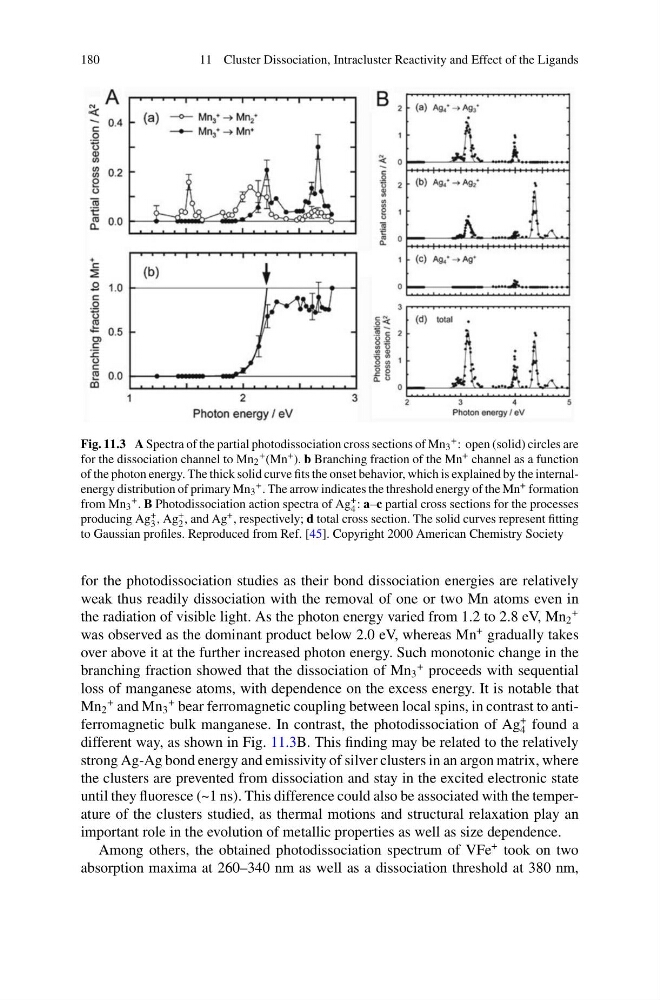
Fig. 11.3 A Spectra of the partial photodissociation cross sections of Mn 3
+ : open (solid) circles are
for the dissociation channel to Mn 2
+ (Mn + ). b Branching fraction of the Mn + channel as a function
of the photon energy. The thick solid curve fits the onset behavior, which is explained by the internalenergy distribution of primary Mn 3
+ . The arrow indicates the threshold energy of the Mn + formation
from Mn 3
+ . B Photodissociation action spectra of Ag +
4 : a–c partial cross sections for the processes
producing Ag +
3 , Ag +
2 , and Ag + , respectively; d total cross section. The solid curves represent fitting
to Gaussian profiles. Reproduced from Ref. [45]. Copyright 2000 American Chemistry Society
for the photodissociation studies as their bond dissociation energies are relatively
weak thus readily dissociation with the removal of one or two Mn atoms even in
the radiation of visible light. As the photon energy varied from 1.2 to 2.8 eV, Mn 2
+
was observed as the dominant product below 2.0 eV, whereas Mn
+ gradually takes
over above it at the further increased photon energy. Such monotonic change in the
branching fraction showed that the dissociation of Mn 3
+ proceeds with sequential
loss of manganese atoms, with dependence on the excess energy. It is notable that
Mn 2
+ and Mn 3
+ bear ferromagnetic coupling between local spins, in contrast to antiferromagnetic bulk manganese. In contrast, the photodissociation of Ag
+
4 found a
different way, as shown in Fig. 11.3B. This finding may be related to the relatively
strong Ag-Ag bond energy and emissivity of silver clusters in an argon matrix, where
the clusters are prevented from dissociation and stay in the excited electronic state
until they fluoresce (~1 ns). This difference could also be associated with the temperature of the clusters studied, as thermal motions and structural relaxation play an
important role in the evolution of metallic properties as well as size dependence.
Among others, the obtained photodissociation spectrum of VFe
+ took on two
absorption maxima at 260–340 nm as well as a dissociation threshold at 380 nm,
11 Cluster Dissociation, Intracluster Reactivity and Effect of the Ligands
Fig. 11.3 A Spectra of the partial photodissociation cross sections of Mn 3
+ : open (solid) circles are
for the dissociation channel to Mn 2
+ (Mn + ). b Branching fraction of the Mn + channel as a function
of the photon energy. The thick solid curve fits the onset behavior, which is explained by the internalenergy distribution of primary Mn 3
+ . The arrow indicates the threshold energy of the Mn + formation
from Mn 3
+ . B Photodissociation action spectra of Ag +
4 : a–c partial cross sections for the processes
producing Ag +
3 , Ag +
2 , and Ag + , respectively; d total cross section. The solid curves represent fitting
to Gaussian profiles. Reproduced from Ref. [45]. Copyright 2000 American Chemistry Society
for the photodissociation studies as their bond dissociation energies are relatively
weak thus readily dissociation with the removal of one or two Mn atoms even in
the radiation of visible light. As the photon energy varied from 1.2 to 2.8 eV, Mn 2
+
was observed as the dominant product below 2.0 eV, whereas Mn
+ gradually takes
over above it at the further increased photon energy. Such monotonic change in the
branching fraction showed that the dissociation of Mn 3
+ proceeds with sequential
loss of manganese atoms, with dependence on the excess energy. It is notable that
Mn 2
+ and Mn 3
+ bear ferromagnetic coupling between local spins, in contrast to antiferromagnetic bulk manganese. In contrast, the photodissociation of Ag
+
4 found a
different way, as shown in Fig. 11.3B. This finding may be related to the relatively
strong Ag-Ag bond energy and emissivity of silver clusters in an argon matrix, where
the clusters are prevented from dissociation and stay in the excited electronic state
until they fluoresce (~1 ns). This difference could also be associated with the temperature of the clusters studied, as thermal motions and structural relaxation play an
important role in the evolution of metallic properties as well as size dependence.
Among others, the obtained photodissociation spectrum of VFe
+ took on two
absorption maxima at 260–340 nm as well as a dissociation threshold at 380 nm,