

11.1 Cluster Dissociation
181
suggesting a bond energy D
o (V
+ –Fe) = 75 ± 5 kcal/mol, which is in good agreement
with that determined by ion-molecule bracketing [46]. Similar photodissociation
studies on Mn 2
+ revealing the bonding energy of Mn
+ –Mn have also been reported [7,
47]. Comparing with a CID method as mentioned above, the dissociation thresholds
obtained using the photodissociation approaches are sharper and generally more
accurate if it is discriminated between one-photon and multiphoton processes.
Early studies showed the mass spectrometry analysis of preselected Fe 6
+ ions in
the absence and presence of a dissociation light field. In contrast, in the presence of
~4 mJ/cm
2 per pulse of 2.33 eV radiation in the dissociation zone, multiple photoproduct ions Fe
+
2–5 were observed with well-resolved peak shape characteristic. From
these observations, it was concluded that fragmentation of the Fe 6
+ ion occurs faster
than the time scale of the mass interrogation. Such behavior is typical of the iron
cluster cation photodissociation events, and has been found to be applicable to other
metal cluster systems, such as the cations composed of nickel and niobium ranging
in size from two to ten atoms [8]. Also addressed, was the fluence dependence of the
different product channels for the Fe 6
+ irradiated with 2.33 eV light. The calculated
solid curves through the experimental fractional populations of the Fe 5
+ , Fe 4
+ , and
Fe 3
+ products were generated using a single adjustable parameter, the absorption
cross section, in the context of a simple stepwise absorption/fragmentation scheme:
Fe
+
6
hν
→ Fe
+
5 + Fe
hν
→ Fe
+
4 + 2Fe
hν
→ Fe
+
3 + 3Fe
hν
→ · · ·
(11.6)
As results, the only one-photon dissociation process of the parent ion at this energy
was found to be the ejection of a neutral Fe atom. If the kinetic scheme is simply based
on Eq. 11.6, all products will be the outcome of dissociation involving the loss of one
Fe atom per photon absorbed. However, as the time scale for fragmentation was faster
than assessable in the apparatus, the identity of the absorber was not determined. That
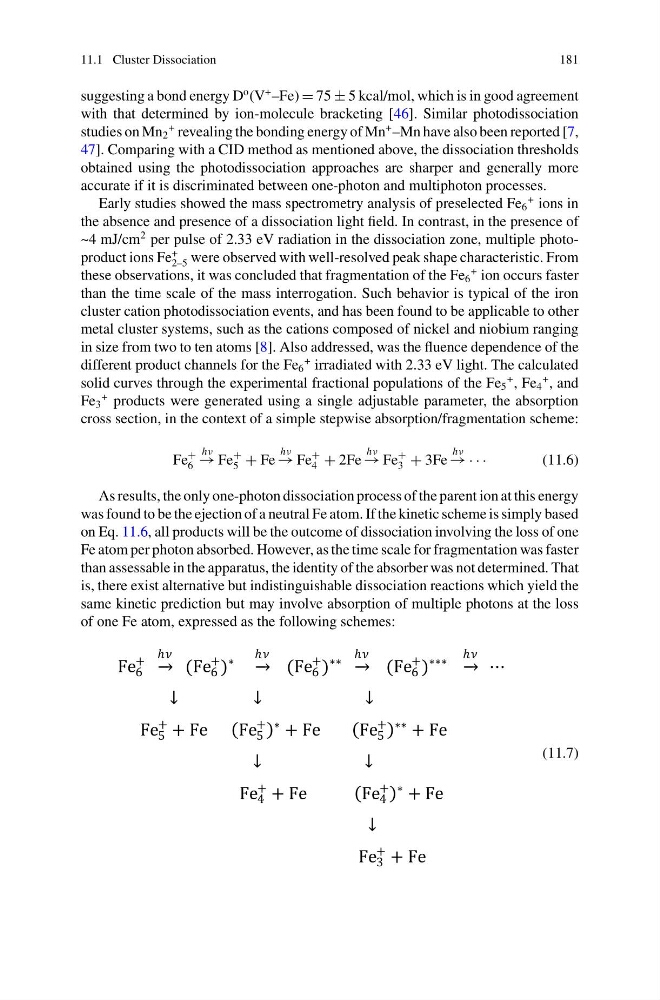
is, there exist alternative but indistinguishable dissociation reactions which yield the
same kinetic prediction but may involve absorption of multiple photons at the loss
of one Fe atom, expressed as the following schemes:
(11.7)
181
suggesting a bond energy D
o (V
+ –Fe) = 75 ± 5 kcal/mol, which is in good agreement
with that determined by ion-molecule bracketing [46]. Similar photodissociation
studies on Mn 2
+ revealing the bonding energy of Mn
+ –Mn have also been reported [7,
47]. Comparing with a CID method as mentioned above, the dissociation thresholds
obtained using the photodissociation approaches are sharper and generally more
accurate if it is discriminated between one-photon and multiphoton processes.
Early studies showed the mass spectrometry analysis of preselected Fe 6
+ ions in
the absence and presence of a dissociation light field. In contrast, in the presence of
~4 mJ/cm
2 per pulse of 2.33 eV radiation in the dissociation zone, multiple photoproduct ions Fe
+
2–5 were observed with well-resolved peak shape characteristic. From
these observations, it was concluded that fragmentation of the Fe 6
+ ion occurs faster
than the time scale of the mass interrogation. Such behavior is typical of the iron
cluster cation photodissociation events, and has been found to be applicable to other
metal cluster systems, such as the cations composed of nickel and niobium ranging
in size from two to ten atoms [8]. Also addressed, was the fluence dependence of the
different product channels for the Fe 6
+ irradiated with 2.33 eV light. The calculated
solid curves through the experimental fractional populations of the Fe 5
+ , Fe 4
+ , and
Fe 3
+ products were generated using a single adjustable parameter, the absorption
cross section, in the context of a simple stepwise absorption/fragmentation scheme:
Fe
+
6
hν
→ Fe
+
5 + Fe
hν
→ Fe
+
4 + 2Fe
hν
→ Fe
+
3 + 3Fe
hν
→ · · ·
(11.6)
As results, the only one-photon dissociation process of the parent ion at this energy
was found to be the ejection of a neutral Fe atom. If the kinetic scheme is simply based
on Eq. 11.6, all products will be the outcome of dissociation involving the loss of one
Fe atom per photon absorbed. However, as the time scale for fragmentation was faster
than assessable in the apparatus, the identity of the absorber was not determined. That
is, there exist alternative but indistinguishable dissociation reactions which yield the
same kinetic prediction but may involve absorption of multiple photons at the loss
of one Fe atom, expressed as the following schemes:
(11.7)