

170
10 Metallo-Carbohedrenes and Their Reactivity
Researchers also compared the stability and reactivity of Ti 8 C 11
+ , Ti 8 C 13
+ , and
Ti 8 C 14
+ [70]. Figure 10.6 presents the product distribution arising from multistep
reactions of Ti 8 C 11
+ , Ti 8 C 13
+ , and Ti 8 C 14
+ with acetone. Unlike the Ti 8 C 12
+ , the
contiguous dissimilation of other titanium-carbon clusters exhibited some degree of
chemical reactivity toward acetone, mainly seen as association reactions. In addition
to the reacting via association channels, the carbon-poor cluster Ti 8 C 11
+ was found
to break the chemical bonds of acetone; however, the carbon-rich clusters Ti 8 C 13
+
and Ti 8 C 14
+ could undergo a loss of carbon leading to the normal Met-Cars Ti 8 C 12
+
[70].
Considering the cluster reactivity is generally dependent on the structural stability,
a large or small HOMO–LUMO gap, and whether or not a closed-shell electronic
configuration, recently Berkdemir et al. [64] investigated the structural and electronic properties of the M-substituted metallocarbohedrynes based on Ti 8 C 12 with a
C 3v symmetry using the spin-polarized density functional theory (DFT) calculations
with the plane-wave basis set and the generalized gradient approximation for the
exchange-correlation functional. They examined Be, Mg, Ca, Sr, and Ba in place of
Ti as these metals consist of two valence electrons less than Ti, as well as Sc and Y
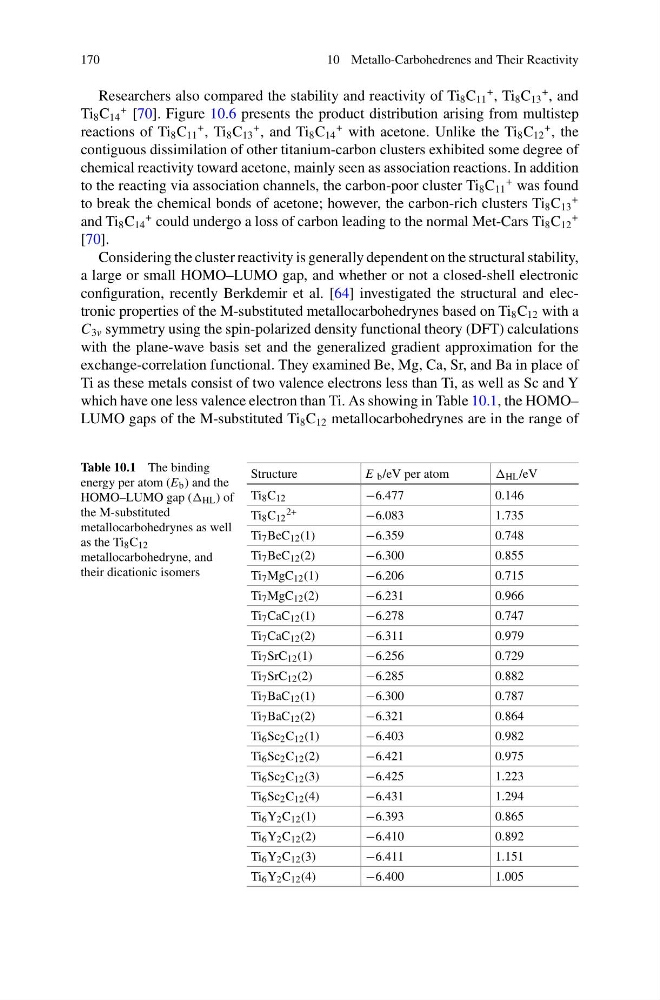
which have one less valence electron than Ti. As showing in Table 10.1, the HOMO–
LUMO gaps of the M-substituted Ti 8 C 12 metallocarbohedrynes are in the range of
Table 10.1 The binding
energy per atom (E b ) and the
HOMO–LUMO gap ( HL ) of
the M-substituted
metallocarbohedrynes as well
as the Ti 8 C 12
metallocarbohedryne, and
their dicationic isomers
Structure
E b /eV per atom
HL /eV
Ti 8 C 12
−6.477
0.146
Ti 8 C 12
2+
−6.083
1.735
Ti 7 BeC 12 (1)
−6.359
0.748
Ti 7 BeC 12 (2)
−6.300
0.855
Ti 7 MgC 12 (1)
−6.206
0.715
Ti 7 MgC 12 (2)
−6.231
0.966
Ti 7 CaC 12 (1)
−6.278
0.747
Ti 7 CaC 12 (2)
−6.311
0.979
Ti 7 SrC 12 (1)
−6.256
0.729
Ti 7 SrC 12 (2)
−6.285
0.882
Ti 7 BaC 12 (1)
−6.300
0.787
Ti 7 BaC 12 (2)
−6.321
0.864
Ti 6 Sc 2 C 12 (1)
−6.403
0.982
Ti 6 Sc 2 C 12 (2)
−6.421
0.975
Ti 6 Sc 2 C 12 (3)
−6.425
1.223
Ti 6 Sc 2 C 12 (4)
−6.431
1.294
Ti 6 Y 2 C 12 (1)
−6.393
0.865
Ti 6 Y 2 C 12 (2)
−6.410
0.892
Ti 6 Y 2 C 12 (3)
−6.411
1.151
Ti 6 Y 2 C 12 (4)
−6.400
1.005
10 Metallo-Carbohedrenes and Their Reactivity
Researchers also compared the stability and reactivity of Ti 8 C 11
+ , Ti 8 C 13
+ , and
Ti 8 C 14
+ [70]. Figure 10.6 presents the product distribution arising from multistep
reactions of Ti 8 C 11
+ , Ti 8 C 13
+ , and Ti 8 C 14
+ with acetone. Unlike the Ti 8 C 12
+ , the
contiguous dissimilation of other titanium-carbon clusters exhibited some degree of
chemical reactivity toward acetone, mainly seen as association reactions. In addition
to the reacting via association channels, the carbon-poor cluster Ti 8 C 11
+ was found
to break the chemical bonds of acetone; however, the carbon-rich clusters Ti 8 C 13
+
and Ti 8 C 14
+ could undergo a loss of carbon leading to the normal Met-Cars Ti 8 C 12
+
[70].
Considering the cluster reactivity is generally dependent on the structural stability,
a large or small HOMO–LUMO gap, and whether or not a closed-shell electronic
configuration, recently Berkdemir et al. [64] investigated the structural and electronic properties of the M-substituted metallocarbohedrynes based on Ti 8 C 12 with a
C 3v symmetry using the spin-polarized density functional theory (DFT) calculations
with the plane-wave basis set and the generalized gradient approximation for the
exchange-correlation functional. They examined Be, Mg, Ca, Sr, and Ba in place of
Ti as these metals consist of two valence electrons less than Ti, as well as Sc and Y
which have one less valence electron than Ti. As showing in Table 10.1, the HOMO–
LUMO gaps of the M-substituted Ti 8 C 12 metallocarbohedrynes are in the range of
Table 10.1 The binding
energy per atom (E b ) and the
HOMO–LUMO gap ( HL ) of
the M-substituted
metallocarbohedrynes as well
as the Ti 8 C 12
metallocarbohedryne, and
their dicationic isomers
Structure
E b /eV per atom
HL /eV
Ti 8 C 12
−6.477
0.146
Ti 8 C 12
2+
−6.083
1.735
Ti 7 BeC 12 (1)
−6.359
0.748
Ti 7 BeC 12 (2)
−6.300
0.855
Ti 7 MgC 12 (1)
−6.206
0.715
Ti 7 MgC 12 (2)
−6.231
0.966
Ti 7 CaC 12 (1)
−6.278
0.747
Ti 7 CaC 12 (2)
−6.311
0.979
Ti 7 SrC 12 (1)
−6.256
0.729
Ti 7 SrC 12 (2)
−6.285
0.882
Ti 7 BaC 12 (1)
−6.300
0.787
Ti 7 BaC 12 (2)
−6.321
0.864
Ti 6 Sc 2 C 12 (1)
−6.403
0.982
Ti 6 Sc 2 C 12 (2)
−6.421
0.975
Ti 6 Sc 2 C 12 (3)
−6.425
1.223
Ti 6 Sc 2 C 12 (4)
−6.431
1.294
Ti 6 Y 2 C 12 (1)
−6.393
0.865
Ti 6 Y 2 C 12 (2)
−6.410
0.892
Ti 6 Y 2 C 12 (3)
−6.411
1.151
Ti 6 Y 2 C 12 (4)
−6.400
1.005