

10.2 Reactivity of Met-Cars
171
0.715–0.979 eV for the case of Be, Mg, Ca, Sr, and Ba; while a range of 0.865–
1.294 eV calculated for the systems involving Sc and Y. These results provided a
reference to understand the stability and reactivity of the metallocarbohedrynes and
their derivatives [2].
10.3 Deposition of Met-Cars
Castleman and coworkers also demonstrated the ability to produce Met-Cars in the
solid state [61], but the difficulties in finding a suitable solvent for isolating MetCars is a challenge. An alternative method involving the deposition of mass-gated
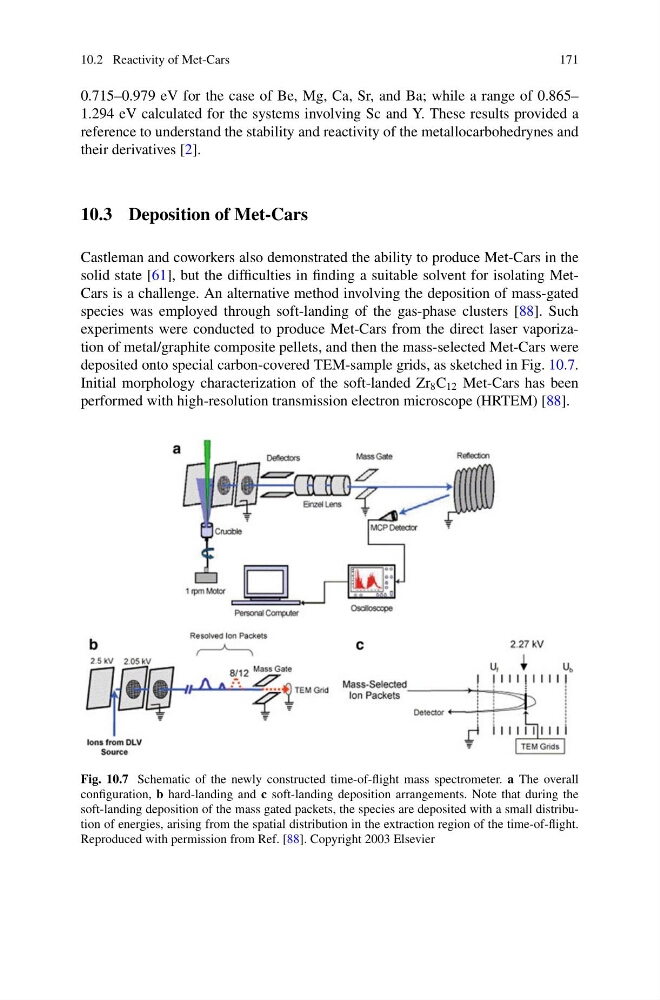
species was employed through soft-landing of the gas-phase clusters [88]. Such
experiments were conducted to produce Met-Cars from the direct laser vaporization of metal/graphite composite pellets, and then the mass-selected Met-Cars were
deposited onto special carbon-covered TEM-sample grids, as sketched in Fig. 10.7.
Initial morphology characterization of the soft-landed Zr 8 C 12 Met-Cars has been
performed with high-resolution transmission electron microscope (HRTEM) [88].
Fig. 10.7 Schematic of the newly constructed time-of-flight mass spectrometer. a The overall
configuration, b hard-landing and c soft-landing deposition arrangements. Note that during the
soft-landing deposition of the mass gated packets, the species are deposited with a small distribution of energies, arising from the spatial distribution in the extraction region of the time-of-flight.
Reproduced with permission from Ref. [88]. Copyright 2003 Elsevier
171
0.715–0.979 eV for the case of Be, Mg, Ca, Sr, and Ba; while a range of 0.865–
1.294 eV calculated for the systems involving Sc and Y. These results provided a
reference to understand the stability and reactivity of the metallocarbohedrynes and
their derivatives [2].
10.3 Deposition of Met-Cars
Castleman and coworkers also demonstrated the ability to produce Met-Cars in the
solid state [61], but the difficulties in finding a suitable solvent for isolating MetCars is a challenge. An alternative method involving the deposition of mass-gated
species was employed through soft-landing of the gas-phase clusters [88]. Such
experiments were conducted to produce Met-Cars from the direct laser vaporization of metal/graphite composite pellets, and then the mass-selected Met-Cars were
deposited onto special carbon-covered TEM-sample grids, as sketched in Fig. 10.7.
Initial morphology characterization of the soft-landed Zr 8 C 12 Met-Cars has been
performed with high-resolution transmission electron microscope (HRTEM) [88].
Fig. 10.7 Schematic of the newly constructed time-of-flight mass spectrometer. a The overall
configuration, b hard-landing and c soft-landing deposition arrangements. Note that during the
soft-landing deposition of the mass gated packets, the species are deposited with a small distribution of energies, arising from the spatial distribution in the extraction region of the time-of-flight.
Reproduced with permission from Ref. [88]. Copyright 2003 Elsevier