

10.2 Reactivity of Met-Cars
169
studies in relatively high gas pressures not only demonstrated the similar chemistry
for various Met-Cars, but also indicated reasonable stability of these novel species
[72].
Further investigations were also extended to Ti–Nb alloy Met-Cars, such as
Ti 7 NbC 12
+ . However, it was found that the reactivity of Ti 7 NbC 12
+ takes on difference
from Ti 8 C 12
+ . As an Nb atom possesses five valence electrons (one more electron than
that of a titanium atom), that is, the cluster Ti 7 NbC 12
+ has a total of 80 electrons which
is equal to that of the neutral Ti 8 C 12 . Note that, although in the sense of all electrons
are paired, 80 electrons do not lead to a closed shell according to the Jellium model
[78, 80–86]. As results, Ti 7 NbC 12
+ was found to be very reactive toward acetone,
as shown in Fig. 10.5c where the observed products indicated that Ti 7 NbC 12
+ react
and take oxygen atoms off acetone to form Ti 7 NbC 12 O(C 3 H 6 O)
+
x species. When an
acetone molecule approaches the positively charged Met-Car cluster, the ion-dipole
interaction tends to shift the positive charge at the oxygen’s point of encountering
due to the lone-pair electrons (electronegativity) of the oxygen atom. This effect was
also noted in the reactions of C 60
2+ with polar molecules [87]. So the abstraction of
oxygen most likely occurs at the dipole-induced charge centers of Ti 7 NbC 12
+ cluster.
Also, the Ti 7 NbC 12
+ was found to react with methyl iodide giving rise to the products
of bonding one to four iodine atoms (Ti 7 NbC 12 I 4
+ ) from methyl iodide, as shown in
Fig. 10.5d.
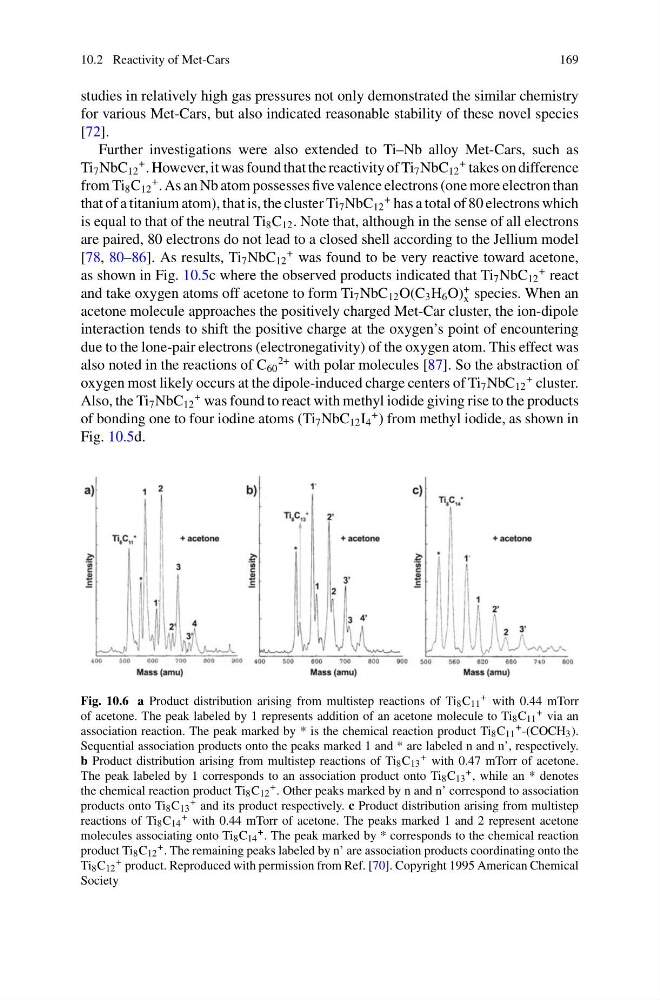
Fig. 10.6 a Product distribution arising from multistep reactions of Ti 8 C 11
+ with 0.44 mTorr
of acetone. The peak labeled by 1 represents addition of an acetone molecule to Ti 8 C 11
+ via an
association reaction. The peak marked by * is the chemical reaction product Ti 8 C 11
+ -(COCH 3 ).
Sequential association products onto the peaks marked 1 and * are labeled n and n’, respectively.
b Product distribution arising from multistep reactions of Ti 8 C 13
+ with 0.47 mTorr of acetone.
The peak labeled by 1 corresponds to an association product onto Ti 8 C 13
+ , while an * denotes
the chemical reaction product Ti 8 C 12
+ . Other peaks marked by n and n’ correspond to association
products onto Ti 8 C 13
+ and its product respectively. c Product distribution arising from multistep
reactions of Ti 8 C 14
+ with 0.44 mTorr of acetone. The peaks marked 1 and 2 represent acetone
molecules associating onto Ti 8 C 14
+ . The peak marked by * corresponds to the chemical reaction
product Ti 8 C 12
+ . The remaining peaks labeled by n’ are association products coordinating onto the
Ti 8 C 12
+ product. Reproduced with permission from Ref. [70]. Copyright 1995 American Chemical
Society
169
studies in relatively high gas pressures not only demonstrated the similar chemistry
for various Met-Cars, but also indicated reasonable stability of these novel species
[72].
Further investigations were also extended to Ti–Nb alloy Met-Cars, such as
Ti 7 NbC 12
+ . However, it was found that the reactivity of Ti 7 NbC 12
+ takes on difference
from Ti 8 C 12
+ . As an Nb atom possesses five valence electrons (one more electron than
that of a titanium atom), that is, the cluster Ti 7 NbC 12
+ has a total of 80 electrons which
is equal to that of the neutral Ti 8 C 12 . Note that, although in the sense of all electrons
are paired, 80 electrons do not lead to a closed shell according to the Jellium model
[78, 80–86]. As results, Ti 7 NbC 12
+ was found to be very reactive toward acetone,
as shown in Fig. 10.5c where the observed products indicated that Ti 7 NbC 12
+ react
and take oxygen atoms off acetone to form Ti 7 NbC 12 O(C 3 H 6 O)
+
x species. When an
acetone molecule approaches the positively charged Met-Car cluster, the ion-dipole
interaction tends to shift the positive charge at the oxygen’s point of encountering
due to the lone-pair electrons (electronegativity) of the oxygen atom. This effect was
also noted in the reactions of C 60
2+ with polar molecules [87]. So the abstraction of
oxygen most likely occurs at the dipole-induced charge centers of Ti 7 NbC 12
+ cluster.
Also, the Ti 7 NbC 12
+ was found to react with methyl iodide giving rise to the products
of bonding one to four iodine atoms (Ti 7 NbC 12 I 4
+ ) from methyl iodide, as shown in
Fig. 10.5d.
Fig. 10.6 a Product distribution arising from multistep reactions of Ti 8 C 11
+ with 0.44 mTorr
of acetone. The peak labeled by 1 represents addition of an acetone molecule to Ti 8 C 11
+ via an
association reaction. The peak marked by * is the chemical reaction product Ti 8 C 11
+ -(COCH 3 ).
Sequential association products onto the peaks marked 1 and * are labeled n and n’, respectively.
b Product distribution arising from multistep reactions of Ti 8 C 13
+ with 0.47 mTorr of acetone.
The peak labeled by 1 corresponds to an association product onto Ti 8 C 13
+ , while an * denotes
the chemical reaction product Ti 8 C 12
+ . Other peaks marked by n and n’ correspond to association
products onto Ti 8 C 13
+ and its product respectively. c Product distribution arising from multistep
reactions of Ti 8 C 14
+ with 0.44 mTorr of acetone. The peaks marked 1 and 2 represent acetone
molecules associating onto Ti 8 C 14
+ . The peak marked by * corresponds to the chemical reaction
product Ti 8 C 12
+ . The remaining peaks labeled by n’ are association products coordinating onto the
Ti 8 C 12
+ product. Reproduced with permission from Ref. [70]. Copyright 1995 American Chemical
Society