

9.4 Microscopic Catalytic Mechanism of Supported Palladium Clusters
149
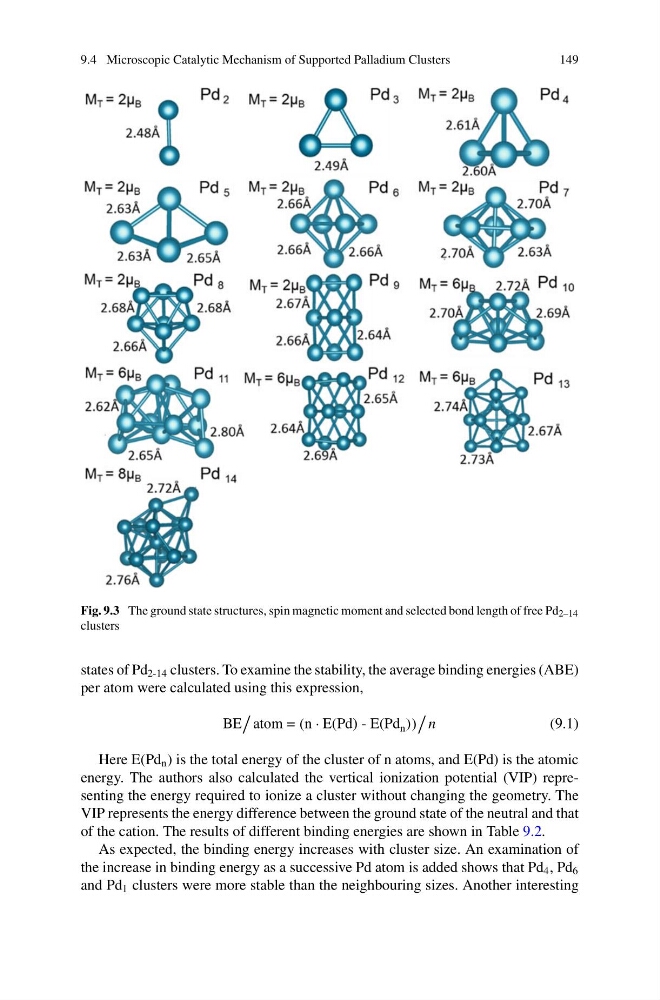
Fig. 9.3 The ground state structures, spin magnetic moment and selected bond length of free Pd 2–14
clusters
states of Pd 2-14 clusters. To examine the stability, the average binding energies (ABE)
per atom were calculated using this expression,
BE
atom = (n · E(Pd) - E(Pd n ))
n
(9.1)
Here E(Pd n ) is the total energy of the cluster of n atoms, and E(Pd) is the atomic
energy. The authors also calculated the vertical ionization potential (VIP) representing the energy required to ionize a cluster without changing the geometry. The
VIP represents the energy difference between the ground state of the neutral and that
of the cation. The results of different binding energies are shown in Table 9.2.
As expected, the binding energy increases with cluster size. An examination of
the increase in binding energy as a successive Pd atom is added shows that Pd 4 , Pd 6
and Pd 1 clusters were more stable than the neighbouring sizes. Another interesting
149
Fig. 9.3 The ground state structures, spin magnetic moment and selected bond length of free Pd 2–14
clusters
states of Pd 2-14 clusters. To examine the stability, the average binding energies (ABE)
per atom were calculated using this expression,
BE
atom = (n · E(Pd) - E(Pd n ))
n
(9.1)
Here E(Pd n ) is the total energy of the cluster of n atoms, and E(Pd) is the atomic
energy. The authors also calculated the vertical ionization potential (VIP) representing the energy required to ionize a cluster without changing the geometry. The
VIP represents the energy difference between the ground state of the neutral and that
of the cation. The results of different binding energies are shown in Table 9.2.
As expected, the binding energy increases with cluster size. An examination of
the increase in binding energy as a successive Pd atom is added shows that Pd 4 , Pd 6
and Pd 1 clusters were more stable than the neighbouring sizes. Another interesting