

148
9 Carbon-Carbon Cross-Coupling Reactions
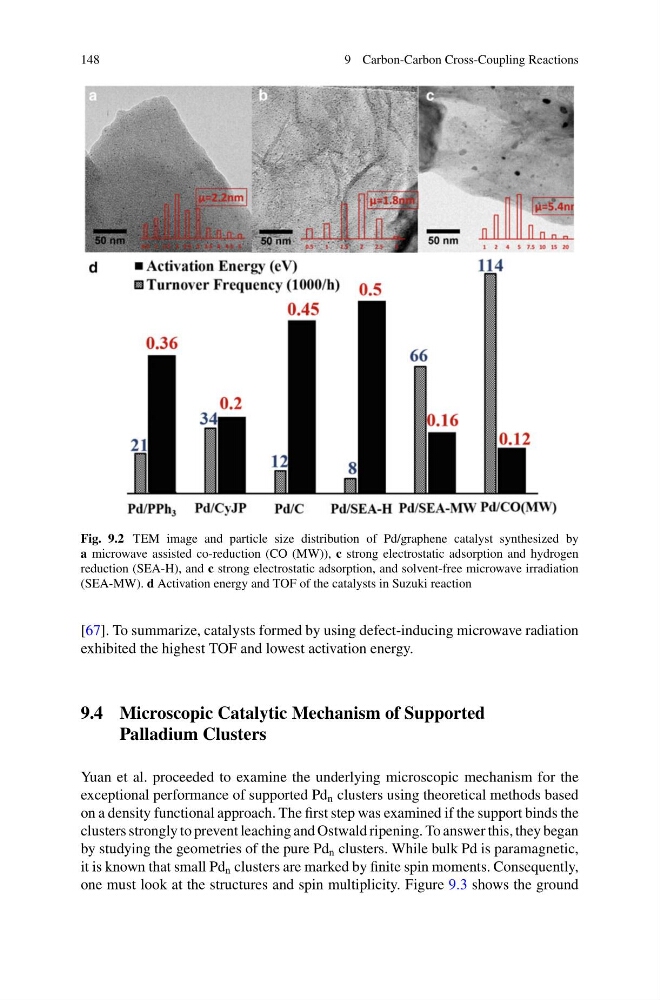
Fig. 9.2 TEM image and particle size distribution of Pd/graphene catalyst synthesized by
a microwave assisted co-reduction (CO (MW)), c strong electrostatic adsorption and hydrogen
reduction (SEA-H), and c strong electrostatic adsorption, and solvent-free microwave irradiation
(SEA-MW). d Activation energy and TOF of the catalysts in Suzuki reaction
[67]. To summarize, catalysts formed by using defect-inducing microwave radiation
exhibited the highest TOF and lowest activation energy.
9.4 Microscopic Catalytic Mechanism of Supported
Palladium Clusters
Yuan et al. proceeded to examine the underlying microscopic mechanism for the
exceptional performance of supported Pd n clusters using theoretical methods based
on a density functional approach. The first step was examined if the support binds the
clusters strongly to prevent leaching and Ostwald ripening. To answer this, they began
by studying the geometries of the pure Pd n clusters. While bulk Pd is paramagnetic,
it is known that small Pd n clusters are marked by finite spin moments. Consequently,
one must look at the structures and spin multiplicity. Figure 9.3 shows the ground
9 Carbon-Carbon Cross-Coupling Reactions
Fig. 9.2 TEM image and particle size distribution of Pd/graphene catalyst synthesized by
a microwave assisted co-reduction (CO (MW)), c strong electrostatic adsorption and hydrogen
reduction (SEA-H), and c strong electrostatic adsorption, and solvent-free microwave irradiation
(SEA-MW). d Activation energy and TOF of the catalysts in Suzuki reaction
[67]. To summarize, catalysts formed by using defect-inducing microwave radiation
exhibited the highest TOF and lowest activation energy.
9.4 Microscopic Catalytic Mechanism of Supported
Palladium Clusters
Yuan et al. proceeded to examine the underlying microscopic mechanism for the
exceptional performance of supported Pd n clusters using theoretical methods based
on a density functional approach. The first step was examined if the support binds the
clusters strongly to prevent leaching and Ostwald ripening. To answer this, they began
by studying the geometries of the pure Pd n clusters. While bulk Pd is paramagnetic,
it is known that small Pd n clusters are marked by finite spin moments. Consequently,
one must look at the structures and spin multiplicity. Figure 9.3 shows the ground