

150
9 Carbon-Carbon Cross-Coupling Reactions
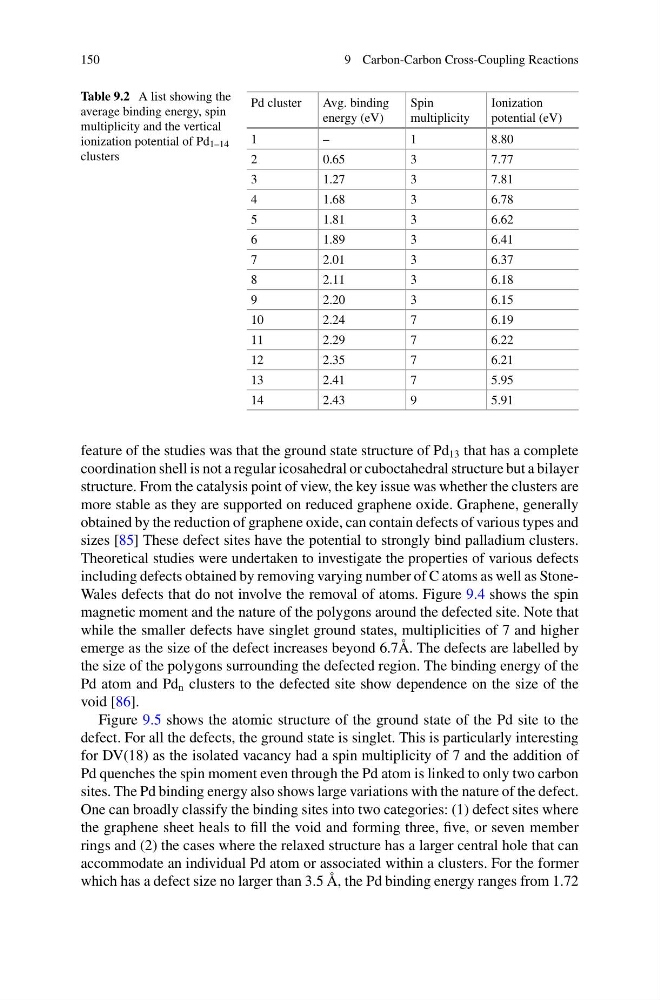
Table 9.2 A list showing the
average binding energy, spin
multiplicity and the vertical
ionization potential of Pd 1–14
clusters
Pd cluster
Avg. binding
energy (eV)
Spin
multiplicity
Ionization
potential (eV)
1
–
1
8.80
2
0.65
3
7.77
3
1.27
3
7.81
4
1.68
3
6.78
5
1.81
3
6.62
6
1.89
3
6.41
7
2.01
3
6.37
8
2.11
3
6.18
9
2.20
3
6.15
10
2.24
7
6.19
11
2.29
7
6.22
12
2.35
7
6.21
13
2.41
7
5.95
14
2.43
9
5.91
feature of the studies was that the ground state structure of Pd 13 that has a complete
coordination shell is not a regular icosahedral or cuboctahedral structure but a bilayer
structure. From the catalysis point of view, the key issue was whether the clusters are
more stable as they are supported on reduced graphene oxide. Graphene, generally
obtained by the reduction of graphene oxide, can contain defects of various types and
sizes [85] These defect sites have the potential to strongly bind palladium clusters.
Theoretical studies were undertaken to investigate the properties of various defects
including defects obtained by removing varying number of C atoms as well as StoneWales defects that do not involve the removal of atoms. Figure 9.4 shows the spin
magnetic moment and the nature of the polygons around the defected site. Note that
while the smaller defects have singlet ground states, multiplicities of 7 and higher
emerge as the size of the defect increases beyond 6.7Å. The defects are labelled by
the size of the polygons surrounding the defected region. The binding energy of the
Pd atom and Pd n clusters to the defected site show dependence on the size of the
void [86].
Figure 9.5 shows the atomic structure of the ground state of the Pd site to the
defect. For all the defects, the ground state is singlet. This is particularly interesting
for DV(18) as the isolated vacancy had a spin multiplicity of 7 and the addition of
Pd quenches the spin moment even through the Pd atom is linked to only two carbon
sites. The Pd binding energy also shows large variations with the nature of the defect.
One can broadly classify the binding sites into two categories: (1) defect sites where
the graphene sheet heals to fill the void and forming three, five, or seven member
rings and (2) the cases where the relaxed structure has a larger central hole that can
accommodate an individual Pd atom or associated within a clusters. For the former
which has a defect size no larger than 3.5 Å, the Pd binding energy ranges from 1.72
9 Carbon-Carbon Cross-Coupling Reactions
Table 9.2 A list showing the
average binding energy, spin
multiplicity and the vertical
ionization potential of Pd 1–14
clusters
Pd cluster
Avg. binding
energy (eV)
Spin
multiplicity
Ionization
potential (eV)
1
–
1
8.80
2
0.65
3
7.77
3
1.27
3
7.81
4
1.68
3
6.78
5
1.81
3
6.62
6
1.89
3
6.41
7
2.01
3
6.37
8
2.11
3
6.18
9
2.20
3
6.15
10
2.24
7
6.19
11
2.29
7
6.22
12
2.35
7
6.21
13
2.41
7
5.95
14
2.43
9
5.91
feature of the studies was that the ground state structure of Pd 13 that has a complete
coordination shell is not a regular icosahedral or cuboctahedral structure but a bilayer
structure. From the catalysis point of view, the key issue was whether the clusters are
more stable as they are supported on reduced graphene oxide. Graphene, generally
obtained by the reduction of graphene oxide, can contain defects of various types and
sizes [85] These defect sites have the potential to strongly bind palladium clusters.
Theoretical studies were undertaken to investigate the properties of various defects
including defects obtained by removing varying number of C atoms as well as StoneWales defects that do not involve the removal of atoms. Figure 9.4 shows the spin
magnetic moment and the nature of the polygons around the defected site. Note that
while the smaller defects have singlet ground states, multiplicities of 7 and higher
emerge as the size of the defect increases beyond 6.7Å. The defects are labelled by
the size of the polygons surrounding the defected region. The binding energy of the
Pd atom and Pd n clusters to the defected site show dependence on the size of the
void [86].
Figure 9.5 shows the atomic structure of the ground state of the Pd site to the
defect. For all the defects, the ground state is singlet. This is particularly interesting
for DV(18) as the isolated vacancy had a spin multiplicity of 7 and the addition of
Pd quenches the spin moment even through the Pd atom is linked to only two carbon
sites. The Pd binding energy also shows large variations with the nature of the defect.
One can broadly classify the binding sites into two categories: (1) defect sites where
the graphene sheet heals to fill the void and forming three, five, or seven member
rings and (2) the cases where the relaxed structure has a larger central hole that can
accommodate an individual Pd atom or associated within a clusters. For the former
which has a defect size no larger than 3.5 Å, the Pd binding energy ranges from 1.72