

8.3 C−H Bond Activation
135
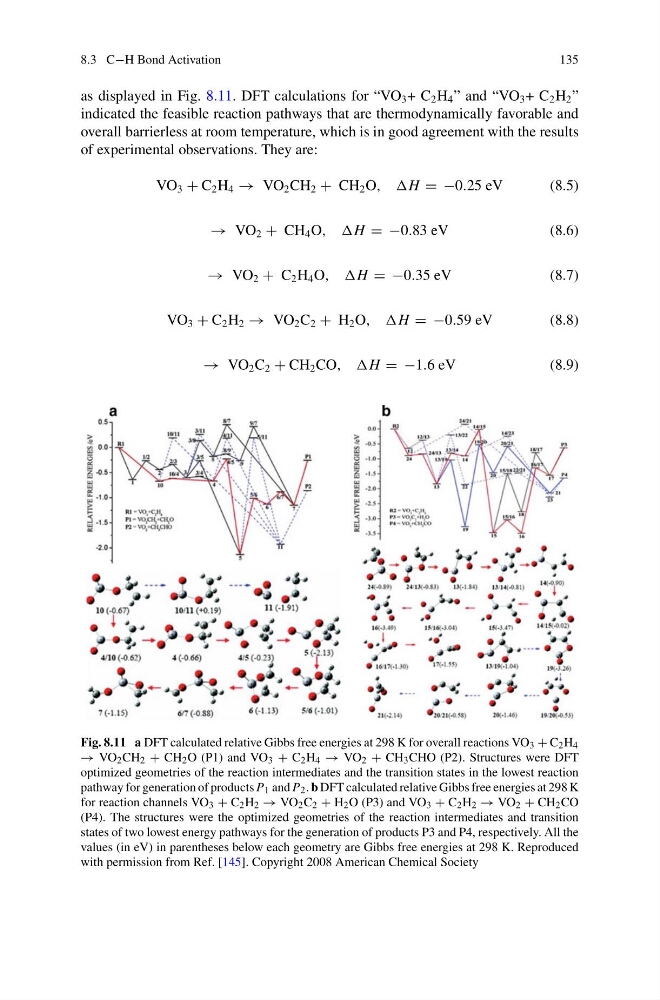
as displayed in Fig. 8.11. DFT calculations for “VO 3 + C 2 H 4 ” and “VO 3 + C 2 H 2 ”
indicated the feasible reaction pathways that are thermodynamically favorable and
overall barrierless at room temperature, which is in good agreement with the results
of experimental observations. They are:
VO 3 + C 2 H 4 → VO 2 CH 2 + CH 2 O, ,H = −0.25 eV
(8.5)
→ VO 2 + CH 4 O, ,H = −0.83 eV
(8.6)
→ VO 2 + C 2 H 4 O, ,H = −0.35 eV
(8.7)
VO 3 + C 2 H 2 → VO 2 C 2 + H 2 O, ,H = −0.59 eV
(8.8)
→ VO 2 C 2 + CH 2 CO, ,H = −1.6 eV
(8.9)
Fig. 8.11 a DFT calculated relative Gibbs free energies at 298 K for overall reactions VO 3 + C 2 H 4
→ VO 2 CH 2 + CH 2 O (P1) and VO 3 + C 2 H 4 → VO 2 + CH 3 CHO (P2). Structures were DFT
optimized geometries of the reaction intermediates and the transition states in the lowest reaction
pathway for generation of products P 1 and P 2 . b DFT calculated relative Gibbs free energies at 298 K
for reaction channels VO 3 + C 2 H 2 → VO 2 C 2 + H 2 O (P3) and VO 3 + C 2 H 2 → VO 2 + CH 2 CO
(P4). The structures were the optimized geometries of the reaction intermediates and transition
states of two lowest energy pathways for the generation of products P3 and P4, respectively. All the
values (in eV) in parentheses below each geometry are Gibbs free energies at 298 K. Reproduced
with permission from Ref. [145]. Copyright 2008 American Chemical Society
135
as displayed in Fig. 8.11. DFT calculations for “VO 3 + C 2 H 4 ” and “VO 3 + C 2 H 2 ”
indicated the feasible reaction pathways that are thermodynamically favorable and
overall barrierless at room temperature, which is in good agreement with the results
of experimental observations. They are:
VO 3 + C 2 H 4 → VO 2 CH 2 + CH 2 O, ,H = −0.25 eV
(8.5)
→ VO 2 + CH 4 O, ,H = −0.83 eV
(8.6)
→ VO 2 + C 2 H 4 O, ,H = −0.35 eV
(8.7)
VO 3 + C 2 H 2 → VO 2 C 2 + H 2 O, ,H = −0.59 eV
(8.8)
→ VO 2 C 2 + CH 2 CO, ,H = −1.6 eV
(8.9)
Fig. 8.11 a DFT calculated relative Gibbs free energies at 298 K for overall reactions VO 3 + C 2 H 4
→ VO 2 CH 2 + CH 2 O (P1) and VO 3 + C 2 H 4 → VO 2 + CH 3 CHO (P2). Structures were DFT
optimized geometries of the reaction intermediates and the transition states in the lowest reaction
pathway for generation of products P 1 and P 2 . b DFT calculated relative Gibbs free energies at 298 K
for reaction channels VO 3 + C 2 H 2 → VO 2 C 2 + H 2 O (P3) and VO 3 + C 2 H 2 → VO 2 + CH 2 CO
(P4). The structures were the optimized geometries of the reaction intermediates and transition
states of two lowest energy pathways for the generation of products P3 and P4, respectively. All the
values (in eV) in parentheses below each geometry are Gibbs free energies at 298 K. Reproduced
with permission from Ref. [145]. Copyright 2008 American Chemical Society