

136
8 Energetic Reactions with Hydrocarbons
These values of the enthalpies of reactions given above were obtained for the
lowest energy structures of the reactants and products in their singlet or doublet spin
states at room-temperature 298 K. It is worth mentioning that the reactions which
are thermodynamically allowed may still be limited due to dynamic constraints,
providing a barrier is unsurmountable, e.g., in the case of the oxygen/hydrogen
transfer and/or structural transformation, etc. [145].
Similar to the above case, recently Wang et al. [59] studied the reactivity of the
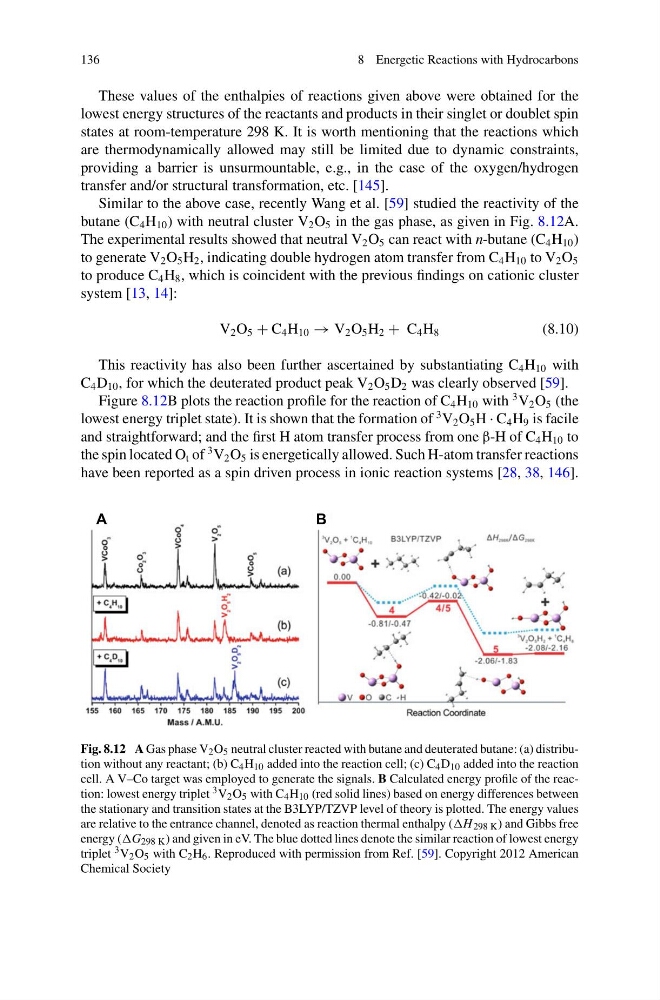
butane (C 4 H 10 ) with neutral cluster V 2 O 5 in the gas phase, as given in Fig. 8.12A.
The experimental results showed that neutral V 2 O 5 can react with n-butane (C 4 H 10 )
to generate V 2 O 5 H 2 , indicating double hydrogen atom transfer from C 4 H 10 to V 2 O 5
to produce C 4 H 8 , which is coincident with the previous findings on cationic cluster
system [13, 14]:
V 2 O 5 + C 4 H 10 → V 2 O 5 H 2 + C 4 H 8
(8.10)
This reactivity has also been further ascertained by substantiating C 4 H 10 with
C 4 D 10 , for which the deuterated product peak V 2 O 5 D 2 was clearly observed [59].
Figure 8.12B plots the reaction profile for the reaction of C 4 H 10 with
3 V 2 O 5 (the
lowest energy triplet state). It is shown that the formation of
3 V 2 O 5 H · C 4 H 9 is facile
and straightforward; and the first H atom transfer process from one β-H of C 4 H 10 to
the spin located O t of
3 V 2 O 5 is energetically allowed. Such H-atom transfer reactions
have been reported as a spin driven process in ionic reaction systems [28, 38, 146].
A
B
Fig. 8.12 A Gas phase V 2 O 5 neutral cluster reacted with butane and deuterated butane: (a) distribution without any reactant; (b) C 4 H 10 added into the reaction cell; (c) C 4 D 10 added into the reaction
cell. A V–Co target was employed to generate the signals. B Calculated energy profile of the reaction: lowest energy triplet 3 V 2 O 5 with C 4 H 10 (red solid lines) based on energy differences between
the stationary and transition states at the B3LYP/TZVP level of theory is plotted. The energy values
are relative to the entrance channel, denoted as reaction thermal enthalpy ( 298 K ) and Gibbs free
energy ( 298 K ) and given in eV. The blue dotted lines denote the similar reaction of lowest energy
triplet 3 V 2 O 5 with C 2 H 6 . Reproduced with permission from Ref. [59]. Copyright 2012 American
Chemical Society
8 Energetic Reactions with Hydrocarbons
These values of the enthalpies of reactions given above were obtained for the
lowest energy structures of the reactants and products in their singlet or doublet spin
states at room-temperature 298 K. It is worth mentioning that the reactions which
are thermodynamically allowed may still be limited due to dynamic constraints,
providing a barrier is unsurmountable, e.g., in the case of the oxygen/hydrogen
transfer and/or structural transformation, etc. [145].
Similar to the above case, recently Wang et al. [59] studied the reactivity of the
butane (C 4 H 10 ) with neutral cluster V 2 O 5 in the gas phase, as given in Fig. 8.12A.
The experimental results showed that neutral V 2 O 5 can react with n-butane (C 4 H 10 )
to generate V 2 O 5 H 2 , indicating double hydrogen atom transfer from C 4 H 10 to V 2 O 5
to produce C 4 H 8 , which is coincident with the previous findings on cationic cluster
system [13, 14]:
V 2 O 5 + C 4 H 10 → V 2 O 5 H 2 + C 4 H 8
(8.10)
This reactivity has also been further ascertained by substantiating C 4 H 10 with
C 4 D 10 , for which the deuterated product peak V 2 O 5 D 2 was clearly observed [59].
Figure 8.12B plots the reaction profile for the reaction of C 4 H 10 with
3 V 2 O 5 (the
lowest energy triplet state). It is shown that the formation of
3 V 2 O 5 H · C 4 H 9 is facile
and straightforward; and the first H atom transfer process from one β-H of C 4 H 10 to
the spin located O t of
3 V 2 O 5 is energetically allowed. Such H-atom transfer reactions
have been reported as a spin driven process in ionic reaction systems [28, 38, 146].
A
B
Fig. 8.12 A Gas phase V 2 O 5 neutral cluster reacted with butane and deuterated butane: (a) distribution without any reactant; (b) C 4 H 10 added into the reaction cell; (c) C 4 D 10 added into the reaction
cell. A V–Co target was employed to generate the signals. B Calculated energy profile of the reaction: lowest energy triplet 3 V 2 O 5 with C 4 H 10 (red solid lines) based on energy differences between
the stationary and transition states at the B3LYP/TZVP level of theory is plotted. The energy values
are relative to the entrance channel, denoted as reaction thermal enthalpy ( 298 K ) and Gibbs free
energy ( 298 K ) and given in eV. The blue dotted lines denote the similar reaction of lowest energy
triplet 3 V 2 O 5 with C 2 H 6 . Reproduced with permission from Ref. [59]. Copyright 2012 American
Chemical Society