

128
8 Energetic Reactions with Hydrocarbons
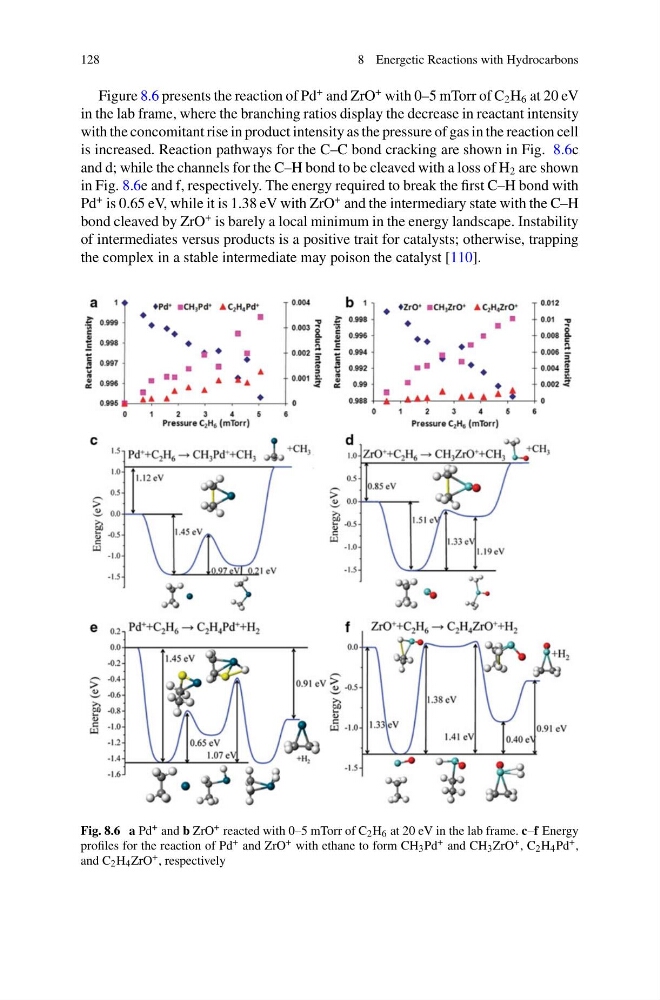
Figure 8.6 presents the reaction of Pd
+ and ZrO
+ with 0–5 mTorr of C 2 H 6 at 20 eV
in the lab frame, where the branching ratios display the decrease in reactant intensity
with the concomitant rise in product intensity as the pressure of gas in the reaction cell
is increased. Reaction pathways for the C–C bond cracking are shown in Fig. 8.6c
and d; while the channels for the C–H bond to be cleaved with a loss of H 2 are shown
in Fig. 8.6e and f, respectively. The energy required to break the first C–H bond with
Pd
+ is 0.65 eV, while it is 1.38 eV with ZrO
+ and the intermediary state with the C–H
bond cleaved by ZrO
+ is barely a local minimum in the energy landscape. Instability
of intermediates versus products is a positive trait for catalysts; otherwise, trapping
the complex in a stable intermediate may poison the catalyst [110].
Fig. 8.6 a Pd + and b ZrO + reacted with 0–5 mTorr of C 2 H 6 at 20 eV in the lab frame. c–f Energy
profiles for the reaction of Pd + and ZrO + with ethane to form CH 3 Pd + and CH 3 ZrO + , C 2 H 4 Pd + ,
and C 2 H 4 ZrO + , respectively
8 Energetic Reactions with Hydrocarbons
Figure 8.6 presents the reaction of Pd
+ and ZrO
+ with 0–5 mTorr of C 2 H 6 at 20 eV
in the lab frame, where the branching ratios display the decrease in reactant intensity
with the concomitant rise in product intensity as the pressure of gas in the reaction cell
is increased. Reaction pathways for the C–C bond cracking are shown in Fig. 8.6c
and d; while the channels for the C–H bond to be cleaved with a loss of H 2 are shown
in Fig. 8.6e and f, respectively. The energy required to break the first C–H bond with
Pd
+ is 0.65 eV, while it is 1.38 eV with ZrO
+ and the intermediary state with the C–H
bond cleaved by ZrO
+ is barely a local minimum in the energy landscape. Instability
of intermediates versus products is a positive trait for catalysts; otherwise, trapping
the complex in a stable intermediate may poison the catalyst [110].
Fig. 8.6 a Pd + and b ZrO + reacted with 0–5 mTorr of C 2 H 6 at 20 eV in the lab frame. c–f Energy
profiles for the reaction of Pd + and ZrO + with ethane to form CH 3 Pd + and CH 3 ZrO + , C 2 H 4 Pd + ,
and C 2 H 4 ZrO + , respectively