

8.3 C−H Bond Activation
127
this precious metal exist on the earth, attempts to identify inexpensive replacement
catalysts with comparable efficiency are motivated. It has been proposed that by
incorporating non-metallic elements (e.g., carbon or oxygen) into the early transition
metal, the surface reactivity of the metal can be moderated to produce an effective
catalyst [105]. The presence of nonmetal element changes the electron density of
the metal and modulates the position of the d states near the Fermi energy, and
the coordination of nonmetal atoms around metal atoms has a large influence upon
catalytic activity. Studying the reactivity of isolated gas-phase ions/clusters with
simple alkanes provide opportunities to identify microscopic origins of the reactivity
[106, 107].
Early thermodynamical studies have suggested the reactivity of C 2 H 6 and C 3 H 8
activated by Pd
+ , which revealed the existence of channels for the cleavage of C–C
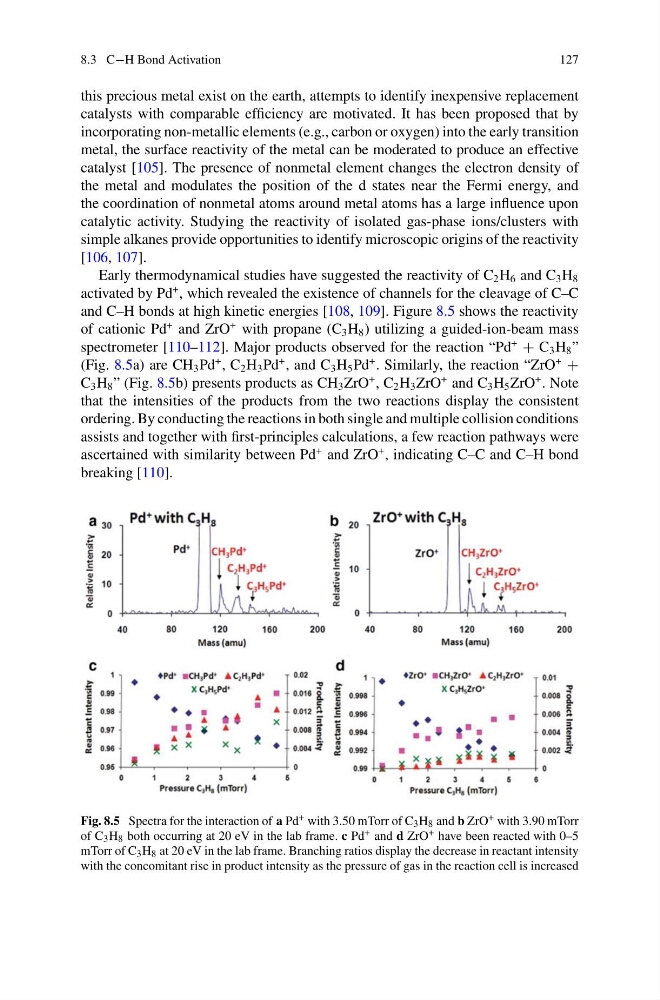
and C–H bonds at high kinetic energies [108, 109]. Figure 8.5 shows the reactivity
of cationic Pd
+ and ZrO
+ with propane (C 3 H 8 ) utilizing a guided-ion-beam mass
spectrometer [110–112]. Major products observed for the reaction “Pd
+
+ C 3 H 8 ”
(Fig. 8.5a) are CH 3 Pd
+ , C 2 H 3 Pd
+ , and C 3 H 5 Pd
+ . Similarly, the reaction “ZrO
+
+
C 3 H 8 ” (Fig. 8.5b) presents products as CH 3 ZrO
+ , C 2 H 3 ZrO
+ and C 3 H 5 ZrO
+ . Note
that the intensities of the products from the two reactions display the consistent
ordering. By conducting the reactions in both single and multiple collision conditions
assists and together with first-principles calculations, a few reaction pathways were
ascertained with similarity between Pd
+ and ZrO
+ , indicating C–C and C–H bond
breaking [110].
Fig. 8.5 Spectra for the interaction of a Pd + with 3.50 mTorr of C 3 H 8 and b ZrO + with 3.90 mTorr
of C 3 H 8 both occurring at 20 eV in the lab frame. c Pd + and d ZrO + have been reacted with 0–5
mTorr of C 3 H 8 at 20 eV in the lab frame. Branching ratios display the decrease in reactant intensity
with the concomitant rise in product intensity as the pressure of gas in the reaction cell is increased
127
this precious metal exist on the earth, attempts to identify inexpensive replacement
catalysts with comparable efficiency are motivated. It has been proposed that by
incorporating non-metallic elements (e.g., carbon or oxygen) into the early transition
metal, the surface reactivity of the metal can be moderated to produce an effective
catalyst [105]. The presence of nonmetal element changes the electron density of
the metal and modulates the position of the d states near the Fermi energy, and
the coordination of nonmetal atoms around metal atoms has a large influence upon
catalytic activity. Studying the reactivity of isolated gas-phase ions/clusters with
simple alkanes provide opportunities to identify microscopic origins of the reactivity
[106, 107].
Early thermodynamical studies have suggested the reactivity of C 2 H 6 and C 3 H 8
activated by Pd
+ , which revealed the existence of channels for the cleavage of C–C
and C–H bonds at high kinetic energies [108, 109]. Figure 8.5 shows the reactivity
of cationic Pd
+ and ZrO
+ with propane (C 3 H 8 ) utilizing a guided-ion-beam mass
spectrometer [110–112]. Major products observed for the reaction “Pd
+
+ C 3 H 8 ”
(Fig. 8.5a) are CH 3 Pd
+ , C 2 H 3 Pd
+ , and C 3 H 5 Pd
+ . Similarly, the reaction “ZrO
+
+
C 3 H 8 ” (Fig. 8.5b) presents products as CH 3 ZrO
+ , C 2 H 3 ZrO
+ and C 3 H 5 ZrO
+ . Note
that the intensities of the products from the two reactions display the consistent
ordering. By conducting the reactions in both single and multiple collision conditions
assists and together with first-principles calculations, a few reaction pathways were
ascertained with similarity between Pd
+ and ZrO
+ , indicating C–C and C–H bond
breaking [110].
Fig. 8.5 Spectra for the interaction of a Pd + with 3.50 mTorr of C 3 H 8 and b ZrO + with 3.90 mTorr
of C 3 H 8 both occurring at 20 eV in the lab frame. c Pd + and d ZrO + have been reacted with 0–5
mTorr of C 3 H 8 at 20 eV in the lab frame. Branching ratios display the decrease in reactant intensity
with the concomitant rise in product intensity as the pressure of gas in the reaction cell is increased