

126
8 Energetic Reactions with Hydrocarbons
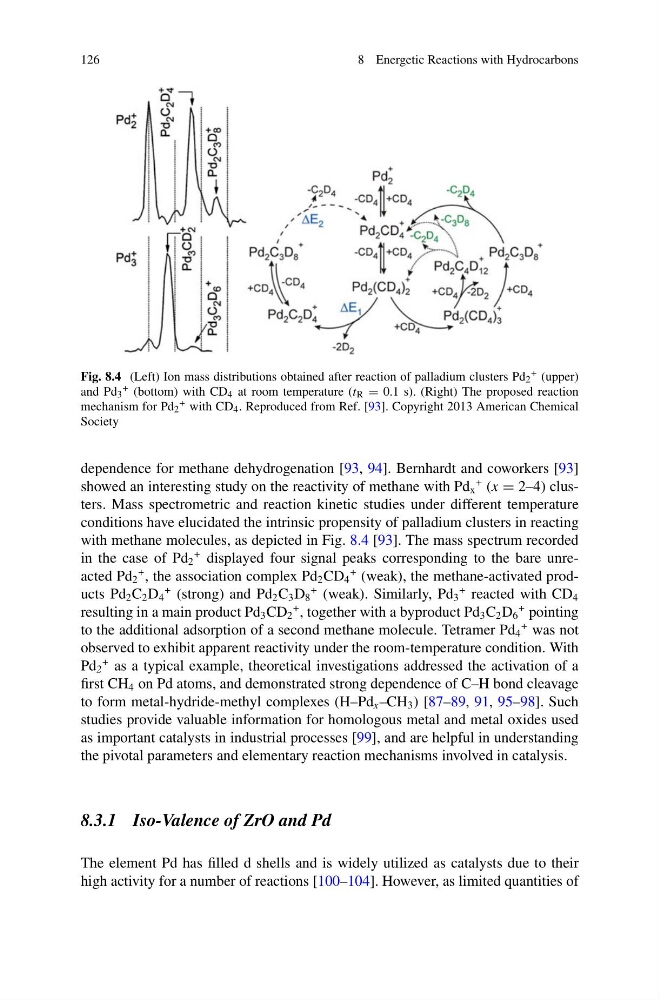
Fig. 8.4 (Left) Ion mass distributions obtained after reaction of palladium clusters Pd 2
+ (upper)
and Pd 3
+ (bottom) with CD 4 at room temperature (t R = 0.1 s). (Right) The proposed reaction
mechanism for Pd 2
+ with CD 4 . Reproduced from Ref. [93]. Copyright 2013 American Chemical
Society
dependence for methane dehydrogenation [93, 94]. Bernhardt and coworkers [93]
showed an interesting study on the reactivity of methane with Pd x
+ (x = 2–4) clusters. Mass spectrometric and reaction kinetic studies under different temperature
conditions have elucidated the intrinsic propensity of palladium clusters in reacting
with methane molecules, as depicted in Fig. 8.4 [93]. The mass spectrum recorded
in the case of Pd 2
+ displayed four signal peaks corresponding to the bare unreacted Pd 2
+ , the association complex Pd 2 CD 4
+ (weak), the methane-activated products Pd 2 C 2 D 4
+ (strong) and Pd 2 C 3 D 8
+ (weak). Similarly, Pd 3
+ reacted with CD 4
resulting in a main product Pd 3 CD 2
+ , together with a byproduct Pd 3 C 2 D 6
+ pointing
to the additional adsorption of a second methane molecule. Tetramer Pd 4
+ was not
observed to exhibit apparent reactivity under the room-temperature condition. With
Pd 2
+ as a typical example, theoretical investigations addressed the activation of a
first CH 4 on Pd atoms, and demonstrated strong dependence of C–H bond cleavage
to form metal-hydride-methyl complexes (H–Pd x –CH 3 ) [87–89, 91, 95–98]. Such
studies provide valuable information for homologous metal and metal oxides used
as important catalysts in industrial processes [99], and are helpful in understanding
the pivotal parameters and elementary reaction mechanisms involved in catalysis.
8.3.1 Iso-Valence of ZrO and Pd
The element Pd has filled d shells and is widely utilized as catalysts due to their
high activity for a number of reactions [100–104]. However, as limited quantities of
8 Energetic Reactions with Hydrocarbons
Fig. 8.4 (Left) Ion mass distributions obtained after reaction of palladium clusters Pd 2
+ (upper)
and Pd 3
+ (bottom) with CD 4 at room temperature (t R = 0.1 s). (Right) The proposed reaction
mechanism for Pd 2
+ with CD 4 . Reproduced from Ref. [93]. Copyright 2013 American Chemical
Society
dependence for methane dehydrogenation [93, 94]. Bernhardt and coworkers [93]
showed an interesting study on the reactivity of methane with Pd x
+ (x = 2–4) clusters. Mass spectrometric and reaction kinetic studies under different temperature
conditions have elucidated the intrinsic propensity of palladium clusters in reacting
with methane molecules, as depicted in Fig. 8.4 [93]. The mass spectrum recorded
in the case of Pd 2
+ displayed four signal peaks corresponding to the bare unreacted Pd 2
+ , the association complex Pd 2 CD 4
+ (weak), the methane-activated products Pd 2 C 2 D 4
+ (strong) and Pd 2 C 3 D 8
+ (weak). Similarly, Pd 3
+ reacted with CD 4
resulting in a main product Pd 3 CD 2
+ , together with a byproduct Pd 3 C 2 D 6
+ pointing
to the additional adsorption of a second methane molecule. Tetramer Pd 4
+ was not
observed to exhibit apparent reactivity under the room-temperature condition. With
Pd 2
+ as a typical example, theoretical investigations addressed the activation of a
first CH 4 on Pd atoms, and demonstrated strong dependence of C–H bond cleavage
to form metal-hydride-methyl complexes (H–Pd x –CH 3 ) [87–89, 91, 95–98]. Such
studies provide valuable information for homologous metal and metal oxides used
as important catalysts in industrial processes [99], and are helpful in understanding
the pivotal parameters and elementary reaction mechanisms involved in catalysis.
8.3.1 Iso-Valence of ZrO and Pd
The element Pd has filled d shells and is widely utilized as catalysts due to their
high activity for a number of reactions [100–104]. However, as limited quantities of