

8.3 C−H Bond Activation
129
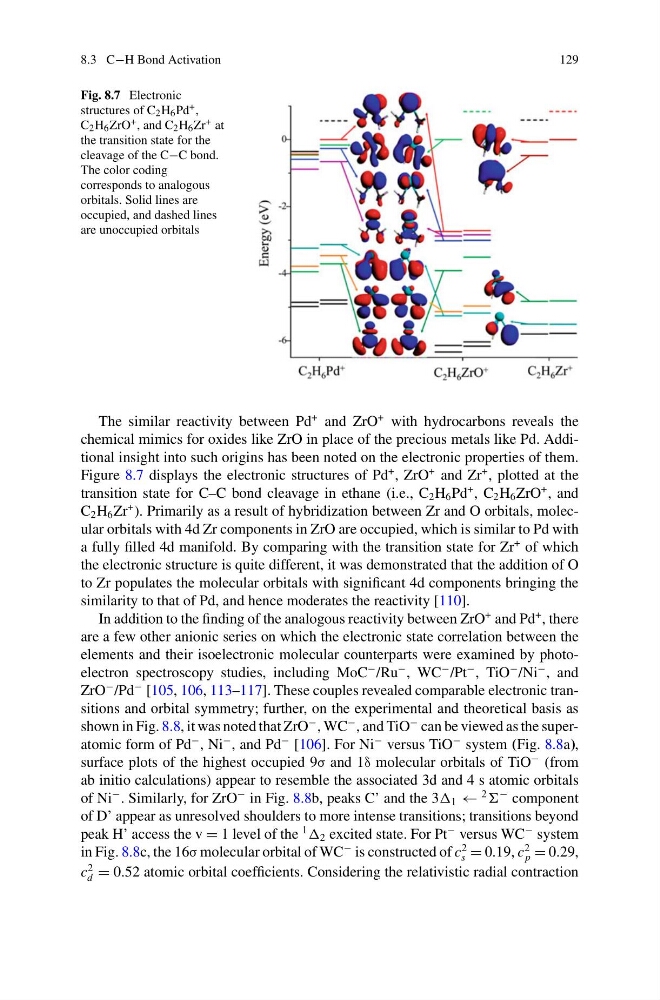
Fig. 8.7 Electronic
structures of C 2 H 6 Pd + ,
C 2 H 6 ZrO + , and C 2 H 6 Zr + at
the transition state for the
cleavage of the C−C bond.
The color coding
corresponds to analogous
orbitals. Solid lines are
occupied, and dashed lines
are unoccupied orbitals
The similar reactivity between Pd
+ and ZrO
+ with hydrocarbons reveals the
chemical mimics for oxides like ZrO in place of the precious metals like Pd. Additional insight into such origins has been noted on the electronic properties of them.
Figure 8.7 displays the electronic structures of Pd
+ , ZrO
+ and Zr
+ , plotted at the
transition state for C–C bond cleavage in ethane (i.e., C 2 H 6 Pd
+ , C 2 H 6 ZrO
+ , and
C 2 H 6 Zr
+ ). Primarily as a result of hybridization between Zr and O orbitals, molecular orbitals with 4d Zr components in ZrO are occupied, which is similar to Pd with
a fully filled 4d manifold. By comparing with the transition state for Zr
+ of which
the electronic structure is quite different, it was demonstrated that the addition of O
to Zr populates the molecular orbitals with significant 4d components bringing the
similarity to that of Pd, and hence moderates the reactivity [110].
In addition to the finding of the analogous reactivity between ZrO
+ and Pd
+ , there
are a few other anionic series on which the electronic state correlation between the
elements and their isoelectronic molecular counterparts were examined by photoelectron spectroscopy studies, including MoC
− /Ru
− , WC
− /Pt
− , TiO
− /Ni
− , and
ZrO
− /Pd
− [105, 106, 113–117]. These couples revealed comparable electronic transitions and orbital symmetry; further, on the experimental and theoretical basis as
shown in Fig. 8.8, it was noted that ZrO
− , WC
− , and TiO
− can be viewed as the superatomic form of Pd
− , Ni
− , and Pd
− [106]. For Ni
− versus TiO
− system (Fig. 8.8a),
surface plots of the highest occupied 9σ and 1δ molecular orbitals of TiO
− (from
ab initio calculations) appear to resemble the associated 3d and 4 s atomic orbitals
of Ni
− . Similarly, for ZrO
− in Fig. 8.8b, peaks C’ and the 3 1 ←
2
− component
of D’ appear as unresolved shoulders to more intense transitions; transitions beyond
peak H’ access the v = 1 level of the
1
2 excited state. For Pt
− versus WC
− system
in Fig. 8.8c, the 16σ molecular orbital of WC
− is constructed of c
2
s = 0.19, c
2
p = 0.29,
c
2
d = 0.52 atomic orbital coefficients. Considering the relativistic radial contraction
129
Fig. 8.7 Electronic
structures of C 2 H 6 Pd + ,
C 2 H 6 ZrO + , and C 2 H 6 Zr + at
the transition state for the
cleavage of the C−C bond.
The color coding
corresponds to analogous
orbitals. Solid lines are
occupied, and dashed lines
are unoccupied orbitals
The similar reactivity between Pd
+ and ZrO
+ with hydrocarbons reveals the
chemical mimics for oxides like ZrO in place of the precious metals like Pd. Additional insight into such origins has been noted on the electronic properties of them.
Figure 8.7 displays the electronic structures of Pd
+ , ZrO
+ and Zr
+ , plotted at the
transition state for C–C bond cleavage in ethane (i.e., C 2 H 6 Pd
+ , C 2 H 6 ZrO
+ , and
C 2 H 6 Zr
+ ). Primarily as a result of hybridization between Zr and O orbitals, molecular orbitals with 4d Zr components in ZrO are occupied, which is similar to Pd with
a fully filled 4d manifold. By comparing with the transition state for Zr
+ of which
the electronic structure is quite different, it was demonstrated that the addition of O
to Zr populates the molecular orbitals with significant 4d components bringing the
similarity to that of Pd, and hence moderates the reactivity [110].
In addition to the finding of the analogous reactivity between ZrO
+ and Pd
+ , there
are a few other anionic series on which the electronic state correlation between the
elements and their isoelectronic molecular counterparts were examined by photoelectron spectroscopy studies, including MoC
− /Ru
− , WC
− /Pt
− , TiO
− /Ni
− , and
ZrO
− /Pd
− [105, 106, 113–117]. These couples revealed comparable electronic transitions and orbital symmetry; further, on the experimental and theoretical basis as
shown in Fig. 8.8, it was noted that ZrO
− , WC
− , and TiO
− can be viewed as the superatomic form of Pd
− , Ni
− , and Pd
− [106]. For Ni
− versus TiO
− system (Fig. 8.8a),
surface plots of the highest occupied 9σ and 1δ molecular orbitals of TiO
− (from
ab initio calculations) appear to resemble the associated 3d and 4 s atomic orbitals
of Ni
− . Similarly, for ZrO
− in Fig. 8.8b, peaks C’ and the 3 1 ←
2
− component
of D’ appear as unresolved shoulders to more intense transitions; transitions beyond
peak H’ access the v = 1 level of the
1
2 excited state. For Pt
− versus WC
− system
in Fig. 8.8c, the 16σ molecular orbital of WC
− is constructed of c
2
s = 0.19, c
2
p = 0.29,
c
2
d = 0.52 atomic orbital coefficients. Considering the relativistic radial contraction