

7.4 Reactivity of CO with Ti x O y
+ and Zr x O y
+
113
A
B
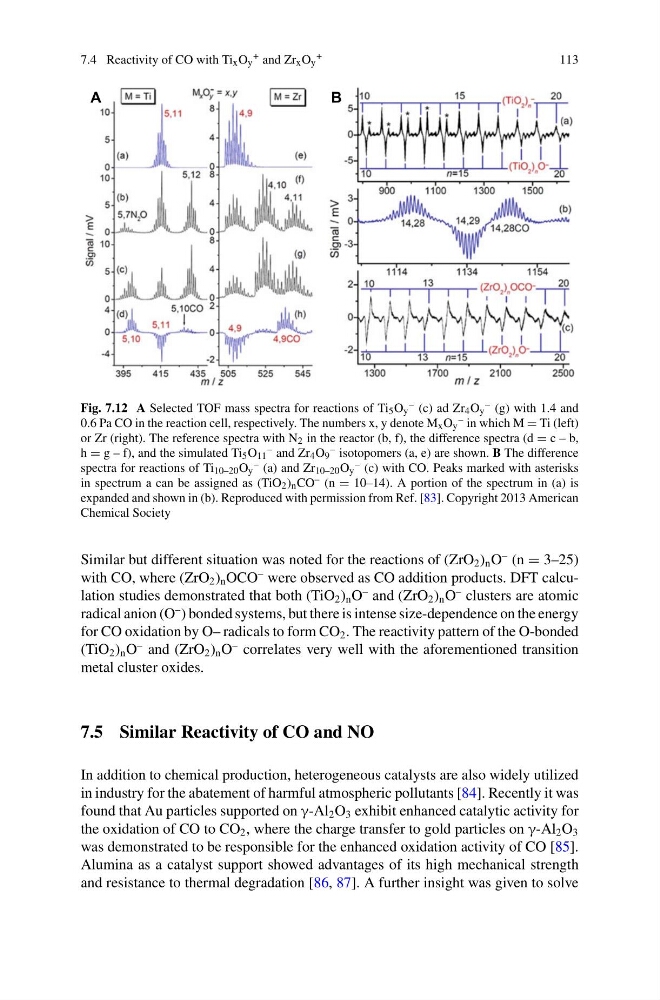
Fig. 7.12 A Selected TOF mass spectra for reactions of Ti 5 O y
– (c) ad Zr 4 O y
– (g) with 1.4 and
0.6 Pa CO in the reaction cell, respectively. The numbers x, y denote M x O y
– in which M = Ti (left)
or Zr (right). The reference spectra with N 2 in the reactor (b, f), the difference spectra (d = c – b,
h = g – f), and the simulated Ti 5 O 11
– and Zr 4 O 9
– isotopomers (a, e) are shown. B The difference
spectra for reactions of Ti 10–20 O y
– (a) and Zr 10–20 O y
– (c) with CO. Peaks marked with asterisks
in spectrum a can be assigned as (TiO 2 ) n CO – (n = 10–14). A portion of the spectrum in (a) is
expanded and shown in (b). Reproduced with permission from Ref. [83]. Copyright 2013 American
Chemical Society
Similar but different situation was noted for the reactions of (ZrO 2 ) n O
– (n = 3–25)
with CO, where (ZrO 2 ) n OCO
– were observed as CO addition products. DFT calculation studies demonstrated that both (TiO 2 ) n O
– and (ZrO 2 ) n O
– clusters are atomic
radical anion (O
– ) bonded systems, but there is intense size-dependence on the energy
for CO oxidation by O– radicals to form CO 2 . The reactivity pattern of the O-bonded
(TiO 2 ) n O
– and (ZrO 2 ) n O
– correlates very well with the aforementioned transition
metal cluster oxides.
7.5 Similar Reactivity of CO and NO
In addition to chemical production, heterogeneous catalysts are also widely utilized
in industry for the abatement of harmful atmospheric pollutants [84]. Recently it was
found that Au particles supported on γ-Al 2 O 3 exhibit enhanced catalytic activity for
the oxidation of CO to CO 2 , where the charge transfer to gold particles on γ-Al 2 O 3
was demonstrated to be responsible for the enhanced oxidation activity of CO [85].
Alumina as a catalyst support showed advantages of its high mechanical strength
and resistance to thermal degradation [86, 87]. A further insight was given to solve
+ and Zr x O y
+
113
A
B
Fig. 7.12 A Selected TOF mass spectra for reactions of Ti 5 O y
– (c) ad Zr 4 O y
– (g) with 1.4 and
0.6 Pa CO in the reaction cell, respectively. The numbers x, y denote M x O y
– in which M = Ti (left)
or Zr (right). The reference spectra with N 2 in the reactor (b, f), the difference spectra (d = c – b,
h = g – f), and the simulated Ti 5 O 11
– and Zr 4 O 9
– isotopomers (a, e) are shown. B The difference
spectra for reactions of Ti 10–20 O y
– (a) and Zr 10–20 O y
– (c) with CO. Peaks marked with asterisks
in spectrum a can be assigned as (TiO 2 ) n CO – (n = 10–14). A portion of the spectrum in (a) is
expanded and shown in (b). Reproduced with permission from Ref. [83]. Copyright 2013 American
Chemical Society
Similar but different situation was noted for the reactions of (ZrO 2 ) n O
– (n = 3–25)
with CO, where (ZrO 2 ) n OCO
– were observed as CO addition products. DFT calculation studies demonstrated that both (TiO 2 ) n O
– and (ZrO 2 ) n O
– clusters are atomic
radical anion (O
– ) bonded systems, but there is intense size-dependence on the energy
for CO oxidation by O– radicals to form CO 2 . The reactivity pattern of the O-bonded
(TiO 2 ) n O
– and (ZrO 2 ) n O
– correlates very well with the aforementioned transition
metal cluster oxides.
7.5 Similar Reactivity of CO and NO
In addition to chemical production, heterogeneous catalysts are also widely utilized
in industry for the abatement of harmful atmospheric pollutants [84]. Recently it was
found that Au particles supported on γ-Al 2 O 3 exhibit enhanced catalytic activity for
the oxidation of CO to CO 2 , where the charge transfer to gold particles on γ-Al 2 O 3
was demonstrated to be responsible for the enhanced oxidation activity of CO [85].
Alumina as a catalyst support showed advantages of its high mechanical strength
and resistance to thermal degradation [86, 87]. A further insight was given to solve