

114
7 The Reactions with Monoxides for Pollution Removal
the fundamental questions whether aluminum oxides are reactive with CO and how
an accumulation or deficiency of electron density influences their reactivity [88].
Employing guided-ion-beam mass spectrometry, Johnson et al. investigated the
small aluminum oxide clusters regarding their reactivity toward CO [88]. As results,
clusters with the same stoichiometry as bulk alumina, both cationic and anionic
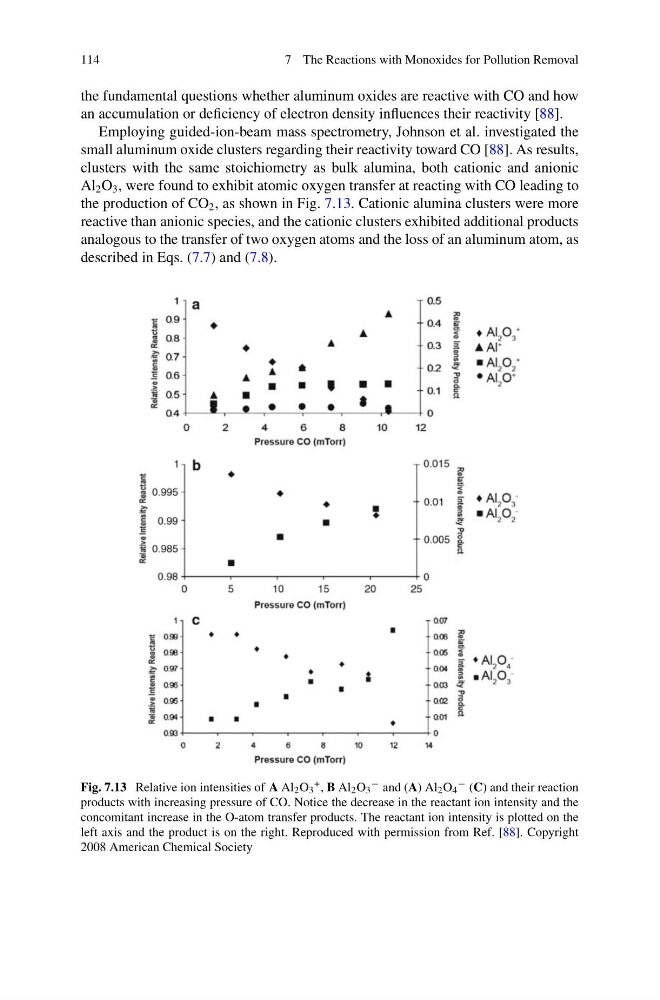
Al 2 O 3 , were found to exhibit atomic oxygen transfer at reacting with CO leading to
the production of CO 2 , as shown in Fig. 7.13. Cationic alumina clusters were more
reactive than anionic species, and the cationic clusters exhibited additional products
analogous to the transfer of two oxygen atoms and the loss of an aluminum atom, as
described in Eqs. (7.7) and (7.8).
Fig. 7.13 Relative ion intensities of A Al 2 O 3
+ , B Al 2 O 3
− and (A) Al 2 O 4
− (C) and their reaction
products with increasing pressure of CO. Notice the decrease in the reactant ion intensity and the
concomitant increase in the O-atom transfer products. The reactant ion intensity is plotted on the
left axis and the product is on the right. Reproduced with permission from Ref. [88]. Copyright
2008 American Chemical Society
7 The Reactions with Monoxides for Pollution Removal
the fundamental questions whether aluminum oxides are reactive with CO and how
an accumulation or deficiency of electron density influences their reactivity [88].
Employing guided-ion-beam mass spectrometry, Johnson et al. investigated the
small aluminum oxide clusters regarding their reactivity toward CO [88]. As results,
clusters with the same stoichiometry as bulk alumina, both cationic and anionic
Al 2 O 3 , were found to exhibit atomic oxygen transfer at reacting with CO leading to
the production of CO 2 , as shown in Fig. 7.13. Cationic alumina clusters were more
reactive than anionic species, and the cationic clusters exhibited additional products
analogous to the transfer of two oxygen atoms and the loss of an aluminum atom, as
described in Eqs. (7.7) and (7.8).
Fig. 7.13 Relative ion intensities of A Al 2 O 3
+ , B Al 2 O 3
− and (A) Al 2 O 4
− (C) and their reaction
products with increasing pressure of CO. Notice the decrease in the reactant ion intensity and the
concomitant increase in the O-atom transfer products. The reactant ion intensity is plotted on the
left axis and the product is on the right. Reproduced with permission from Ref. [88]. Copyright
2008 American Chemical Society