

112
7 The Reactions with Monoxides for Pollution Removal
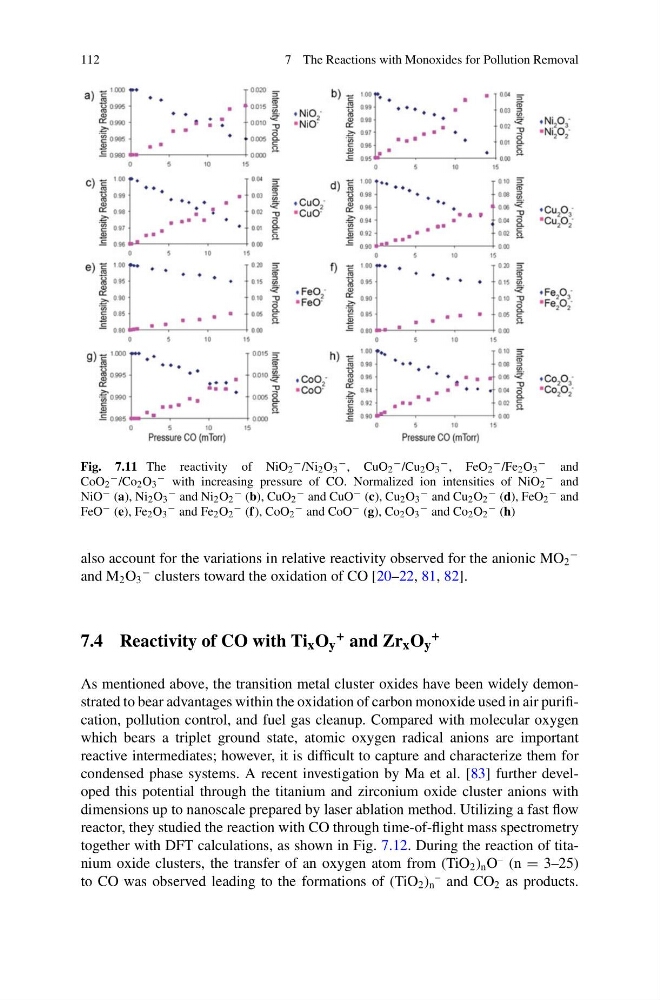
Fig. 7.11 The reactivity of NiO 2
− /Ni 2 O 3
− , CuO 2
− /Cu 2 O 3
− , FeO 2
− /Fe 2 O 3
−
and
CoO 2
− /Co 2 O 3
− with increasing pressure of CO. Normalized ion intensities of NiO 2
− and
NiO − (a), Ni 2 O 3
− and Ni 2 O 2
− (b), CuO 2
− and CuO − (c), Cu 2 O 3
− and Cu 2 O 2
− (d), FeO 2
− and
FeO − (e), Fe 2 O 3
− and Fe 2 O 2
− (f), CoO 2
− and CoO − (g), Co 2 O 3
− and Co 2 O 2
− (h)
also account for the variations in relative reactivity observed for the anionic MO 2
−
and M 2 O 3
− clusters toward the oxidation of CO [20–22, 81, 82].
7.4 Reactivity of CO with Ti x O y
+ and Zr x O y
+
As mentioned above, the transition metal cluster oxides have been widely demonstrated to bear advantages within the oxidation of carbon monoxide used in air purification, pollution control, and fuel gas cleanup. Compared with molecular oxygen
which bears a triplet ground state, atomic oxygen radical anions are important
reactive intermediates; however, it is difficult to capture and characterize them for
condensed phase systems. A recent investigation by Ma et al. [83] further developed this potential through the titanium and zirconium oxide cluster anions with
dimensions up to nanoscale prepared by laser ablation method. Utilizing a fast flow
reactor, they studied the reaction with CO through time-of-flight mass spectrometry
together with DFT calculations, as shown in Fig. 7.12. During the reaction of titanium oxide clusters, the transfer of an oxygen atom from (TiO 2 ) n O
– (n = 3–25)
to CO was observed leading to the formations of (TiO 2 ) n
– and CO 2 as products.
7 The Reactions with Monoxides for Pollution Removal
Fig. 7.11 The reactivity of NiO 2
− /Ni 2 O 3
− , CuO 2
− /Cu 2 O 3
− , FeO 2
− /Fe 2 O 3
−
and
CoO 2
− /Co 2 O 3
− with increasing pressure of CO. Normalized ion intensities of NiO 2
− and
NiO − (a), Ni 2 O 3
− and Ni 2 O 2
− (b), CuO 2
− and CuO − (c), Cu 2 O 3
− and Cu 2 O 2
− (d), FeO 2
− and
FeO − (e), Fe 2 O 3
− and Fe 2 O 2
− (f), CoO 2
− and CoO − (g), Co 2 O 3
− and Co 2 O 2
− (h)
also account for the variations in relative reactivity observed for the anionic MO 2
−
and M 2 O 3
− clusters toward the oxidation of CO [20–22, 81, 82].
7.4 Reactivity of CO with Ti x O y
+ and Zr x O y
+
As mentioned above, the transition metal cluster oxides have been widely demonstrated to bear advantages within the oxidation of carbon monoxide used in air purification, pollution control, and fuel gas cleanup. Compared with molecular oxygen
which bears a triplet ground state, atomic oxygen radical anions are important
reactive intermediates; however, it is difficult to capture and characterize them for
condensed phase systems. A recent investigation by Ma et al. [83] further developed this potential through the titanium and zirconium oxide cluster anions with
dimensions up to nanoscale prepared by laser ablation method. Utilizing a fast flow
reactor, they studied the reaction with CO through time-of-flight mass spectrometry
together with DFT calculations, as shown in Fig. 7.12. During the reaction of titanium oxide clusters, the transfer of an oxygen atom from (TiO 2 ) n O
– (n = 3–25)
to CO was observed leading to the formations of (TiO 2 ) n
– and CO 2 as products.