

7.3 Reactivity of CO with Iron Oxides
111
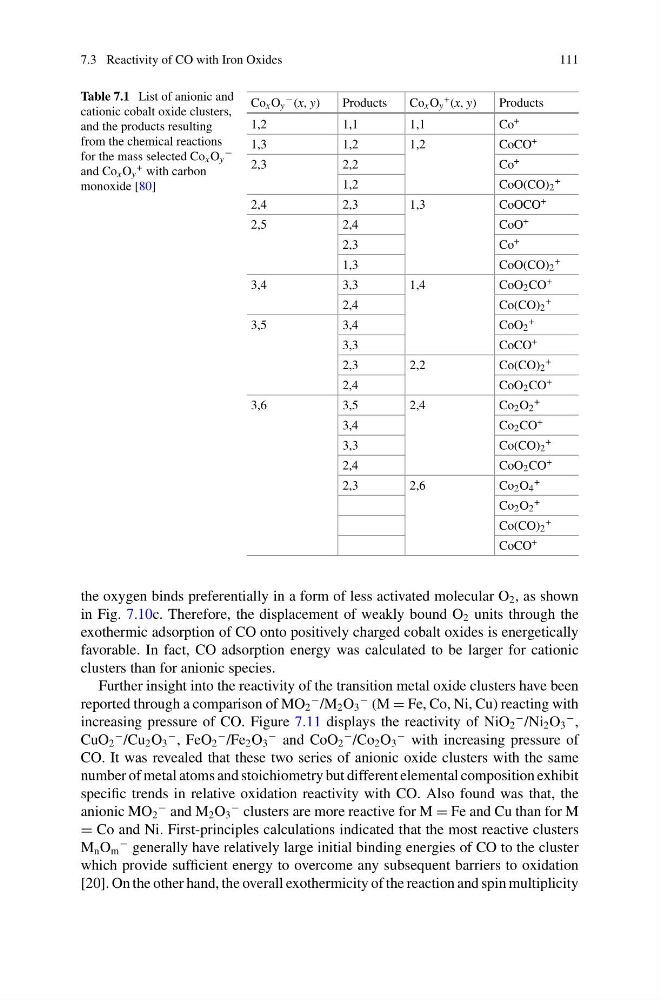
Table 7.1 List of anionic and
cationic cobalt oxide clusters,
and the products resulting
from the chemical reactions
for the mass selected Co x O y
−
and Co x O y
+ with carbon
monoxide [80]
Co x O y
− (x, y)
Products
Co x O y
+ (x, y)
Products
1,2
1,1
1,1
Co +
1,3
1,2
1,2
CoCO +
2,3
2,2
Co +
1,2
CoO(CO) 2
+
2,4
2,3
1,3
CoOCO +
2,5
2,4
CoO +
2,3
Co +
1,3
CoO(CO) 2
+
3,4
3,3
1,4
CoO 2 CO +
2,4
Co(CO) 2
+
3,5
3,4
CoO 2
+
3,3
CoCO +
2,3
2,2
Co(CO) 2
+
2,4
CoO 2 CO +
3,6
3,5
2,4
Co 2 O 2
+
3,4
Co 2 CO +
3,3
Co(CO) 2
+
2,4
CoO 2 CO +
2,3
2,6
Co 2 O 4
+
Co 2 O 2
+
Co(CO) 2
+
CoCO +
the oxygen binds preferentially in a form of less activated molecular O 2 , as shown
in Fig. 7.10c. Therefore, the displacement of weakly bound O 2 units through the
exothermic adsorption of CO onto positively charged cobalt oxides is energetically
favorable. In fact, CO adsorption energy was calculated to be larger for cationic
clusters than for anionic species.
Further insight into the reactivity of the transition metal oxide clusters have been
reported through a comparison of MO 2
− /M 2 O 3
− (M = Fe, Co, Ni, Cu) reacting with
increasing pressure of CO. Figure 7.11 displays the reactivity of NiO 2
− /Ni 2 O 3
− ,
CuO 2
− /Cu 2 O 3
− , FeO 2
− /Fe 2 O 3
− and CoO 2
− /Co 2 O 3
− with increasing pressure of
CO. It was revealed that these two series of anionic oxide clusters with the same
number of metal atoms and stoichiometry but different elemental composition exhibit
specific trends in relative oxidation reactivity with CO. Also found was that, the
anionic MO 2
− and M 2 O 3
− clusters are more reactive for M = Fe and Cu than for M
= Co and Ni. First-principles calculations indicated that the most reactive clusters
M n O m
− generally have relatively large initial binding energies of CO to the cluster
which provide sufficient energy to overcome any subsequent barriers to oxidation
[20]. On the other hand, the overall exothermicity of the reaction and spin multiplicity
111
Table 7.1 List of anionic and
cationic cobalt oxide clusters,
and the products resulting
from the chemical reactions
for the mass selected Co x O y
−
and Co x O y
+ with carbon
monoxide [80]
Co x O y
− (x, y)
Products
Co x O y
+ (x, y)
Products
1,2
1,1
1,1
Co +
1,3
1,2
1,2
CoCO +
2,3
2,2
Co +
1,2
CoO(CO) 2
+
2,4
2,3
1,3
CoOCO +
2,5
2,4
CoO +
2,3
Co +
1,3
CoO(CO) 2
+
3,4
3,3
1,4
CoO 2 CO +
2,4
Co(CO) 2
+
3,5
3,4
CoO 2
+
3,3
CoCO +
2,3
2,2
Co(CO) 2
+
2,4
CoO 2 CO +
3,6
3,5
2,4
Co 2 O 2
+
3,4
Co 2 CO +
3,3
Co(CO) 2
+
2,4
CoO 2 CO +
2,3
2,6
Co 2 O 4
+
Co 2 O 2
+
Co(CO) 2
+
CoCO +
the oxygen binds preferentially in a form of less activated molecular O 2 , as shown
in Fig. 7.10c. Therefore, the displacement of weakly bound O 2 units through the
exothermic adsorption of CO onto positively charged cobalt oxides is energetically
favorable. In fact, CO adsorption energy was calculated to be larger for cationic
clusters than for anionic species.
Further insight into the reactivity of the transition metal oxide clusters have been
reported through a comparison of MO 2
− /M 2 O 3
− (M = Fe, Co, Ni, Cu) reacting with
increasing pressure of CO. Figure 7.11 displays the reactivity of NiO 2
− /Ni 2 O 3
− ,
CuO 2
− /Cu 2 O 3
− , FeO 2
− /Fe 2 O 3
− and CoO 2
− /Co 2 O 3
− with increasing pressure of
CO. It was revealed that these two series of anionic oxide clusters with the same
number of metal atoms and stoichiometry but different elemental composition exhibit
specific trends in relative oxidation reactivity with CO. Also found was that, the
anionic MO 2
− and M 2 O 3
− clusters are more reactive for M = Fe and Cu than for M
= Co and Ni. First-principles calculations indicated that the most reactive clusters
M n O m
− generally have relatively large initial binding energies of CO to the cluster
which provide sufficient energy to overcome any subsequent barriers to oxidation
[20]. On the other hand, the overall exothermicity of the reaction and spin multiplicity