

110
7 The Reactions with Monoxides for Pollution Removal
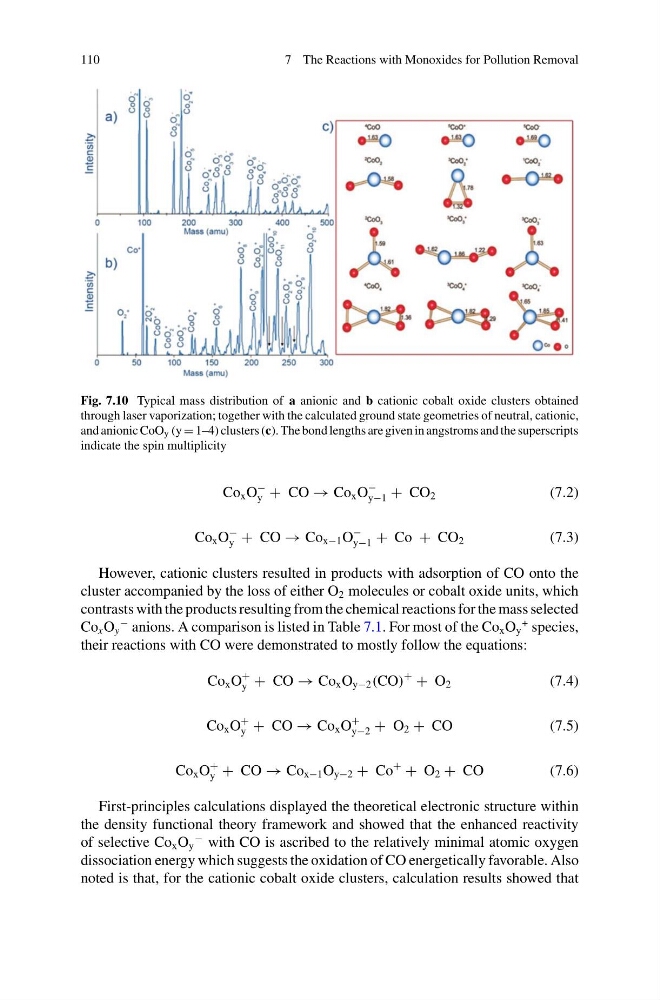
Fig. 7.10 Typical mass distribution of a anionic and b cationic cobalt oxide clusters obtained
through laser vaporization; together with the calculated ground state geometries of neutral, cationic,
and anionic CoO y (y = 1–4) clusters (c). The bond lengths are given in angstroms and the superscripts
indicate the spin multiplicity
Co x O
−
y + CO → Co x O
−
y−1 + CO 2
(7.2)
Co x O
−
y + CO → Co x−1 O
−
y−1 + Co + CO 2
(7.3)
However, cationic clusters resulted in products with adsorption of CO onto the
cluster accompanied by the loss of either O 2 molecules or cobalt oxide units, which
contrasts with the products resulting from the chemical reactions for the mass selected
Co x O y
− anions. A comparison is listed in Table 7.1. For most of the Co x O y
+ species,
their reactions with CO were demonstrated to mostly follow the equations:
Co x O
+
y + CO → Co x O y−2 (CO)
+
+ O 2
(7.4)
Co x O
+
y + CO → Co x O
+
y−2 + O 2 + CO
(7.5)
Co x O
+
y + CO → Co x−1 O y−2 + Co
+
+ O 2 + CO
(7.6)
First-principles calculations displayed the theoretical electronic structure within
the density functional theory framework and showed that the enhanced reactivity
of selective Co x O y
− with CO is ascribed to the relatively minimal atomic oxygen
dissociation energy which suggests the oxidation of CO energetically favorable. Also
noted is that, for the cationic cobalt oxide clusters, calculation results showed that
7 The Reactions with Monoxides for Pollution Removal
Fig. 7.10 Typical mass distribution of a anionic and b cationic cobalt oxide clusters obtained
through laser vaporization; together with the calculated ground state geometries of neutral, cationic,
and anionic CoO y (y = 1–4) clusters (c). The bond lengths are given in angstroms and the superscripts
indicate the spin multiplicity
Co x O
−
y + CO → Co x O
−
y−1 + CO 2
(7.2)
Co x O
−
y + CO → Co x−1 O
−
y−1 + Co + CO 2
(7.3)
However, cationic clusters resulted in products with adsorption of CO onto the
cluster accompanied by the loss of either O 2 molecules or cobalt oxide units, which
contrasts with the products resulting from the chemical reactions for the mass selected
Co x O y
− anions. A comparison is listed in Table 7.1. For most of the Co x O y
+ species,
their reactions with CO were demonstrated to mostly follow the equations:
Co x O
+
y + CO → Co x O y−2 (CO)
+
+ O 2
(7.4)
Co x O
+
y + CO → Co x O
+
y−2 + O 2 + CO
(7.5)
Co x O
+
y + CO → Co x−1 O y−2 + Co
+
+ O 2 + CO
(7.6)
First-principles calculations displayed the theoretical electronic structure within
the density functional theory framework and showed that the enhanced reactivity
of selective Co x O y
− with CO is ascribed to the relatively minimal atomic oxygen
dissociation energy which suggests the oxidation of CO energetically favorable. Also
noted is that, for the cationic cobalt oxide clusters, calculation results showed that