

7.3 Reactivity of CO with Iron Oxides
109
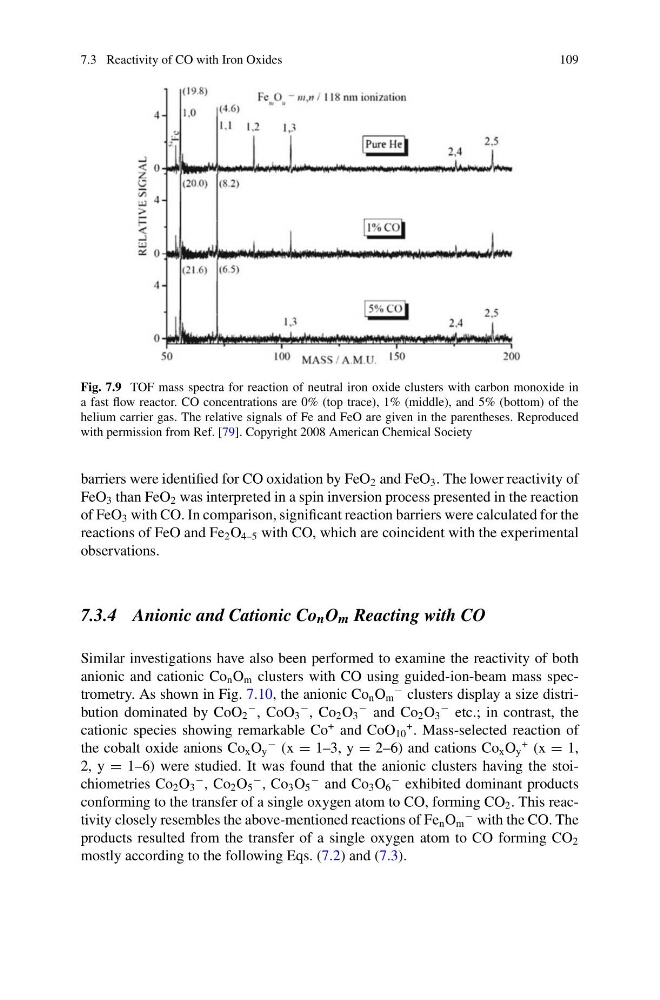
Fig. 7.9 TOF mass spectra for reaction of neutral iron oxide clusters with carbon monoxide in
a fast flow reactor. CO concentrations are 0% (top trace), 1% (middle), and 5% (bottom) of the
helium carrier gas. The relative signals of Fe and FeO are given in the parentheses. Reproduced
with permission from Ref. [79]. Copyright 2008 American Chemical Society
barriers were identified for CO oxidation by FeO 2 and FeO 3 . The lower reactivity of
FeO 3 than FeO 2 was interpreted in a spin inversion process presented in the reaction
of FeO 3 with CO. In comparison, significant reaction barriers were calculated for the
reactions of FeO and Fe 2 O 4–5 with CO, which are coincident with the experimental
observations.
7.3.4 Anionic and Cationic Co n O m Reacting with CO
Similar investigations have also been performed to examine the reactivity of both
anionic and cationic Co n O m clusters with CO using guided-ion-beam mass spectrometry. As shown in Fig. 7.10, the anionic Co n O m
− clusters display a size distribution dominated by CoO 2
− , CoO 3
− , Co 2 O 3
− and Co 2 O 3
− etc.; in contrast, the
cationic species showing remarkable Co
+ and CoO 10
+ . Mass-selected reaction of
the cobalt oxide anions Co x O y
− (x = 1–3, y = 2–6) and cations Co x O y
+ (x = 1,
2, y = 1–6) were studied. It was found that the anionic clusters having the stoichiometries Co 2 O 3
− , Co 2 O 5
− , Co 3 O 5
− and Co 3 O 6
− exhibited dominant products
conforming to the transfer of a single oxygen atom to CO, forming CO 2 . This reactivity closely resembles the above-mentioned reactions of Fe n O m
− with the CO. The
products resulted from the transfer of a single oxygen atom to CO forming CO 2
mostly according to the following Eqs. (7.2) and (7.3).
109
Fig. 7.9 TOF mass spectra for reaction of neutral iron oxide clusters with carbon monoxide in
a fast flow reactor. CO concentrations are 0% (top trace), 1% (middle), and 5% (bottom) of the
helium carrier gas. The relative signals of Fe and FeO are given in the parentheses. Reproduced
with permission from Ref. [79]. Copyright 2008 American Chemical Society
barriers were identified for CO oxidation by FeO 2 and FeO 3 . The lower reactivity of
FeO 3 than FeO 2 was interpreted in a spin inversion process presented in the reaction
of FeO 3 with CO. In comparison, significant reaction barriers were calculated for the
reactions of FeO and Fe 2 O 4–5 with CO, which are coincident with the experimental
observations.
7.3.4 Anionic and Cationic Co n O m Reacting with CO
Similar investigations have also been performed to examine the reactivity of both
anionic and cationic Co n O m clusters with CO using guided-ion-beam mass spectrometry. As shown in Fig. 7.10, the anionic Co n O m
− clusters display a size distribution dominated by CoO 2
− , CoO 3
− , Co 2 O 3
− and Co 2 O 3
− etc.; in contrast, the
cationic species showing remarkable Co
+ and CoO 10
+ . Mass-selected reaction of
the cobalt oxide anions Co x O y
− (x = 1–3, y = 2–6) and cations Co x O y
+ (x = 1,
2, y = 1–6) were studied. It was found that the anionic clusters having the stoichiometries Co 2 O 3
− , Co 2 O 5
− , Co 3 O 5
− and Co 3 O 6
− exhibited dominant products
conforming to the transfer of a single oxygen atom to CO, forming CO 2 . This reactivity closely resembles the above-mentioned reactions of Fe n O m
− with the CO. The
products resulted from the transfer of a single oxygen atom to CO forming CO 2
mostly according to the following Eqs. (7.2) and (7.3).