

important scent compound is dimethyl disulfide (Fig. 12), a compound also identified in an unrelated deceptive species of Solanaceae – Jaborosa rotacea [201, 211].
Flower scent dominated by oligosulfides and fatty acid-derived acids is associated
with carrion mimicry, whereas scent mainly composed of p-cresol, indole, and 2heptanone is associated with dung mimicry (Fig. 12) [152, 201, 212–214].Carrion
and dung mimicry on the basis of similar compounds has evolved independently in
different plant lineages.
4
Elaiophores
Elaiophores are secretory structures involved in the production of nonvolatile lipid
rewards to pollinators. These structures were discovered about 50 years ago by
Stefan Vogel [215], described and reported for the first time for Malpighiaceae,
Krameriaceae, Scrophulariaceae, Iridaceae, and Orchidaceae [216], and are usually
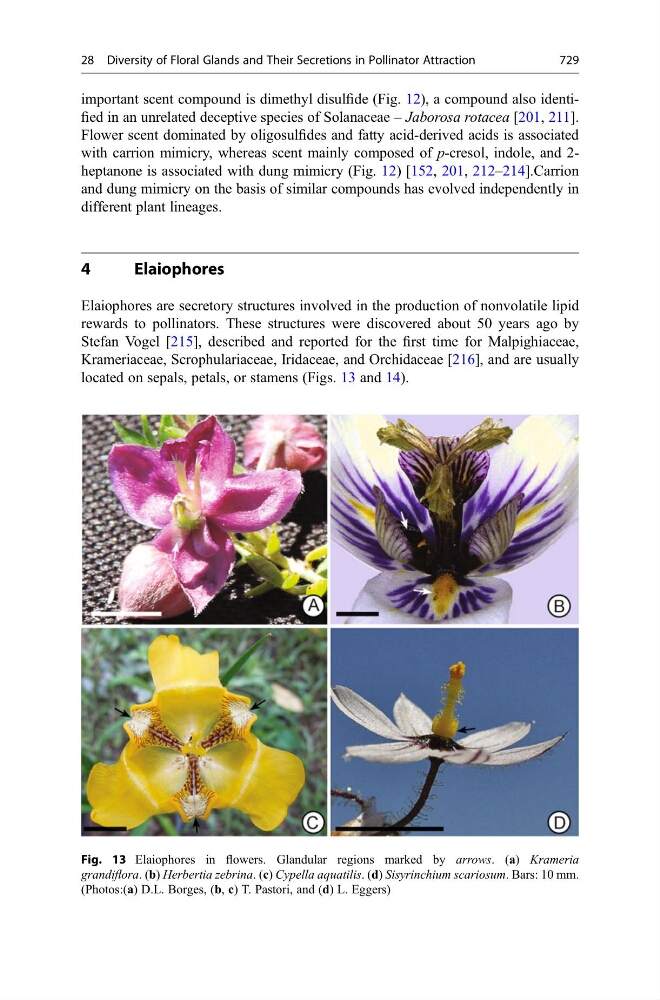
located on sepals, petals, or stamens (Figs. 13 and 14).
Fig. 13 Elaiophores in flowers. Glandular regions marked by arrows. (a) Krameria
grandiflora. (b) Herbertia zebrina. (c) Cypella aquatilis. (d) Sisyrinchium scariosum. Bars: 10 mm.
(Photos:(a) D.L. Borges, (b, c) T. Pastori, and (d) L. Eggers)
28 Diversity of Floral Glands and Their Secretions in Pollinator Attraction
729