

demonstrate that in deceptive species the reduction of the quantity of floral scents is
responsible for a decrease in the number of pollinators, confirming their importance
[188, 191, 192]. The perfume may act in both, food and sexual deception, providing
an olfactory cue to these animals, which may be searching for food rewards, nests,
and/or a sexual partner [193, 194].
In food-deceptive pollination, bees are the most common agents, mainly attracted
by the visual and olfactory features of the flower, but there are also records of
Coleoptera, Diptera, and Lepidoptera involved in this kind of pollination, since the
scents produced by the osmophores in this case are mainly monoterpenes and
sesquiterpenes, like those described in nondeceptive species [183, 186, 194, 195].
Regarding sexual-deceptive pollination, the flowers of some members of
Orchidaceae mimic sexual partners of potential visitors, having flowers that
are morphologically similar to the female and producing scents that are perceived
as pheromones by the pollinators [183, 186, 196]. The scents produced by the
flowers are very specific, each species of orchid emitting the particular scents that
attracts a specific pollinator, ultimately involving a process referred to as pseudocopula [197–199].
Some deceptive species with flowers that bear strong colors and scents can
attract insects, mainly beetles and flies, that oviposit within the flower while simultaneously leading to pollination [183, 200, 201]. In one of the most elaborate
examples of this kind of pollination, several species of Aristolochia and Asarum
(Aristolochiaceae) and Ceropegia (Apocynaceae) attract and temporarily entrap
pollinators – their flowers usually have strong odors that simulate decaying organic
matter [8, 153, 202–207].
Some species of Orchidaceae in the genera Satyrium and Dracula also attract flies
by emitting strong fungal scents [201, 208, 209]. For instance, the flowers
of Dracula chestertonii emit a strong mushroom-like scent attracting female flies;
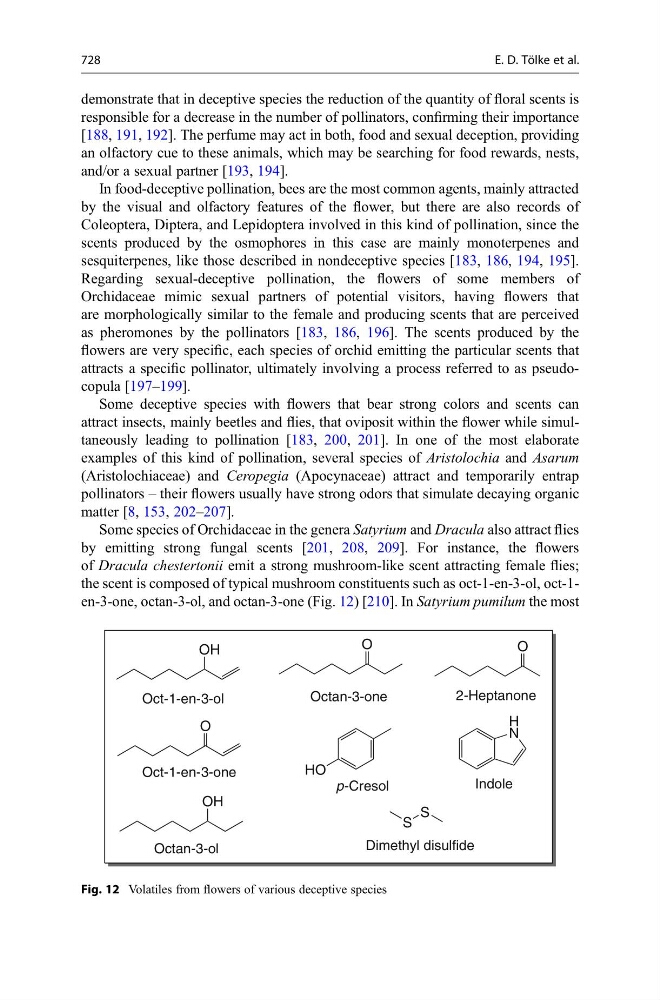
the scent is composed of typical mushroom constituents such as oct-1-en-3-ol, oct-1en-3-one, octan-3-ol, and octan-3-one (Fig. 12) [210]. In Satyrium pumilum the most
OH
O
OH
O
S
S
HO
H
N
O
Oct-1-en-3-ol
Oct-1-en-3-one
Octan-3-ol
Octan-3-one
Dimethyl disulfide
p-Cresol
Indole
2-Heptanone
Fig. 12 Volatiles from flowers of various deceptive species
728
E. D. Tölke et al.