

coffee, certifications, specialty coffee, etc.), input costs, selling prices, etc. The
benefits of shade grown coffee systems are found to be significantly linked with
amelioration of other environmental factors like biodiversity, soil and water conservation, optimal temperature, and humidity maintenance, etc. [220]. But we are
unlikely to add unnecessary details here about these improvements and the pros
and cons of sun versus shade gown coffee systems as it will mask the true objective
of this section and additionally literature and coffee productions manuals are full of
details on this topic. The species which are chosen for the purpose of shade by
farmers largely depend upon their side benefits and ease of management, but up to
60% shade trees belong from leguminous family [221]. Table 5 represents the
general criteria for the selection of a tree species for shade purpose. After elevation,
shade is considered core element in the bigger size (AA or AB) quality production of
green coffee beans due to provision microclimatic conditions of optimum cooler
climatic temperature and humidity and eventually longer or delayed ripening procedure [22, 45, 92]. The credit of high quality coffee production by delayed ripening
may goes to accumulation of desired components in well-desired ratios with other
contents [22, 32], while higher sucrose, trigonelline, and chlorogenic acid contents
in sun grown coffee are the symbol of incompletion of these processes in beans due
to rapid ripening of flesh of fruit in sunlight [29, 222]. So the conversion of coffee
cherries to green beans was significantly greater for shaded coffee than for full sun
coffee [210]. Larger leaf area to fruit ratio under shade is also an indicator of better
bean filling capacity leading to better cup quality. As in coffee producing and
exporting countries, physical quality of berries and green beans really matters as
the price and quality of their product depends upon the grade (size) of berries or
green beans. Moreover, Van Der Vassen and his colleagues noted that bean size and
density is often correlated to aroma, flavor, and superior beverage quality. Even
small variations in bean size can affect a number of sensorial attributes, e.g., through
different responses to roasting [18]. Yield and quality are the only two tools which
determine the extent of profit of framers. Various agricultural management practices
such as fertilization, fruit thinning, pollarding, weeding affect both these tools [223].
Agricultural and management practices are considered playing supportive role to
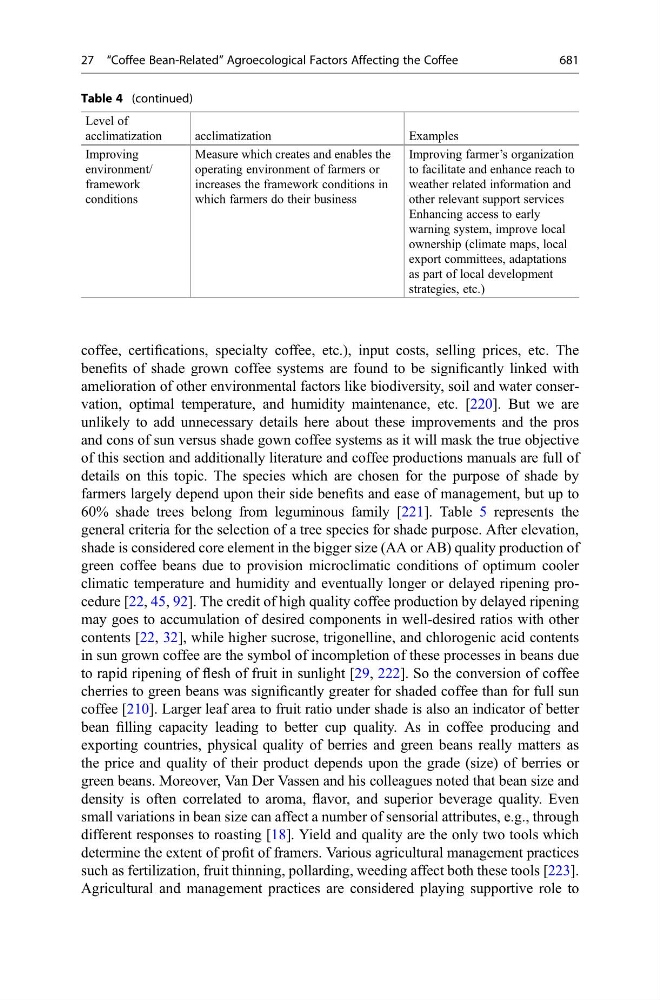
Table 4 (continued)
Level of
acclimatization
acclimatization
Examples
Improving
environment/
framework
conditions
Measure which creates and enables the
operating environment of farmers or
increases the framework conditions in
which farmers do their business
Improving farmer’s organization
to facilitate and enhance reach to
weather related information and
other relevant support services
Enhancing access to early
warning system, improve local
ownership (climate maps, local
export committees, adaptations
as part of local development
strategies, etc.)
27 “Coffee Bean-Related” Agroecological Factors Affecting the Coffee
681